Theory of Relativity Masterclass 12-Week Program in Theory of Relativity

Learn why moving clocks run slow and how mass curves spacetime, one unit per week.

  • Certificate
  • Online
  • Join a community of 3500+

Six equations of relativity met in the program

The Lorentz factor 1905
Mass and energy 1905
The spacetime interval, signature (−, +, +, +) Minkowski, 1908
Einstein's field equations 1915
The Schwarzschild radius 1916
Starlight bent by the Sun, 1.75″ at its edge Measured 1919

Our alumni study at

Eight Einstein rings photographed by the Hubble Space Telescope in 2005: in each tile a yellow foreground galaxy sits inside a thin blue ring or arc, the light of a more distant galaxy bent around it.
Eight Einstein rings found by the Hubble Space Telescope, 2005. NASA, public domain, cropped

About the program

The ToR Masterclass takes you through Einstein's theories of relativity one unit at a time. You enrol, and from then on a new unit reaches you every week. Each unit is a chapter written for this program, with spacetime diagrams you can draw yourself, worked examples, derivations, and the published research of physicists who are active today.

A quiz completes every unit and opens the next. At the end you sit a final exam and receive a certificate with a public verification page.

  • Structured. A fixed sequence of units that starts with frames of reference and light and reaches the field equations, black holes, and gravitational waves.
  • Demanding and fair. Time dilation, the Lorentz transformation, and the curvature of spacetime are derived in small steps, with school algebra first and calculus only where a unit has taught it.
  • Recognized. A certificate and a transcript, both with a verification ID that anyone can check online.
Mass and energy, Einstein 1905. Derived step by step in Unit 7.
How the program works

Who is this program for?

For high school students, university students, and lifelong learners. You need no prior knowledge of relativity: Unit 1 gives every participant the same toolkit.

High School Students

You want to see why time slows down near the speed of light, with the mathematics. The masterclass prepares you for university physics and for the IPhO, the APhO, and your national olympiad.

  • School mathematics is enough
  • Certificate for applications
  • Olympiad-level special relativity
Physics Olympiad Preparation

University Students

A companion to a physics or mathematics degree that goes beyond a first course on relativity. Use it to prepare for a general relativity module, a thesis on gravitation, or the Physics GRE.

  • Derivations and worked examples
  • Current research papers
  • Tensor calculus built step by step

Lifelong Learners

You have read about black holes, GPS clocks, and the twin paradox and want the theory behind them. The masterclass takes you from Einstein's postulates of 1905 to the gravitational waves seen by LIGO.

  • No deadlines, pause any time
  • Unit 1 refreshes the mathematics
  • Read on screen or as PDF

How does it work?

From enrolment to certificate in six steps.

  1. Enrol

    Create your account with your email address, choose your masterclass, and pay the Tuition Fee. Your program starts at once.

  2. Receive your unit

    Unit 1 arrives immediately, every further unit on a Monday: as a web page and as a PDF to keep.

  3. Study

    Work through the text, the spacetime diagrams, the worked examples, and the derivations, and try the tool of the week. A day later we send further reading with current research papers.

  4. Take a quiz for every unit

    Each unit has its own quiz: ten questions, open book, no time limit. You submit it before the next unit is sent to you.

  5. Sit the final exam

    50 questions across all units of your masterclass in 60 minutes, open book. Pass with 70%, with up to 3 attempts.

  6. Earn your certificate

    Certificate and transcript as PDF, each with a verification ID and a personal link you can share.

The program in detail

Topics

Sixteen units in three parts, from Einstein's two postulates of 1905 to the gravitational waves that LIGO first recorded in 2015. Foundation covers the first eight, Advanced the first twelve, and Advanced + Gravitational Waves all sixteen.

Albert Einstein, aged about 25, seated at his desk in the patent office in Bern, shown in a cold blue tone.

Einstein at the patent office in Bern, about 1904. Lucien Chavan / ETH-Bibliothek Zürich, public domain, toned

Units 1 to 8

Space, Time, and Light

Why the speed of light is the same for every observer, how moving clocks slow and moving rulers shrink, how the Lorentz transformation and spacetime diagrams resolve the twin paradox, and where E = mc² comes from.

Lorentz factor, 1905. For a speed v it grows from 1 towards infinity as v approaches c.
Time dilation, Unit 3. A moving clock shows its proper time Δτ; your clocks measure the longer Δt.
  1. 1Frames of Reference and the Physicist's Toolkit
  2. 2Light, the Ether, and the Two Postulates
  3. 3Simultaneity, Time Dilation, and Length Contraction
  4. 4The Lorentz Transformation and the Addition of Velocities
  5. 5Spacetime Diagrams and the Invariant Interval
  6. 6The Twin Paradox and Accelerated Motion
  7. 7Relativistic Energy, Momentum, and Mass-Energy Equivalence
  8. 8The Equivalence Principle and Curved Spacetime

Muons made about 15 km up in the atmosphere live 2.2 microseconds at rest, long enough to travel about 660 metres. They reach the ground because their clocks run slow.

The total solar eclipse of 29 May 1919 photographed at Sobral: the black disc of the Moon inside the white corona, with the Hyades stars used to measure the bending of light circled and labelled.

The eclipse of 29 May 1919 at Sobral, stars of the Hyades marked. ESO/Landessternwarte Heidelberg-Königstuhl/F. W. Dyson, A. S. Eddington, and C. Davidson, CC BY 4.0

Units 9 to 12

General Relativity

How gravity becomes the curvature of spacetime, how Einstein's field equations link that curvature to matter, why Mercury's orbit turns and starlight bends at the Sun, and what happens at the event horizon of a black hole.

Deflection of light, 1915. A ray passing a mass M at distance b; at the edge of the Sun, 1.75 arcseconds.
Schwarzschild radius, 1916. The event horizon of a mass M that does not rotate, Units 11 and 12.
  1. 9Tensors, Metrics, and Geodesics
  2. 10Einstein's Field Equations
  3. 11The Schwarzschild Solution and the Classical Tests
  4. 12Black Holes and Event Horizons

General relativity predicts that starlight grazing the Sun is bent by 1.75 arcseconds, twice the Newtonian value. The eclipse expeditions of 29 May 1919 to Sobral and Príncipe measured it.

Aerial view of the LIGO Hanford Observatory in Washington State: one 4 km arm runs straight across the desert to the horizon, shown in indigo and amber.

LIGO Hanford Observatory, Washington State. LIGO Laboratory, public domain, toned

Units 13 to 16

Gravitational Waves

How a ripple in spacetime travels at the speed of light, what two merging black holes emit in their last second, how LIGO measures a stretch far smaller than a proton, and how pulsars and LISA will hear slower waves.

Einstein's field equations, 1915, with the cosmological constant Λ he added in 1917. Curvature on the left, matter and energy on the right. Unit 13 solves them far from the source, and waves come out.
  1. 13Linearized Gravity and Gravitational Waves
  2. 14Merging Black Holes and Neutron Stars
  3. 15Laser Interferometer Observatories
  4. 16Pulsar Timing Arrays and Space Detectors

On 14 September 2015 the signal of two merging black holes changed the length of LIGO's 4 km arms by less than a hundredth of the width of a proton.

Tuition Fee

Choose the masterclass that fits you. One Tuition Fee, paid once, covers all units, quizzes, the final exam, and your certificate.

8 weeks

Foundation

Special relativity in full, from the two postulates to E = mc² and the equivalence principle.

Tuition Fee$35$39
Enrol in Foundation
  • 8 weekly units as web page and PDF
  • Quiz and further reading for every unit
  • Final exam, certificate, and transcript
Topics in this program
  1. 01
    Frames of Reference and the Physicist's Toolkit
  2. 02
    Light, the Ether, and the Two Postulates
  3. 03
    Simultaneity, Time Dilation, and Length Contraction
  4. 04
    The Lorentz Transformation and the Addition of Velocities
  5. 05
    Spacetime Diagrams and the Invariant Interval
  6. 06
    The Twin Paradox and Accelerated Motion
  7. 07
    Relativistic Energy, Momentum, and Mass-Energy Equivalence
  8. 08
    The Equivalence Principle and Curved Spacetime
  9. 09
    Tensors, Metrics, and Geodesics
  10. 10
    Einstein's Field Equations
  11. 11
    The Schwarzschild Solution and the Classical Tests
  12. 12
    Black Holes and Event Horizons
  13. 13
    Gravitational WavesLinearized Gravity and Gravitational Waves
  14. 14
    Gravitational WavesMerging Black Holes and Neutron Stars
  15. 15
    Gravitational WavesLaser Interferometer Observatories
  16. 16
    Gravitational WavesPulsar Timing Arrays and Space Detectors
16 weeks

Advanced + Gravitational Waves

The full program plus four units on gravitational waves and their detectors.

Tuition Fee$85$119
Enrol in Advanced + Gravitational Waves
  • 16 weekly units as web page and PDF
  • Quiz and further reading for every unit
  • Final exam, certificate, and transcript
Topics in this program
  1. 01
    Frames of Reference and the Physicist's Toolkit
  2. 02
    Light, the Ether, and the Two Postulates
  3. 03
    Simultaneity, Time Dilation, and Length Contraction
  4. 04
    The Lorentz Transformation and the Addition of Velocities
  5. 05
    Spacetime Diagrams and the Invariant Interval
  6. 06
    The Twin Paradox and Accelerated Motion
  7. 07
    Relativistic Energy, Momentum, and Mass-Energy Equivalence
  8. 08
    The Equivalence Principle and Curved Spacetime
  9. 09
    Tensors, Metrics, and Geodesics
  10. 10
    Einstein's Field Equations
  11. 11
    The Schwarzschild Solution and the Classical Tests
  12. 12
    Black Holes and Event Horizons
  13. 13
    Gravitational WavesLinearized Gravity and Gravitational Waves
  14. 14
    Gravitational WavesMerging Black Holes and Neutron Stars
  15. 15
    Gravitational WavesLaser Interferometer Observatories
  16. 16
    Gravitational WavesPulsar Timing Arrays and Space Detectors

Tuition fees are one-time payments and include applicable taxes. Secure payment by card through Stripe.

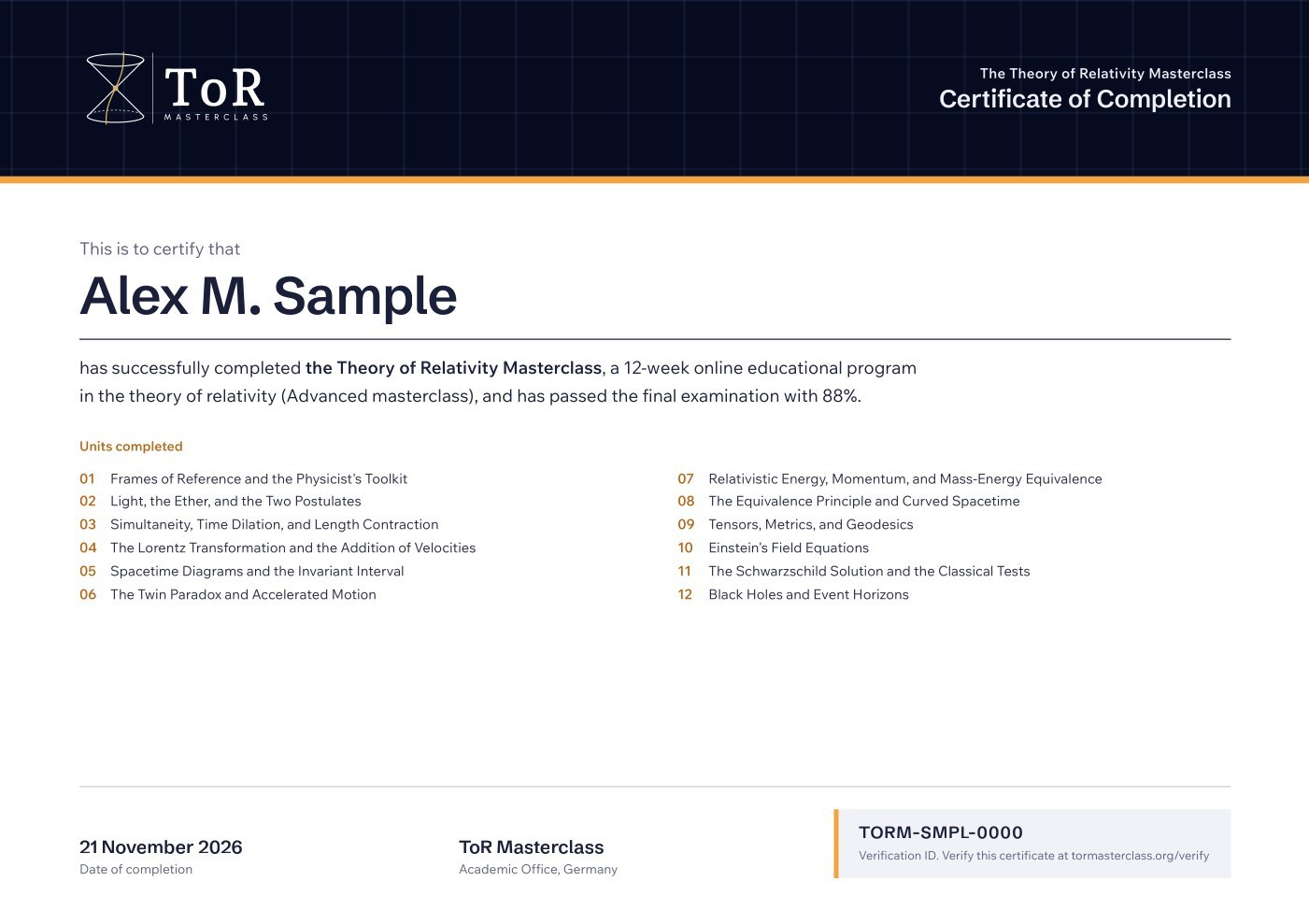
Sample certificate of completion of Theory of Relativity Masterclass

Your certificate

Participants who pass the final exam receive an official certificate of completion. It states your name, the masterclass, its duration, and the units you completed.

  • Certificate and transcript. The transcript lists your score in every unit quiz and in the final exam.
  • Verifiable. Both documents carry a verification ID that can be checked on this website.
  • Shareable. Your personal verification link shows your result to universities and employers.
First page of Unit 3: Simultaneity, Time Dilation, and Length Contraction

Read a sample unit

Read one complete unit before you enrol, exactly as participants receive it: the full text with its spacetime diagrams, worked examples, derivations, and research spotlight.

Unit 3, 19 pages

Simultaneity, Time Dilation, and Length Contraction

Builds a light clock, sets it moving, and derives with Pythagoras' theorem why a moving clock ticks more slowly, why a moving ruler is shorter, and why two observers can disagree about whether two events happened at the same moment. The muons that reach the ground from 15 kilometres up are the test: counted on Mount Washington in 1962, they survive by the factor Einstein predicted in 1905, and lithium ions in a storage ring confirm that factor to a few parts in a billion.

The unit opens with five questions

  1. Why do two observers in relative motion disagree about whether two distant events happened at the same moment?
  2. How does a light clock show that a moving clock ticks more slowly, and by what factor?
  3. Why do muons made about 15 km up in the atmosphere reach the ground when their lifetime at rest is only 2.2 microseconds?
  4. Why is a moving ruler shorter along its direction of motion but unchanged across it?
  5. What is proper time, and which observer measures it?

Academic community

Masterclass participants come from all over the world, and when you complete the program you stay part of a network that keeps you close to physics.

Physics academics in our community
3500+
Countries represented
90+
Schools and universities represented
750+

ToR-Connect

Our alumni program connects former participants across countries: for study advice, exchange about university applications, and shared projects.

Opportunities

Past participants hear from us about scholarships, competitions, summer schools, and other academic opportunities in physics and gravitation.

A place in research

The program shows you how research on gravity is done and where it happens, so that your next step, at school, at university, or beyond, is an informed one.

The academic community

Galaxy cluster MACS J0416.1-2403. NASA, ESA, and the Hubble Frontier Fields team, CC BY 2.0, darkened behind the community section

Frequently asked questions

Who is this program for?

For high school students, university students, and lifelong learners. High school students use it to see the mathematics behind time dilation and E = mc² before university, and to prepare for the relativity part of physics olympiads. University students take it next to a physics, mathematics, or engineering degree, often before a first module on general relativity. Lifelong learners use it to get the theory behind the black holes, GPS clocks, and twin paradoxes they have read about. The Foundation masterclass covers special relativity in full; the Advanced masterclass goes on to tensors, Einstein's field equations, the Schwarzschild solution, and black holes.

What do I need to know before I start?

School mathematics is enough: algebra, square roots, Pythagoras' theorem, and graphs of straight lines. Unit 1 builds every tool the later units use, among them vectors, frames of reference, the binomial approximation, and a first look at the derivative and the integral. The units of the Advanced masterclass teach partial derivatives, matrices, and index notation in Unit 9 before they use them, and every step of a calculation is shown. No unit sets c = 1; the speed of light stays in every formula.

How much time does a week in the program take, and are there live sessions?

Most participants spend three to five hours a week. On Monday you receive the unit by email, as a web page and as a PDF. A day later we send further reading, including current research papers that are free to read. During the week you study the unit, try the tool of the week if you like, and take the open-book quiz of ten questions. There are no live sessions, so the program works in every time zone and next to school or work.

Can I finish the program in less than 12 weeks?

Yes. A new unit is scheduled for every Monday, but once you have submitted the quiz of a unit you can ask for the next one ahead of schedule, from your dashboard or from the email we send you. The earliest moment is 24 hours after the previous unit was sent. We recommend the weekly rhythm, because the material needs time to settle, but the pace is your decision.

What happens if I fall behind or have to pause?

Nothing is lost. The next unit is only sent once you have submitted the quiz of the current one, so the program waits for you. You can pause for a week or for a term and continue at any time. There is no penalty and no deadline.

How does the final exam work?

After the last unit you sit the final exam online: 50 multiple-choice questions across all units of your masterclass, drawn individually for each participant, with a time limit of 60 minutes. It is open book. You pass with 70% correct answers. If you do not pass, you can try again after 3 days with new questions, up to 3 attempts in total.

All questions

Begin your 12 weeks in spacetime

Total solar eclipse of 21 August 2017. Bernd Thaller, CC BY 2.0, darkened behind the closing section