

Tensors, Metrics, and Geodesics
The first Advanced unit teaches the mathematics of curved spacetime before it is used: the metric as the whole geometry of a surface, index notation and the summation convention, vectors and tensors as objects that transform in a definite way, and geodesics as the straightest lines, first on the sphere and then in spacetime. Christoffel symbols, parallel transport, and the Riemann tensor follow, with the gyroscopes of Gravity Probe B as the experiment that carried a vector around the Earth and measured the turn.
Unit 8 ended with a proposal and no equations: free fall is the straightest possible motion through a spacetime whose geometry is shaped by mass, and tides are what the curvature of that geometry does to neighbouring falling bodies. To turn the proposal into a theory, “straightest”, “geometry”, and “curvature” must become exact words with formulas attached. Mathematicians built that language in the nineteenth century for curved surfaces, and this unit teaches it on the simplest curved surface, the sphere, before applying it to spacetime. At the end, a gyroscope orbiting the Earth measures a quantity that this unit computes on a globe.
1 Distances on a curved surface
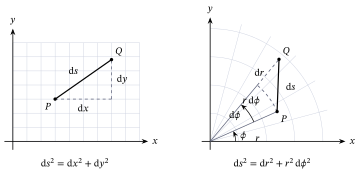
Take a sheet of paper with the usual coordinates \(x\) and \(y\). Two points that differ by \(\dd x\) in one coordinate and by \(\dd y\) in the other are a distance \(\dd s\) apart, and Pythagoras’ theorem gives \begin{equation} \dd s^2 = \dd x^2 + \dd y^2 . \label{eq:cart} \end{equation} The small letters \(\dd\) mean that the step is short, as in the derivatives and integrals of Unit 1. Equation \eqref{eq:cart} is called the line element of the plane, and the rule it expresses, how coordinate differences are turned into a distance, is called the metric.
The same plane can be described by polar coordinates, the distance \(r\) from the origin and the angle \(\phi\) from the \(x\) axis, as Figure 1 shows. A step \(\dd r\) outward has length \(\dd r\). A step \(\dd\phi\) in angle moves the point along a circle of radius \(r\), which is an arc of length \(r\,\dd\phi\). The two steps are perpendicular, so Pythagoras’ theorem applies again, and the line element of the plane in polar coordinates is \begin{equation} \dd s^2 = \dd r^2 + r^2\,\dd\phi^2 . \label{eq:polar} \end{equation} Equations \eqref{eq:cart} and \eqref{eq:polar} describe the same flat sheet; the coefficient \(r^2\) records that a degree of angle is worth more length far from the origin than close to it.
Now take a sphere of radius \(R\) and describe a point on it by its colatitude \(\theta\), the angle measured down from the north pole, and its longitude \(\phi\). A step \(\dd\theta\) along a meridian has length \(R\,\dd\theta\), since the meridian is a circle of radius \(R\). A step \(\dd\phi\) along a parallel of latitude has length \(R\sin\theta\,\dd\phi\), since the parallel is a circle of radius \(R\sin\theta\), which shrinks to nothing at the poles. The two directions are perpendicular, so \begin{equation} \dd s^2 = R^2\,\dd\theta^2 + R^2\sin^2\theta\,\dd\phi^2 . \label{eq:sphere} \end{equation} The difference from Equation \eqref{eq:polar} looks small. It is the whole difference between a flat surface and a curved one, as Section 5 will show, and nothing else about the geometry of the sphere needs to be known once Equation \eqref{eq:sphere} is known.
The length of a path is the sum of the lengths of its short steps, which is an integral of \(\dd s\) along the path. For example, a path that runs along the parallel at colatitude \(\theta\) has \(\dd\theta = 0\) at every step, so \(\dd s = R\sin\theta\,\dd\phi\), and between the longitudes \(\phi_1\) and \(\phi_2\) its length is \(R\sin\theta\,(\phi_2 - \phi_1)\), with the angle in radians.