

Simultaneity, Time Dilation, and Length Contraction
Builds a light clock, sets it moving, and derives with Pythagoras' theorem why a moving clock ticks more slowly, why a moving ruler is shorter, and why two observers can disagree about whether two events happened at the same moment. The muons that reach the ground from 15 kilometres up are the test: counted on Mount Washington in 1962, they survive by the factor Einstein predicted in 1905, and lithium ions in a storage ring confirm that factor to a few parts in a billion.
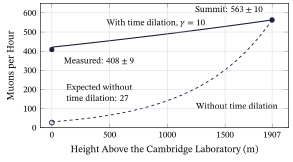
In 1962 two physicists drove a detector up Mount Washington in New Hampshire, counted the muons that arrived at the summit each hour, and then counted again in their laboratory in Cambridge, Massachusetts, 1,907 m lower down. Muons are unstable particles that cosmic rays create about 15 km up in the atmosphere. At rest they live 2.2 microseconds on average, and even at the speed of light a muon covers only about 660 metres in that time, so by the decay law of Unit 1 only a few dozen of the 563 muons counted at the top each hour should have survived the trip down. David H. Frisch (1918-1991) and his colleague James H. Smith found 408. The same shortfall had been seen in a rougher form by Bruno Rossi (1905-1993) and David B. Hall in Colorado in 1940. The explanation is the subject of this unit: a moving clock runs slow, and a muon is a clock. The factor by which it runs slow follows from the two postulates of Unit 2 with nothing more than Pythagoras’ theorem, and the same factor shortens every moving ruler.
1 The relativity of simultaneity
Unit 2 defined an observer as a whole frame of reference, with a clock at every point and all clocks synchronized by light signals. Two events are simultaneous in that frame when the clocks at the two places show the same reading. There is an equivalent test that needs no clocks at all: if light flashes from the two events meet exactly at the midpoint between them, they were emitted at the same time, because light covers the two equal distances at the same speed. The second postulate says that this speed is \(c\) in every inertial frame. The consequence is that two frames in relative motion do not agree on which events are simultaneous, and the argument that shows it is Einstein’s own.
Consider a long train that moves along a straight embankment at a speed \(v\) to the right, as drawn in Figure 1. Two lightning bolts strike the two ends of the train, the rear end \(A\) and the front end \(B\), and each leaves a burn mark on the train and a second one on the embankment. An observer \(M\) stands on the embankment exactly midway between the two marks there, and a passenger \(M'\) sits exactly midway between the two marks on the train. The strikes happen at the moment when \(M'\) passes \(M\), so the two are side by side as the flashes set out.
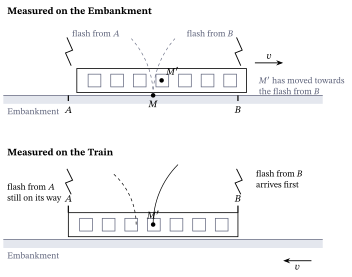
For the observer on the embankment the two flashes travel at \(c\) over equal distances and arrive at \(M\) at the same instant, so the strikes were simultaneous in the frame of the embankment. The passenger, meanwhile, has moved, because between the strikes and the arrival of the light \(M'\) travelled a short distance to the right, towards the flash from \(B\) and away from the flash from \(A\). The flash from \(B\) therefore reaches \(M'\) before the flash from \(A\) does. Up to here the embankment observer and the passenger agree, because the order in which two flashes reach one person is a fact that everybody can check.
Now take the same facts into the frame of the train. The passenger is at rest midway between the two marks on the train, and by the second postulate the two flashes travel at \(c\) in the train’s frame as well, so each needs the same time to cover the same distance to \(M'\). The flash from \(B\) arrived first, so it must have set out first. Measured in the train, the lightning struck \(B\) before it struck \(A\). Neither observer has made a mistake and neither has a privileged view. The two frames assign different times to the two events, and both assignments are correct in their own frame.
Three remarks keep the result in proportion.
- Two events at the same place and the same time are a single happening as far as timing is concerned, and every frame agrees about them. The disagreement needs a separation between the events along the direction of motion.
- The order of the two strikes can also be reversed by a third frame moving the other way. If the order of two events depends on the frame, one may fear that an effect could come before its cause in some frame; Unit 5 shows why this can never happen for two events that are able to influence each other.
- The size of the disagreement is set by \(v/c\) and by the length of the train, and Unit 4 derives the formula. For a 300 m train at 100 m/s the two frames disagree by a third of a picosecond, where a picosecond is a millionth of a microsecond, which is why nobody noticed before 1905.
2 The light clock
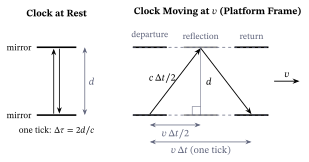
The simplest clock to analyse in physics is a pulse of light bouncing between two parallel mirrors. The mirrors are a distance \(d\) apart, and one tick is the round trip of the pulse from the lower mirror to the upper one and back, which takes the time \[ \Delta\tau = \frac{2d}{c} . \] With \(d = 15\) cm the round trip is 30 cm, and since light covers about 30 centimetres per nanosecond, which is a billionth of a second, the clock ticks once per nanosecond. The Greek letter \(\tau\) (tau) instead of \(t\) marks the time that this clock itself shows, and the reason for the separate letter appears in a moment. Nothing in the argument that follows depends on the clock being made of light; any other clock placed next to it must agree with it, because otherwise the clock that falls out of step would reveal the motion of the frame, which the first postulate forbids.
2.1 The clock in motion
Now set the clock on a train that moves at speed \(v\) to the right, with the mirrors arranged so that the pulse bounces at right angles to the motion, and watch it from the platform (Figure 2). Between the departure of the pulse from the lower mirror and its return there, the clock has moved a distance \(v\,\Delta t\), where \(\Delta t\) is the time the platform clocks measure for one tick. The pulse has to reach the upper mirror where that mirror is at the time of the reflection, which is halfway along the distance \(v\,\Delta t\), so from the platform its path consists of two slanted legs instead of one vertical line of length \(2d\), and it is longer than \(2d\). In Newtonian physics that would not matter, because the light would move faster to make up for it, as a ball thrown upwards inside a moving train does, since the ball carries the train’s forward speed with it. The second postulate removes this possibility: on the platform too, the pulse moves at exactly \(c\). A longer path at the same speed takes a longer time, and so the moving clock ticks more slowly as judged from the platform.
The factor that appears here appears in every formula of special relativity, and it has a name and a letter of its own, the Greek \(\gamma\) (gamma).
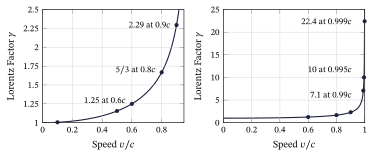
The name time dilation describes the effect from the platform’s point of view, since to dilate means to stretch or widen, and the interval between the ticks of the moving clock is stretched. Table 1 gives the Lorentz factor for the speeds this program uses, and Figure 3 shows its shape. Up to a tenth of the speed of light nothing noticeable happens; between a half and nine tenths of \(c\) the factor grows from 1.15 to 2.3; and in the last per cent it climbs without limit. The binomial approximation of Unit 1 describes the flat part. For speeds \(v\) much smaller than \(c\), written \(v \ll c\), \[ \gamma \approx 1 + \frac{v^2}{2c^2} , \] which is the form used for everything that moves at aircraft or satellite speeds. The two speeds \(0.6c\) and \(0.8c\) give the Lorentz factors \(5/4\) and \(5/3\) exactly, because \(3\), \(4\), and \(5\) form a Pythagorean triple, three whole numbers with \(3^2 + 4^2 = 5^2\), and the worked examples of this and the next units use them for that reason.
| Speed \(v\) | Lorentz Factor \(\gamma\) | Example |
|---|---|---|
| \(0.1c\) | 1.005 | no everyday object comes close |
| \(0.5c\) | 1.155 | |
| \(0.6c\) | 1.25 | exactly \(5/4\) |
| \(0.8c\) | 1.667 | exactly \(5/3\) |
| \(0.9c\) | 2.294 | |
| \(0.99c\) | 7.09 | |
| \(0.995c\) | 10.0 | the muons of Section 3 |
| \(0.999c\) | 22.4 |
2.2 Proper time
The two symbols in the time dilation formula are not interchangeable, and keeping them apart is the single most useful habit this unit can teach. The proper time \(\Delta\tau\) between two events is the time measured by the one clock that is present at both events. The two ticks of the light clock both happen at the clock, so the clock’s own reading is the proper time between them. The platform frame needs two different clocks to time the same two ticks, one where the first tick happens and one farther along where the second tick happens, and it reads off \(\Delta t\) as the difference between them. Whenever a problem asks which time is which, the question to ask is which clock was at both events. That clock shows the proper time, and every other frame measures a longer time.
The proper time is also a time that has a meaning independent of any frame. Every inertial observer who computes the proper time between two ticks of a clock from their own \(\Delta t\) and their own \(v\) gets the same \(\Delta\tau\), because that is the number written on the clock’s face. Unit 5 builds the whole geometry of spacetime on this quantity.
2.3 Who sees whose clock run slow
The first postulate makes the situation symmetric. From the train, the platform is what moves, at \(v\) to the left, and a light clock on the platform ticks slowly by the same factor \(\gamma\) as judged from the train. Each observer finds the other’s clock slow. Students who meet this for the first time usually suspect a contradiction, and the reason there is none deserves a close look.
When the platform compares its clocks with the train’s clock, it uses two synchronized platform clocks at two places and one train clock that passes both. When the train compares, it uses two synchronized train clocks and one platform clock that passes both. The two comparisons involve different pairs of events, so they are not the same measurement with the roles swapped, and there is no one pair of clocks, one on each side, about which the two sides make opposite claims. What makes the two results compatible is Section 1: the two platform clocks are synchronized in the platform frame, but in the train frame they are not, and the train reads the platform’s claim as the result of comparing one clock against two that were set wrongly. The platform says the same about the train’s clocks. Both are right, and the difference between them is exactly the relativity of simultaneity, which is why that section came first. Unit 6 turns this symmetry into the twin paradox, where the two clocks finally meet again and one of them really is behind.
3 Time dilation measured
A formula derived from a thought experiment deserves a real one. Three measurements are described here, in order of precision: muons falling through the atmosphere, hydrogen ions glowing in a tube, and lithium ions circulating in a storage ring.
3.1 Muons from cosmic rays
Cosmic rays, mostly protons, hit the nuclei of the air about 15 km up and produce showers of short-lived particles. Among the products are muons, heavy relatives of the electron with a mass of \(105.7\unit{MeV}/c^2\), about 207 times the mass of the electron, which decay with a mean lifetime of \(2.2\) microseconds when at rest. Many of them travel close to the speed of light. Without time dilation, a muon at \(0.995c\) would move on average \(0.995 \times 299{,}792\unit{km\,s^{-1}} \times 2.2\unit{\mu s} \approx 660\) m before decaying, and the 15 km of atmosphere would be more than twenty mean lifetimes deep, since \(15{,}000\unit{m}/660\unit{m} \approx 23\). The fraction surviving a time \(t\) is \(e^{-t/\tau}\) for a mean lifetime \(\tau\), as for any radioactive decay (the lifetime carries the letter \(\tau\) because it is a proper time, the time on the muon’s own clock), so about \(e^{-23}\), or one in ten billion, would reach the ground. In fact muons are the most common charged particles from cosmic rays at sea level, and about one passes through the palm of a hand every second.
Frisch and Smith turned this into a measurement, which they published in the American Journal of Physics in 1963. Their detector was a block of plastic scintillator, a material that gives a flash of light when a charged particle stops in it, with a stack of metal absorber plates above it. The plates slowed the muons, and only those in a narrow band of speeds, between \(0.9950c\) and \(0.9954c\) on arrival at the summit, came to rest inside the scintillator rather than above or below it, because faster muons passed through the block and slower ones stopped in the plates. A stopped muon decays after a while into an electron or a positron and two neutrinos, and the electron makes a second flash, so each muon that stopped was recorded together with its decay time. At the summit of Mount Washington, \(1{,}917\) m above sea level, they registered \(563 \pm 10\) such muons per hour, and the distribution of decay times gave the mean lifetime at rest of \(2.2\) microseconds directly, since a stopped muon is at rest in the detector. Then they repeated the measurement in Cambridge, \(1{,}907\) m lower, with a slightly thinner stack of plates so that the same muons, slowed by the air to about \(0.988c\), would again stop in the scintillator. Figure 4 shows the two counts next to the predictions with and without time dilation.

3.2 Moving atoms as clocks
An atom emits light at frequencies fixed by its internal structure, so a beam of moving atoms is a set of moving clocks, and the frequency of their light read in the laboratory is a reading of those clocks. The first experiment of this kind was done by Herbert E. Ives (1882-1953) and his colleague G. R. Stilwell at the Bell Telephone Laboratories, and published in the Journal of the Optical Society of America in 1938 under the title An Experimental Study of the Rate of a Moving Atomic Clock. They accelerated hydrogen molecular ions, hydrogen molecules with one electron missing, through voltages of up to \(18{,}350\) V, let them pick up electrons and glow, and photographed the blue-green spectral line H\(\beta\) of hydrogen at \(486.1\) nm, one of the few sharp colours in which hydrogen gas glows, looking along the beam and, by means of a small mirror, against it at the same time. The ordinary Doppler shift, the change of frequency of a moving source that is familiar from the pitch of a passing siren and which Unit 5 treats in full, moves the line to shorter wavelengths in one view and to longer ones in the other by the same amount, and the average of the two views cancels it. What remains in the average is a shift of the whole pattern to longer wavelengths, because the moving atom’s clock runs slow and emits a lower frequency, and this shift is the measurement.
The lithium ions of the research spotlight carry the same idea to a third of \(c\) and to a precision of a few parts in a billion.
4 Length contraction
4.1 The muon’s point of view
Return to the muon, but this time ride with it. In its own frame the muon is at rest and lives \(2.2\) microseconds on average, with no time dilation to help it, because its own clock is the one that shows the proper time. What it sees coming is Mount Washington, rushing up at \(0.995c\). From the ground frame we know that the muon’s clock advanced by \(0.64\) microseconds between the summit and the laboratory, and during \(0.64\) microseconds a mountain approaching at \(0.995c\) covers only \(0.64\unit{\mu s} \times 0.995 \times 2.998 \times 10^{8}\unit{m\,s^{-1}} = 191\) m. Both frames agree that the muon was at the summit and later at the laboratory, so in the muon’s frame the vertical distance between the two is \(191\) m, a tenth of the \(1{,}907\) m measured on the ground. In its own frame the muon lives its ordinary 2.2 microseconds, and what has shrunk is the mountain. The two descriptions are the same physics seen from two frames, and the factor between them is the Lorentz factor once more.
The length of a moving rod means something definite: it is the distance between the positions of its two ends at the same time in the measuring frame. Since frames disagree about what "at the same time" means, they can disagree about the length without contradiction, and Section 1 is once more the reason. The proper length \(L_0\) is the length everybody can agree on, in the same way that the proper time is the time everybody can agree on, because it is the one measured in the rod’s rest frame, and any other frame measures less. Like time dilation, the effect is symmetric. A metre stick on the platform is \(1/\gamma\) metres long as measured from the train, and a metre stick on the train is \(1/\gamma\) metres long as measured from the platform.
A length contraction that takes a \(100\) m train to \(60\) m needs a speed of \(240{,}000\) kilometres per second, and there is no everyday counterpart. An airliner at \(250\) m/s is shorter in flight by \(L_0 - L \approx L_0 v^2/(2c^2)\), the binomial approximation of Unit 1 applied to the square root, which for a \(70\) m fuselage is \(2.4 \times 10^{-11}\) m, a quarter of the diameter of a hydrogen atom. Where the speed is large enough for length contraction to matter, a rule of thumb for the whole subject applies. The muon’s \(191\) m is the same statement as its \(0.64\) microseconds, and a problem that looks hard in one frame is often the time dilation problem of the other frame in disguise.
5 Lengths across the motion and what a camera sees
5.1 The two rulers
The key equation of Section 4 claims that only lengths along the motion change. The claim can be proved by an argument that needs no formula, only the first postulate and a paint brush. Take two identical metre sticks, \(A\) and \(B\), held upright, at right angles to the \(x\) axis, and let \(B\) move past \(A\) along \(x\) at speed \(v\) so that their lower ends pass at the same height (Figure 6). Fix a brush to the top of \(B\) so that it marks \(A\) as it passes.
Suppose that motion shortened lengths across the direction of motion. Measured in the frame of \(A\), the moving stick \(B\) would then be shorter than a metre, and its brush would leave a mark on \(A\) below \(A\)’s top. But measured in the frame of \(B\), it is \(A\) that moves, so \(A\) would be the shorter one, and \(B\)’s brush would pass above \(A\)’s top and leave no mark at all. A mark on a stick is a fact, either there or not, and two frames cannot disagree about it. The assumption must therefore be wrong, and the same argument rules out a lengthening. Lengths across the motion are the same in every frame. The argument cannot be run along the direction of motion, because there the two ends pass each other at different times, and the relativity of simultaneity gives the frames room to disagree.
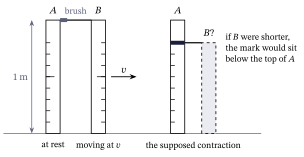
This is why the light clock was built with its mirrors across the motion. The mirror distance \(d\) is the same in both frames, and the derivation of time dilation used that fact without comment. Had the pulse bounced along the direction of motion instead, the mirror distance itself would have contracted, and the clock would still tick slowly by the same \(\gamma\), but the calculation would have had to carry both effects at once. Unit 4 puts both effects, together with the relativity of simultaneity, into one set of four equations.
5.2 Measuring against seeing
Length contraction is a statement about measurement, and measurement in this unit always means recording the positions of the two ends at the same time in the measuring frame, with the frame’s own synchronized clocks and rulers. What the eye or a camera would see is a different question. A photograph collects the light that arrives at the lens at one instant, and that light left the near parts of a moving object later than the far parts, because it had less far to travel. For an object moving at a sizeable fraction of \(c\) the delays matter, and the picture shows the object’s parts where they were at different times. For a sphere the result is still a sphere, and for a cube the result looks like a cube turned through an angle rather than a cube squashed along its motion. Nothing in that contradicts the contraction, which is still there in the measured positions; the camera measures something else. The effect was worked out in 1959, more than fifty years after Einstein’s paper, by James Terrell and Roger Penrose independently; a short paper of 1924 by Anton Lampa (1868-1938) had found it for a moving rod and had been forgotten. Unit 5 explains the effect with the geometry of spacetime and shows the first photographs of it, which were taken in 2024 with a trick that stands in for the speed of light and published in 2025.
The length of the moving train is measured without any photograph at all. Line the platform with clocks, synchronized in the platform frame, and put a marker at each clock. At the agreed instant every marker records whether the train is in front of it or not, and the markers that saw the train span the measured length \(L\). No light had to travel anywhere, because each marker looked only at its own spot. A single camera at one point does the opposite, since it combines light that left the far end of the train earlier than the light from the near end, and so its picture mixes positions from different times. The length contraction of this unit is the first kind of measurement, and every length in the worked examples was measured that way.