

Light, the Ether, and the Two Postulates
Follows the measurement of the speed of light from Rømer and Fizeau to Michelson, Maxwell's prediction that light travels at a speed fixed by the constants of electricity and magnetism, and the ether that was meant to carry it. The Michelson-Morley experiment of 1887 and its null result lead to Einstein's two postulates, to the synchronization of clocks by light signals, and to the modern resonator experiments that bound any direction dependence of the speed of light.
Every clock in a smartphone, every GPS fix, and every measurement of a distance in the solar system rests on one number, the speed of light, and on one strange fact about it: everybody who measures it gets the same value, whether they move towards the source or away from it. This unit follows that number from the first proof that light takes time at all, in 1676, to the experiment of 1887 that failed to find the medium that light was supposed to travel in, and to the two short sentences with which Albert Einstein (1879-1955) replaced that medium in 1905. Units 3 to 7 draw the consequences of those two sentences; this unit says where they came from and what they claim.
1 The speed of light
Light moves so fast that for two thousand years the question whether it needs any time at all to travel seemed pointless. Galileo Galilei (1564-1642) proposed timing a lantern signal between two hills and could only report that light was at least very quick. The first real measurement came from the sky, and it came as a by-product of a problem in navigation.
1.1 Rømer and the moons of Jupiter
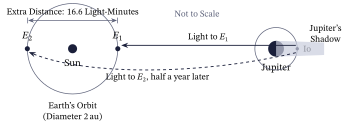
Jupiter’s innermost large moon, Io, circles the planet once every 42.5 hours and disappears into Jupiter’s shadow on every orbit. In the 1670s the Paris Observatory timed these eclipses to help map-makers fix their longitude, since an eclipse is seen at the same instant from everywhere on the Earth and can serve as a clock in the sky. A map-maker who compares the local time of an eclipse, read from the position of the Sun, with the Paris time of the same eclipse from the tables finds the difference in longitude, because the Earth turns through 15 degrees in every hour. The Danish astronomer Ole Rømer (1644-1710), working in Paris, noticed that the eclipses did not come at regular intervals. When the Earth moved away from Jupiter, each eclipse came a little later than the previous one; when the Earth approached, the eclipses came early. Over half a year the delay added up to many minutes.
Rømer’s explanation, announced to the Royal Academy of Sciences in November 1676, is drawn in Figure 1. Light from Io needs time to reach the Earth, and when the Earth is on the far side of its orbit that light has to cross the whole orbit in addition. The eclipses are late by the time light needs for the extra distance. Rømer estimated that light takes about 22 minutes to cross the diameter of the Earth’s orbit (11 minutes from the Sun to the Earth), and he used it to predict that the eclipses of November 1676 would be seen about ten minutes later than the eclipse tables predicted. They were, and on 21 November he explained why to the Academy.
A second astronomical proof came in 1729 from James Bradley (1693-1762), who found that every star in the sky traces a tiny ellipse once a year, with a radius of about 20 arcseconds, the angle that a coin two centimetres across covers when it is seen from 200 metres away. The shift is the aberration of light. A telescope moving with the Earth at 30 kilometres per second must be tilted slightly forward to catch a ray, as an umbrella is tilted into the rain, and the angle of the tilt, in radians, is the ratio of the Earth’s speed to the speed of light. Because the Earth’s speed is the circumference of its orbit divided by a year, the angle alone gives the time light needs to travel from the Sun to the Earth. Bradley found 8 minutes 12 seconds, within two per cent of the modern 8 minutes 19 seconds. Aberration will matter again in Section 2, because it says something about the medium light moves in.
1.2 Measuring the speed on the ground
In 1849 Hippolyte Fizeau (1819-1896) measured the speed of light between two hills near Paris, without any help from the sky. A beam of light passed between the teeth of a spinning wheel with 720 teeth, travelled 8,633 metres to a mirror on Montmartre, and came back through the same wheel. At low speed the returning light passed through the same gap it had left through. When the wheel turned fast enough that a tooth had moved into the gap during the round trip, the returning light was blocked and the observer saw darkness. The rotation rate at which this first happened told Fizeau the travel time.