 Image: Alessandro Cai (public domain)
How we have known gravitational waves exist since 1974
The first detection of a gravitational wave was announced on 11 February 2016. The first proof that gravitational waves exist is older than that by four decades, and it was found by listening to a radio pulsar whose orbit is shrinking. Every year the orbit of PSR B1913+16 gets 76.5 microseconds shorter, and the shrinking matches, to two parts in a thousand, the energy that general relativity says the pair must be radiating away as gravitational waves. For that discovery Russell Hulse and Joseph Taylor received the Nobel Prize in Physics 1993.
A pulsar whose period would not hold still
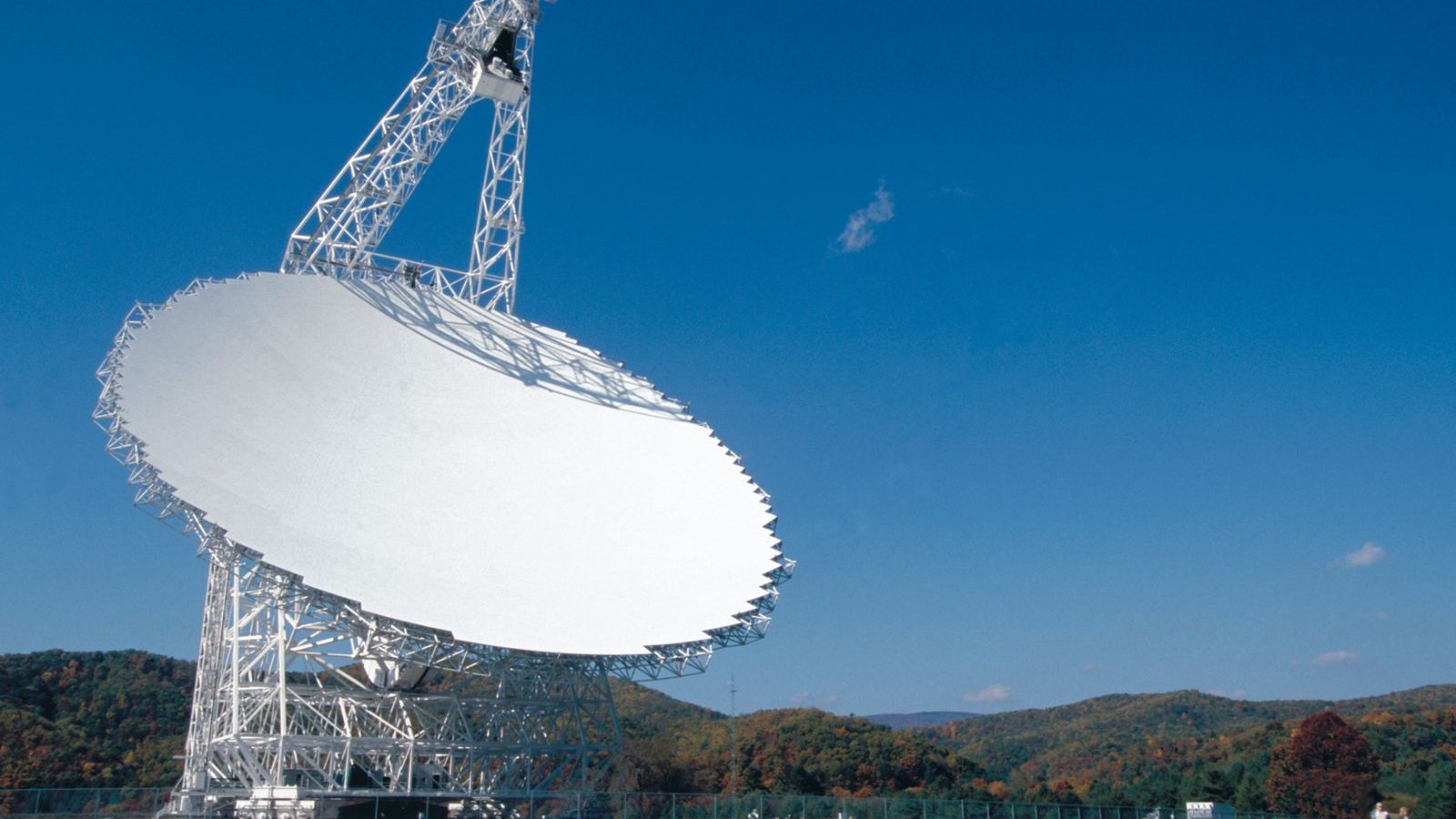
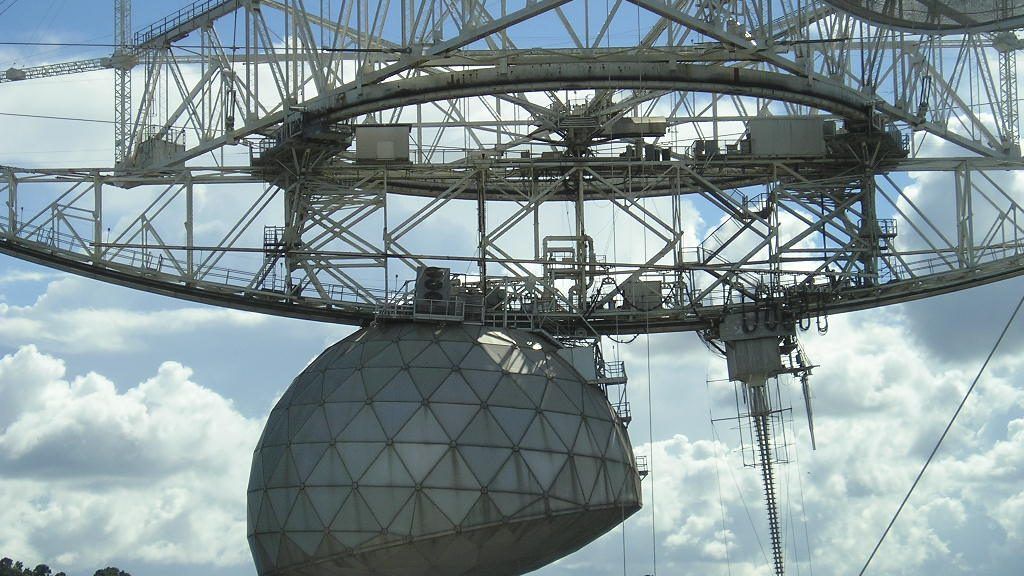
In the summer of 1974 Hulse was a graduate student of Taylor's at the University of Massachusetts, running a survey for new pulsars with the 305 metre Arecibo telescope in Puerto Rico. A pulsar is a neutron star that spins and sends a beam of radio waves past the Earth once per turn, so it appears as a train of pulses with a fixed period. The pulsar Hulse found on 2 July 1974 had a period of 59 milliseconds, but the period refused to stay put: it drifted by a few parts in a thousand over hours, and by September he saw that the drift repeated every 7.75 hours. That is a Doppler shift. The pulsar is in orbit around another star, approaching us for half the orbit and receding for the other half, and its pulse period stretches and compresses in step. The companion is never seen, but its mass and the orbit follow from the pulse timing, and the companion turned out to be another neutron star.
The orbit is small and fast. The two stars go round each other in 7 hours 45 minutes, in an ellipse of eccentricity 0.617 whose closest approach is about one solar radius and whose widest separation is about four and a half. Their speeds are a few hundred kilometres per second, a thousandth of the speed of light. That is slow for special relativity, but the gravitational field at a separation of one solar radius from a 1.4 solar mass star is strong enough that the general-relativistic corrections to the orbit are measurable within months.
The orbit as a clock
Timing a pulsar means recording the arrival time of each pulse and fitting a model that includes the spin, the orbit, the motion of the Earth, and the delays in the interstellar gas. For a binary pulsar the model also contains the effects of general relativity, and three of them have now been measured for PSR B1913+16. The periastron, the point of closest approach, advances by 4.23 degrees a year, the same precession that moves Mercury's perihelion by 43 arcseconds a century, 35,000 times faster because the orbit is so much tighter. The pulses arrive later when the pulsar is near periastron, because its clock runs slow there, both from its speed and from the companion's gravity, by a combination of the time dilation of special relativity and the gravitational redshift. Those two effects fix the two masses: \(1.438 \pm 0.001\) solar masses for the pulsar and \(1.390 \pm 0.001\) for the companion.
With the masses known, general relativity makes a third prediction with no free parameter. Two masses in orbit have a changing quadrupole moment, and Einstein's quadrupole formula of 1918 gives the power they radiate in gravitational waves. For a circular orbit of two masses \(m_1\) and \(m_2\) separated by \(a\),
\[ P = \frac{32}{5}\,\frac{G^4}{c^5}\,\frac{(m_1 m_2)^2 (m_1 + m_2)}{a^5}, \]and for an eccentric orbit a factor that depends on the eccentricity multiplies this; for \(e = 0.617\) the factor is about 12. The result for PSR B1913+16 is about \(7 \times 10^{24}\) watts, two per cent of the luminosity of the Sun, radiated as ripples in spacetime. Energy lost from an orbit makes the orbit smaller and faster, so the orbital period must decrease, and the formula says by how much: \(2.4 \times 10^{-12}\) seconds per second, or 76.5 microseconds a year.
Thirty-five years of data
A decrease of 76 microseconds a year in a period of 27,900 seconds cannot be seen in one year. It can be seen in the accumulated shift of the time of periastron, which grows as the square of the elapsed time, like the distance fallen by a dropped stone. After ten years the periastron was arriving about four seconds earlier than it would have with a constant period, and after forty years about a minute earlier. The plot of that shift against year, with the curve of general relativity drawn through it, is one of the most reproduced figures in physics.
Taylor announced the first detection of the decay in December 1978, after four years of timing, and he and Joel Weisberg published the full analysis in 1982; it has been updated every few years since. The most recent full analysis, by Weisberg and Yuping Huang in 2016, used 9,257 pulse arrival times over 35 years. The measured decay has to be corrected for a small kinematic effect, because the pulsar and the Sun accelerate differently in the gravitational field of the Galaxy, and once that is done the ratio of the observed decay to the general-relativistic prediction is \(0.9983 \pm 0.0016\). The paper is free on arXiv. The uncertainty is now dominated by how well the distance to the pulsar and the Galaxy's rotation are known, not by the pulsar timing.
The Nobel committee gave the 1993 prize to Hulse and Taylor "for the discovery of a new type of pulsar, a discovery that has opened up new possibilities for the study of gravitation". The prize summary is a good short account. Hulse had left astronomy by then and was working on plasma physics at Princeton.
Why this counts as a detection, and why it does not
The pulsar shows that gravitational waves carry energy away from a source, at the rate the theory predicts. It does not show the waves themselves arriving anywhere. The waves from PSR B1913+16 reach the Earth with a strain of about \(10^{-23}\) at a frequency of 70 microhertz, two cycles per orbit, a frequency that no detector on the ground or in space can reach, because a ground detector works above 10 hertz and the planned LISA mission bottoms out near 0.1 millihertz. Physicists therefore called the pulsar the indirect evidence, and the direct detection waited until 2015, when two black holes merged within LIGO's band. The two results are the same physics at two ends of the process: the pulsar is in the slow inspiral that will last another 300 million years, and GW150914 was the last fifth of a second of the same inspiral for a much heavier pair.
The double pulsar
In 2003 a team at the Parkes telescope in Australia found PSR J0737-3039, a pair of neutron stars in which both are pulsars, with an orbital period of only 2.45 hours. Two clocks in the same orbit allow more tests than one, and the orbit is seen almost edge-on, so the pulses of one star pass close to the other and are delayed by its gravity, the Shapiro delay of Unit 11. In 2021 Michael Kramer and colleagues published 16 years of timing of the system and found the orbital decay in agreement with the quadrupole formula to \(1.3 \times 10^{-4}\), ten times better than the Hulse-Taylor pulsar, in a paper that is free to read. Both systems are listed with all their measured parameters in the ATNF Pulsar Catalogue, where anyone can look up the orbital period and its rate of change and check the formula above.
Unit 13 of the masterclass derives the quadrupole formula in outline, computes the radiated power of PSR B1913+16 from its catalogue values, and compares the predicted period decay with the measured one as a worked example.