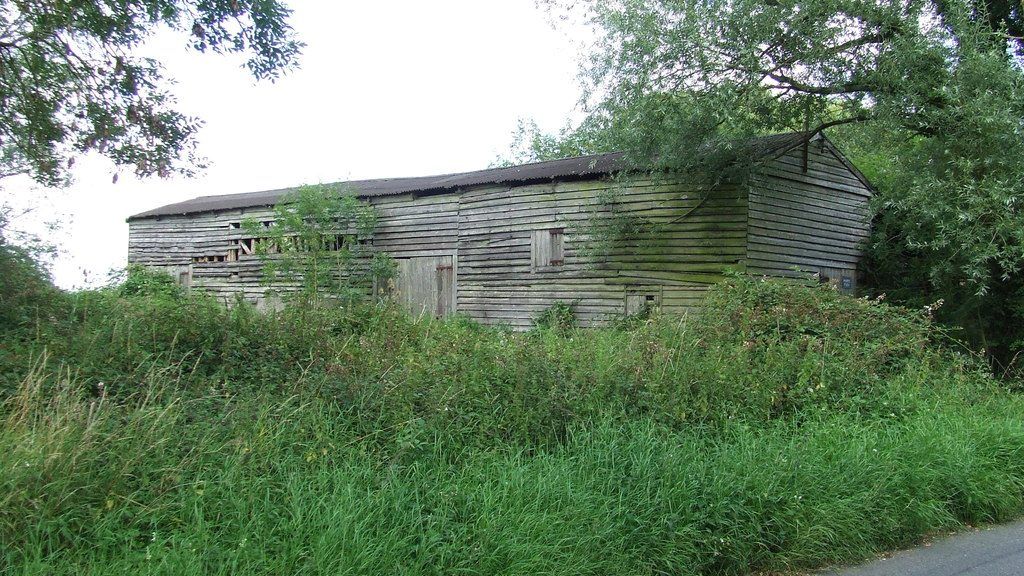
 Image: Keith Evans (CC BY-SA 2.0)
Can a 20 metre pole fit in a 10 metre barn?
A runner carries a pole 20 metres long towards a barn 10 metres long with a door at each end. The runner moves at \(0.866c\), for which the Lorentz factor is exactly 2. In the barn's frame the pole is contracted to 10 metres, so there is an instant at which it is entirely inside, and a farmer can shut both doors at that instant and open them again before the pole hits anything. In the runner's frame the barn is contracted to 5 metres and the pole is 20 metres long, so it can never be inside with both doors shut. One of these descriptions must be wrong, or so it seems. Neither is. Working out exactly what the doors do in each frame is the best short lesson in special relativity there is.
The barn's frame
Length contraction says that an object moving at speed \(v\) is shorter along its direction of motion by the Lorentz factor,
\[ L = \frac{L_0}{\gamma}, \qquad \gamma = \frac{1}{\sqrt{1 - v^2/c^2}}. \]At \(0.866c\), \(v^2/c^2 = 0.75\), the square root is 0.5, and \(\gamma = 2\). The pole's proper length is 20 metres, so the farmer measures 10 metres. Set the clocks of the barn's frame so that at \(t = 0\) the front tip of the pole is at the far door and the back end is at the near door. The farmer closes both doors at \(t = 0\), which is one instant in the barn's frame, and the pole is inside. A nanosecond later the tip would hit the far door, so the farmer opens it again at once. This is the whole story in the barn's frame: pole inside, both doors shut, no collision.
The runner's frame
In the runner's frame the barn comes at the pole at \(0.866c\) and is 5 metres long. The two door closings are two events, and the question is when each happens on the runner's clocks. The Lorentz transformation for time is
\[ t' = \gamma\left(t - \frac{v\,x}{c^2}\right). \]Put the near door at \(x = 0\) and the far door at \(x = 10\) metres, both closing at \(t = 0\). The near door event has \(t' = 0\). The far door event has
\[ t' = -\gamma\,\frac{v \times 10\ \mathrm{m}}{c^2} = -2 \times \frac{0.866 \times 10\ \mathrm{m}}{c} = -\frac{17.3\ \mathrm{m}}{c} = -57.7\ \mathrm{ns}. \]In the runner's frame the far door closes 57.7 nanoseconds before the near door. At that moment the tip of the pole is at the far door, and the back end is 20 metres behind the tip, which is 15 metres outside the near door, since the barn is only 5 metres long. The far door now opens again, the tip passes through, and the barn keeps moving over the pole at \(0.866c\). In 57.7 nanoseconds it moves \(0.866 \times 0.3\) metres per nanosecond \(\times 57.7\), which is 15 metres. The near door then arrives at the back end of the pole and closes behind it. At no moment in the runner's frame are both doors shut at once, and at no moment is the pole inside the barn.
Both descriptions contain the same events: the far door closes with the pole's tip at it, the near door closes with the pole's back end at it, and no part of the pole ever hits a closed door. The frames disagree only on whether those two closings happened at the same time, and the relativity of simultaneity is exactly the statement that two events at different places can be simultaneous in one frame and not in another. There is no fact of the matter about "the pole is inside the barn" that both frames must share, because "inside the barn" means "both ends between the doors at the same time", and "the same time" is the thing that is relative.
What if the doors stay shut?
The puzzle gets sharper if the farmer refuses to open the far door. In the barn's frame the pole is inside, both doors are shut, and now the tip hits the far door and stops. What does the back end do? If the pole were rigid, the back end would stop at the same instant, and the pole would sit at rest inside the barn, 10 metres long, with a proper length of 20 metres squeezed into 10. That cannot happen, and the reason is that a rigid body does not exist in relativity. When the tip stops, the back end cannot know about it until a signal has travelled the length of the pole, and no signal is faster than \(c\). A compression wave in steel moves at about 5 kilometres per second, which is nothing compared with the speed of the pole, so the back end keeps coming at \(0.866c\) until the pole has crumpled into the space available. The pole is destroyed, in both frames, and the two frames agree on that too. In the runner's frame the far door stops the tip while the back end is still 15 metres outside, and the barn then ploughs over the stationary tip and the still-moving rest of the pole until everything has piled up.
The lesson generalizes. Every "paradox" of special relativity that involves rigid rods, instantaneous signals, or the phrase "at the same time" in two frames comes apart the same way. Write down the events, transform their coordinates, and check what each frame says about the order of events at different places. Unit 3 of the masterclass does this with the train and the platform first and then with the pole, and Unit 6 treats the stopping of a fast rod as an exercise in what acceleration does to an extended body.
Length contraction is real, and nobody has photographed it
Students often ask whether the contraction is something you would see. It is something you would measure, by noting where the two ends are at the same time in your frame. A photograph records light that arrives at the camera at one instant, and that light left the near and far parts of the object at different times. James Terrell and Roger Penrose showed in 1959 that a fast sphere still looks like a sphere in a photograph, and that a fast cube looks rotated rather than squashed. The contraction is in the measurement, and the measurement is what physics is made of. The heavy ions in the Large Hadron Collider are, in the laboratory frame, flattened into discs more than 2,500 times thinner than they are wide, and the way their collisions develop depends on it.
The pole at \(0.866c\) is a fantasy, of course. The point of the exercise is the arithmetic, and the arithmetic is the same at any speed: at 300 metres per second, an airliner 70 metres long is shorter by 35 picometres, less than the radius of a hydrogen atom, and the two door events would be separated by about \(2 \times 10^{-13}\) seconds in the pilot's frame. The reason relativity looks strange is only that the factor \(v/c\) in daily life is \(10^{-6}\), and squared it is \(10^{-12}\). Unit 4 gives the full Lorentz transformation and shows how both the contraction and the shift in simultaneity drop out of one pair of equations.