

The Lorentz Transformation and the Addition of Velocities
Derives the Lorentz transformation from the principle of relativity and the invariance of the speed of light, and recovers time dilation, length contraction, and the relativity of simultaneity from its four equations. The velocity-addition formula follows, with a probe fired from a fast ship, the protons of the LHC, and Fizeau's moving water of 1851 as the examples, and the unit ends with the invariant combination of time and position and the modern search for any violation of Lorentz symmetry.
A ship passes a planet at \(0.8c\) and launches a probe straight ahead at \(0.8c\) relative to the ship. By the Galilean addition of velocities of Unit 1 the probe moves at \(1.6c\) relative to the planet, and by the second postulate of Unit 2 nothing of the kind can happen. Unit 3 derived three consequences of the postulates one at a time, each with its own thought experiment, and the probe needs all three at once. This unit replaces the Galilean transformation by four equations, the Lorentz transformation, which convert the time and place of any event from one inertial frame to another. Time dilation, length contraction, and the relativity of simultaneity drop out of these equations in a line each, the speed of the probe takes two lines, and a measurement that Fizeau made with flowing water in 1851, half a century before Einstein, turns out to have been a test of them.
1 Why the Galilean transformation must go
Unit 1 set up two frames of reference in what is called the standard configuration, drawn in Figure 1. The frame \(S\) has the coordinates \((t, x, y, z)\) and the frame \(S'\) has \((t', x', y', z')\). The frame \(S'\) moves relative to \(S\) at the constant speed \(v\) along the common \(x\) axis, the two sets of axes are parallel, and the two origins coincide at the moment \(t = t' = 0\). Every transformation in this unit refers to this arrangement; any other arrangement of two inertial frames can be turned into it by shifting and rotating the axes.
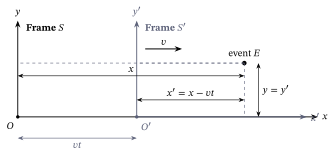
The Galilean transformation of Unit 1 reads \[ x' = x - vt , \qquad y' = y , \qquad z' = z , \qquad t' = t . \] It is what the drawing suggests and what all everyday experience confirms, and it is nevertheless wrong in two ways. The last equation says that two events simultaneous in \(S\) are simultaneous in \(S'\) as well, which the train and the two lightning strikes showed to be wrong. The first equation, combined with the last, says that a light flash moving along \(x = ct\) in \(S\) has \(x' = ct - vt = (c - v)\,t\) in \(S'\), and since \(t' = t\) this means that it moves along \(x' = (c - v)\,t'\), at the speed \(c - v\), which contradicts the second postulate. Since \(t' = t\) is wrong, the time equation has to be rebuilt, and since the four equations have to agree with each other, the space equation has to be rebuilt with it.
What should the new equations satisfy? Four requirements fix them completely.