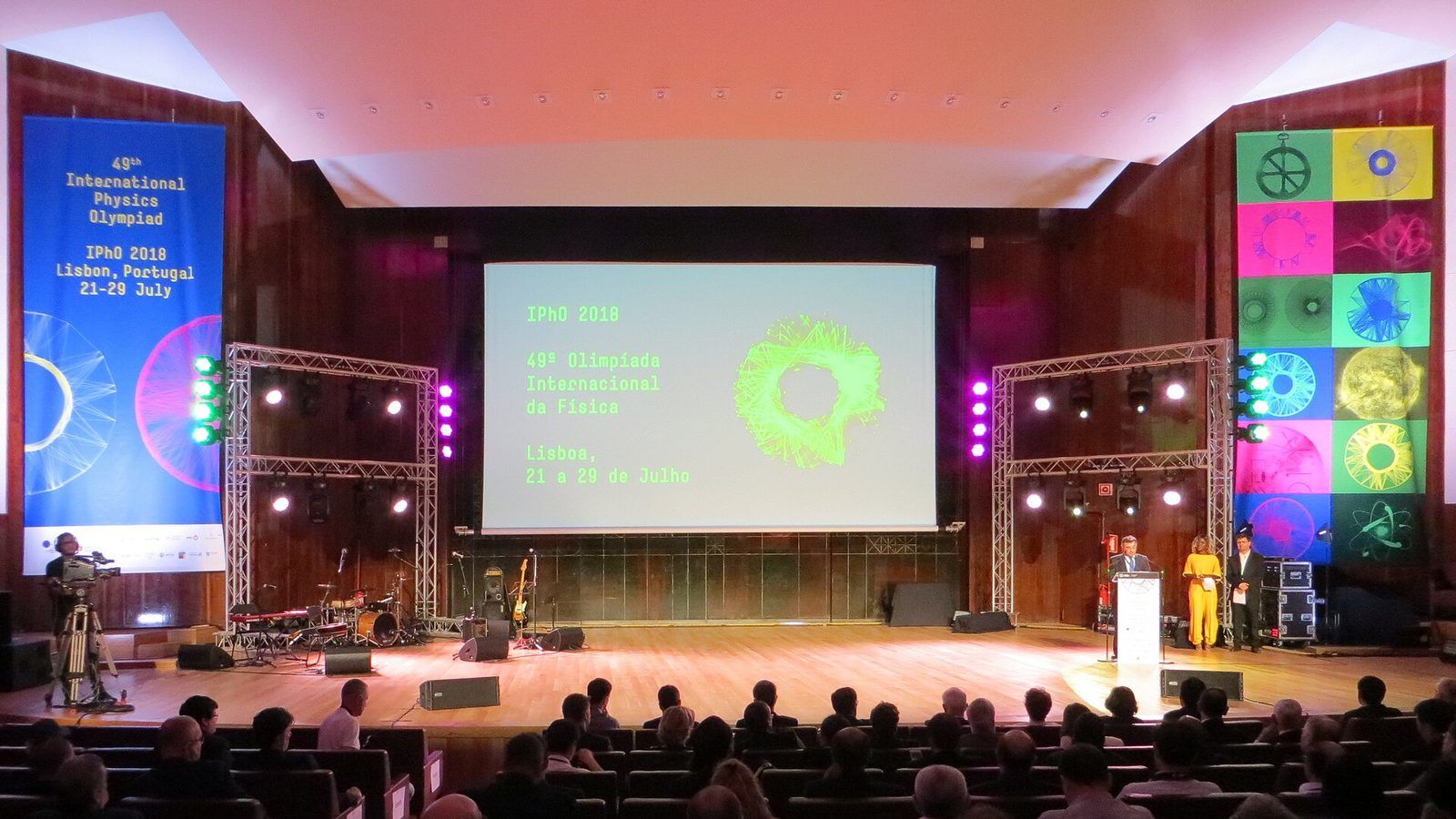
 Image: IPhO 2018 (CC BY-SA 4.0)
How to prepare for the relativity questions of the physics olympiad
The theoretical syllabus of the International Physics Olympiad (IPhO) lists relativity as its fifth item, in one paragraph. It reads: "Principle of relativity and Lorentz transformations for the time and spatial coordinate, and for the energy and momentum; mass-energy equivalence; invariance of the space time interval and of the rest mass. Addition of parallel velocities; time dilation; length contraction; relativity of simultaneity; energy and momentum of photons and relativistic Doppler effect; relativistic equation of motion; conservation of energy and momentum for elastic and non-elastic interaction of particles." General relativity does not appear. The statutes add that every problem must be solvable with standard high school mathematics. The whole of the syllabus and statutes is on the official site.
That paragraph is short, and the physics in it is finite. What makes olympiad relativity hard is not the theory but the speed and precision with which it has to be applied under time pressure, and that comes from practice, not from reading. This article sorts out what to know, what to practise, and where to find problems.
The formulas, and where each clause is taught
Everything in the syllabus follows from the two postulates and the Lorentz transformation. Written for a frame \(S'\) moving at speed \(v\) along the \(x\) axis of a frame \(S\), with the Lorentz factor \(\gamma = 1/\sqrt{1 - v^2/c^2}\),
\[ x' = \gamma\,(x - vt), \qquad t' = \gamma\left(t - \frac{vx}{c^2}\right), \]and the same pair of equations with \(x\) replaced by \(pc\) and \(ct\) by \(E\) is the transformation of energy and momentum. From the first pair come time dilation (\(\Delta t = \gamma\,\Delta\tau\)), length contraction (\(L = L_0/\gamma\)), the relativity of simultaneity (two events simultaneous in \(S\) are separated in \(S'\) by \(\Delta t' = -\gamma v\,\Delta x/c^2\)), and the addition of parallel velocities, \(u = (u' + v)/(1 + u'v/c^2)\). From the second pair come \(E = \gamma mc^2\), \(\vec{p} = \gamma m \vec{v}\), and the two invariants that solve most collision problems, the interval \(c^2\Delta t^2 - \Delta x^2\) and the rest mass through
\[ E^2 = p^2c^2 + m^2c^4. \]For a photon \(m = 0\), so \(E = pc\), and the relativistic Doppler formula \(f' = f\sqrt{(1 - v/c)/(1 + v/c)}\) for a source receding at \(v\) follows from transforming a photon's energy. The relativistic equation of motion is \(\vec{F} = \mathrm{d}\vec{p}/\mathrm{d}t\) with the relativistic momentum, and the one fact to remember about it is that a force along the velocity has to overcome a factor \(\gamma^3\) while a force perpendicular to it only \(\gamma\).
In the masterclass these clauses are spread over the first seven units. Unit 2 states the principle of relativity and the postulates. Unit 3 derives time dilation, length contraction, and the relativity of simultaneity. Unit 4 derives the Lorentz transformation and the velocity-addition formula. Unit 5 covers the interval and the Doppler effect. Unit 6 treats accelerated motion and the equation of motion, and Unit 7 does energy, momentum, photons, and collisions. The Foundation masterclass covers the whole syllabus item; the Advanced units on general relativity go beyond anything an olympiad asks.
Work in units of c
Olympiad solutions, and research papers, write speeds as fractions of \(c\) and energies and momenta in the same unit, usually MeV. A speed of \(0.6c\) has \(\gamma = 1.25\); \(0.8c\) has \(\gamma = 5/3\); \(0.99c\) has \(\gamma = 7.09\). Learn the first two pairs by heart, since examiners like numbers that come out clean, and keep \(\gamma\) and \(\beta = v/c\) together with \(\gamma\beta = \sqrt{\gamma^2 - 1}\). A momentum is then "\(p c = 400\) MeV" and a mass is "\(m c^2 = 938\) MeV", and the energy-momentum relation becomes Pythagoras' theorem for a triangle with sides \(pc\), \(mc^2\), and \(E\). For example, a proton with \(pc = 1{,}250\) MeV has \(E = \sqrt{1250^2 + 938^2} = 1{,}563\) MeV, \(\gamma = E/mc^2 = 1.67\), and \(\beta = pc/E = 0.80\). No factor of \(3 \times 10^8\) ever appears, and a mistake in powers of ten cannot happen.
The collision problem
The clause about "elastic and non-elastic interaction of particles" is where most marks are won and lost. The pattern is nearly always the same: a particle decays, or two particles collide and produce others, and the question is a threshold energy, a mass, or an angle. The method is also always the same. Add the four-momenta of everything before, add the four-momenta of everything after, set the totals equal, and then compute the invariant \(E^2 - p^2c^2\) of the total, which is the same in every frame. At the threshold for producing a set of particles, the products are at rest in the centre-of-mass frame, so the invariant of the total equals \((\sum m)^2 c^4\). That one line gives, for example, that a proton hitting a proton at rest needs a kinetic energy of \(6\,m_pc^2\), about 5.6 GeV, to make a proton-antiproton pair, which is why the Bevatron of 1954 was built for 6 GeV.
Decays go the same way. A particle of mass \(M\) at rest decaying into two of masses \(m_1\) and \(m_2\) gives each product a fixed energy, and the formula for \(E_1\) is found in three lines by writing the four-momentum of particle 2 as the total minus that of particle 1 and squaring. Compton scattering, a photon bouncing off an electron, is the same calculation with one massless particle, and it appears in olympiads under various disguises, such as a laser beam scattering off an electron beam to make gamma rays. Practise these until the squaring step is automatic.
Past problems
The official site holds the problems and solutions of every IPhO since the first, in Warsaw in 1967, on its documentation page. Relativity appears every few years, usually as part of a problem rather than a whole one. The 2016 olympiad in Zurich set a problem on the Large Hadron Collider in which the protons' time to cross an accelerating gap needs the \(\gamma^3\) of the equation of motion and the particle identification part asks for a mass from a measured speed and momentum; the marking scheme gave zero for the non-relativistic answer. Reading how such a problem is scored tells you what the examiners want to see written down. Jaan Kalda's study guides, free PDFs organised by solving ideas that generations of olympiad students have used, cover the mechanics and kinematics on which the relativity problems are built.
The competitions themselves form a ladder. Everyone starts in a national olympiad, such as the British Physics Olympiad or the USA Physics Olympiad of the American Association of Physics Teachers, whose rounds run from the autumn to the spring. The national winners go to the regional olympiads, the European Physics Olympiad and the Asian Physics Olympiad in May and June, and the five-member national teams go to the IPhO in July; the 2026 IPhO is in Bucaramanga, Colombia, from 4 to 12 July. Alongside the official route there are the Physics Cup, a year-long online competition of hard single problems, and the Online Physics Olympiad, which anyone can enter from home. The unofficial site ipho-unofficial.org keeps the results and the timeline of every edition.
How to use the masterclass for this
Read Units 1 to 7 in order over the eight weeks, which fits between a national first round in the autumn and the selection rounds in the spring. Do every worked example with pen and paper before reading its solution, and treat the questions in the text as timed problems, with ten minutes each and no notes. The site's page of important equations is the formula sheet that you are not allowed to bring into the exam, so use it to check which formulas you can reproduce from memory and which you still look up. The quizzes tell you which clause of the syllabus you have not yet made automatic.
The masterclass teaches the physics in that paragraph and the habits of working in units of \(c\) and with invariants. It does not teach the rest of the syllabus, which is six times longer, and it cannot supply the speed that comes only from solving a few hundred problems against the clock. For the relativity item, though, a student who has done the seven units and the past problems above has met everything the paper can ask. The olympiad preparation page of the site maps each syllabus clause to its unit and lists the problem sources in one place.