Relativistic Energy, Momentum, and Mass-Energy Equivalence
Shows with a glancing collision why Newtonian momentum is no longer conserved and derives the relativistic momentum, the kinetic energy from the work integral, and the total energy, with the rest energy E = mc² as the term that remains at rest. The unit states carefully what mass-energy equivalence says and does not say, derives the energy-momentum relation that holds for every particle, light included, and applies it to the Sun's output, to the helium nucleus, to particle collisions and decays, and to the way physicists found the mass of a particle that lived for 10^-22 seconds.
Units 3 to 6 were about clocks and metre sticks. They said how long a journey takes and how long a moving train is, and nothing about what it costs to set the train in motion. This unit turns to the dynamics. It asks what replaces momentum and kinetic energy when Newton’s formulas fail, why a proton in the Large Hadron Collider can be given a Lorentz factor of 7,247 but never the speed of light, and where the equation \(E = mc^2\) comes from. The last question is the one Einstein put to himself in September 1905, three months after his first paper on relativity, in a note of three pages that ends with a sentence about mass and radiation. The unit derives that sentence, says carefully what it does and does not mean, and applies it to the Sun, to the helium nucleus, and to the proton collisions in which a particle with a mass of 125 GeV was found in 2012.
1 Momentum in two frames
Unit 1 recalled Newton’s definition of momentum, \(\vec{p} = m\vec{v}\), and his second law in the form he wrote it, \(\vec{F} = \dd\vec{p}/\dd t\). The most useful consequence of the law is that the total momentum of two bodies that collide is the same before and after the collision, whatever happens between them. Momentum conservation is a statement about every inertial frame, because the first postulate of Unit 2 says that the laws of physics, mechanics included, take the same form in all of them. That requirement is enough to show that \(m\vec{v}\) cannot be the right momentum.
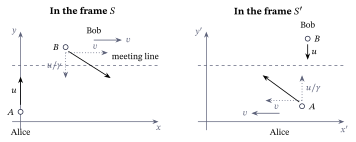
The test case is a collision seen from two frames, drawn in Figure 1. Alice is at rest in the frame \(S\) and Bob is at rest in the frame \(S'\), which moves at the speed \(v\) along the \(x\) axis of \(S\) in the standard configuration of Unit 4. Each holds a ball, and the two balls are identical. Alice throws her ball \(A\) straight across the motion, along the \(y\) axis, at a small speed \(u\). Bob throws his ball \(B\) straight across in the opposite direction, along the negative \(y'\) axis, at the same small speed \(u\) measured in his own frame. The throws are timed so that the balls meet halfway, and the collision is elastic, so that each ball bounces back along its own line and returns to its thrower. The arrangement is symmetric, because seen from \(S'\) it is the same picture as seen from \(S\) with the two balls exchanged, so by the first postulate whatever Alice says about her ball, Bob says about his.