 Image: clipperarctic (CC BY-SA 2.0)
The clocks that flew around the world
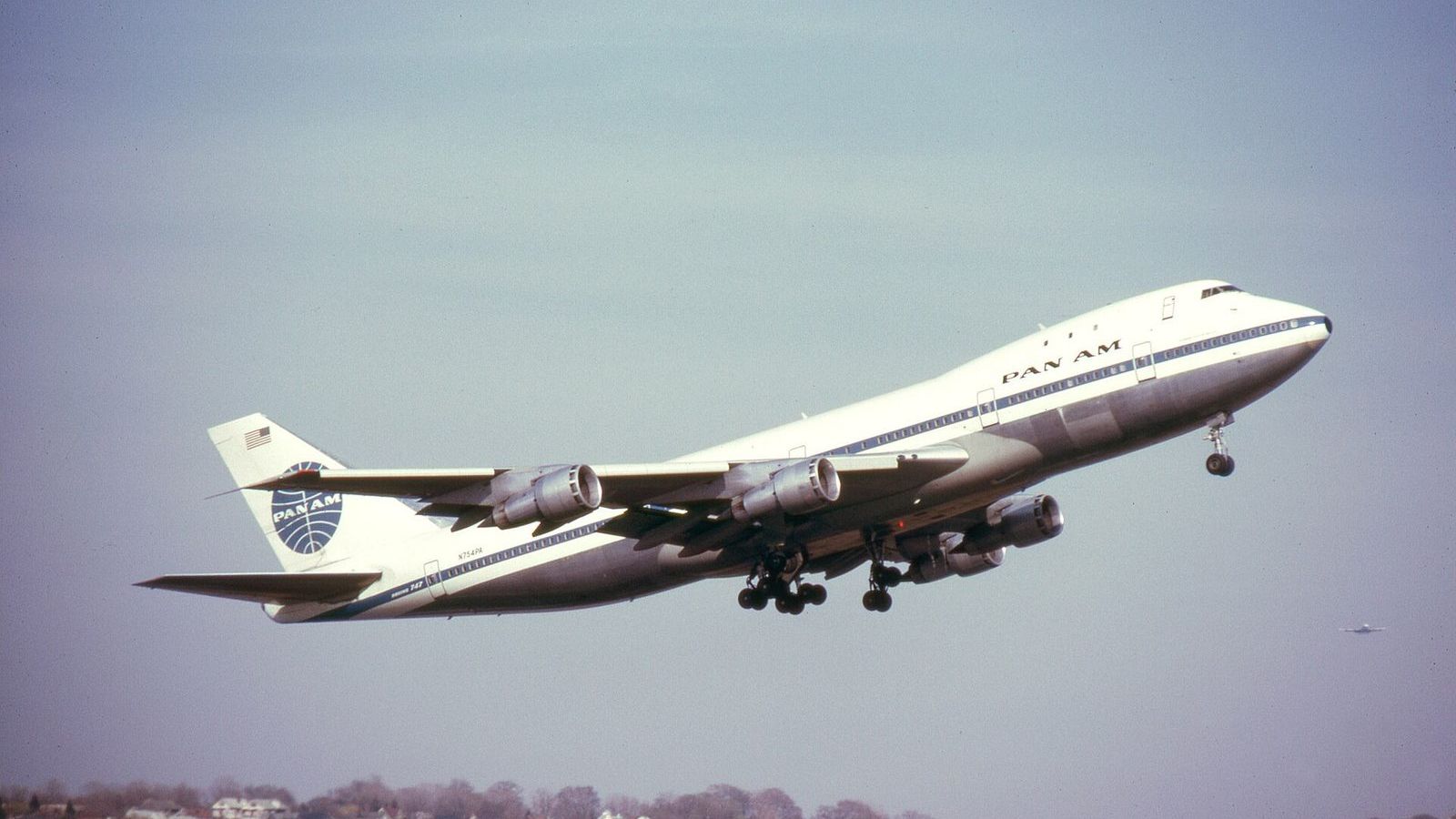
In October 1971 a physicist and an astronomer bought airline tickets for four atomic clocks. The clocks flew around the world eastward on commercial flights, came home, flew around the world westward, and came home again. When they were compared with the clocks that had stayed at the United States Naval Observatory in Washington, the eastbound clocks had lost 59 nanoseconds and the westbound clocks had gained 273. Relativity predicted 40 lost and 275 gained, with uncertainties that covered the measurements. The whole experiment cost about 8,000 dollars, most of it on tickets, which must make it the cheapest confirmation of general relativity ever made.
The two effects that add
Joseph Hafele of Washington University in St Louis had worked out the prediction for a lecture and then realized that the clocks of 1971 could measure it. There are two contributions, and both were in the air a long time before anyone could check them with clocks.
The first is gravitational. A clock higher in the Earth's field ticks faster than one at the surface, by a fraction \(gh/c^2\), where \(h\) is the height. For an airliner at 9 kilometres the fraction is \(9.8 \times 9{,}000 / (9 \times 10^{16})\), which is about \(10^{-12}\). Over a flight of 40 hours, 144,000 seconds, that is 140 nanoseconds gained, and it does not matter which way the aircraft flies.
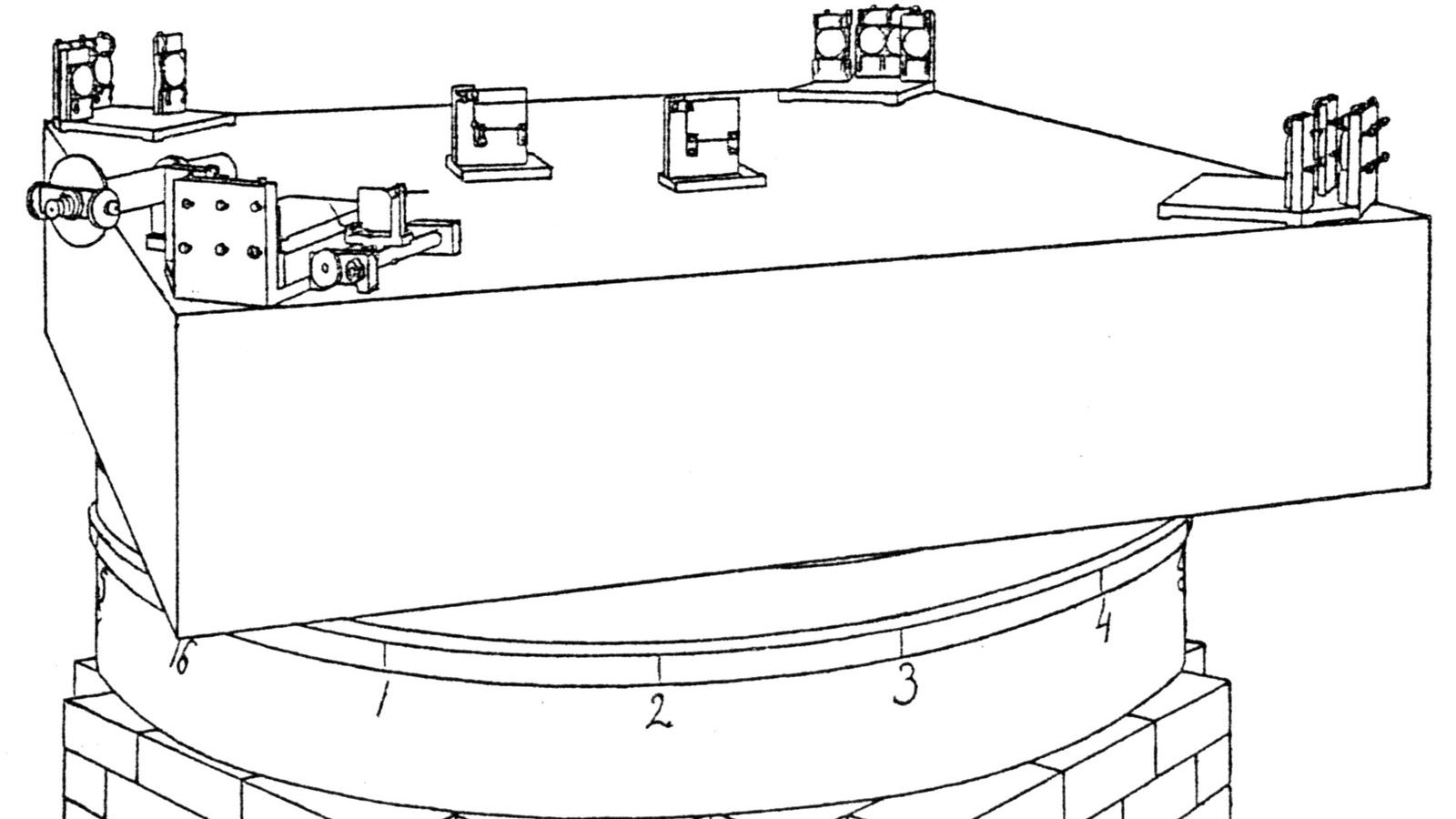
The second is kinematic, and its sign depends on the direction. A moving clock runs slow by the fraction \(v^2/2c^2\) for small speeds. The subtlety is what "moving" means. The clock at the Naval Observatory is itself moving, because the Earth rotates, at about 350 metres per second at the latitude of Washington. The right frame in which to count is one centred on the Earth that does not rotate. In that frame the ground clock moves at the rotation speed \(v_{\mathrm{g}}\), an eastbound aircraft moves at \(v_{\mathrm{g}} + v\) and is slowed more than the ground clock, and a westbound aircraft moves at \(v_{\mathrm{g}} - v\), which for an airliner at 250 metres per second is slower than the ground, so it is slowed less than the ground clock and comes back ahead. The kinematic difference between a flying clock and the ground clock, as a fraction, is
\[ -\frac{(v_{\mathrm{g}} \pm v)^2 - v_{\mathrm{g}}^2}{2c^2} = -\frac{\pm 2 v_{\mathrm{g}} v + v^2}{2c^2}. \]For the eastbound flight both terms slow the clock. For the westbound flight the first term, which is the larger, speeds it up. This is why the two directions give such different answers, and it is the same arithmetic that was used thirty years earlier in the Sagnac effect for light going round a rotating ring.
The numbers
Hafele and Richard Keating, of the Naval Observatory's time service, used the actual flight logs, with the altitude, speed, heading, and latitude of each leg, to integrate both terms over the trips. For the eastbound trip, which took about 65 hours with 41 hours in the air, the prediction was a gain of 144 nanoseconds from altitude and a loss of 184 from speed, a net loss of 40 nanoseconds with an uncertainty of 23. For the westbound trip, about 80 hours with 49 in the air, the prediction was a gain of 179 from altitude and a gain of 96 from speed, a net gain of 275 with an uncertainty of 21.
The measurements were a loss of 59 nanoseconds, with an uncertainty of 10, going east, and a gain of 273, with an uncertainty of 7, going west. The two papers appeared together in Science on 14 July 1972, one on the predictions and one on the observations; the abstract of the second is on the NASA Astrophysics Data System at Around-the-World Atomic Clocks: Observed Relativistic Time Gains.
What it took to measure a nanosecond
The clocks were Hewlett-Packard caesium beam standards, each the size of a small suitcase and each with a stability of a few parts in \(10^{13}\) over a day, which is tens of nanoseconds. One clock would not have been enough. Four were flown so that their mutual differences could be watched, and a clock that jumped, as caesium clocks of that era sometimes did, could be caught and corrected. The clocks were compared with the Observatory's ensemble before and after each trip, and the comparison itself, through a cable, was good to about a nanosecond. The flying clocks occupied seats of their own, strapped in and plugged into the aircraft's power, with a battery for the changes of aircraft, and the airlines' crews referred to the passenger as Mr Clock.
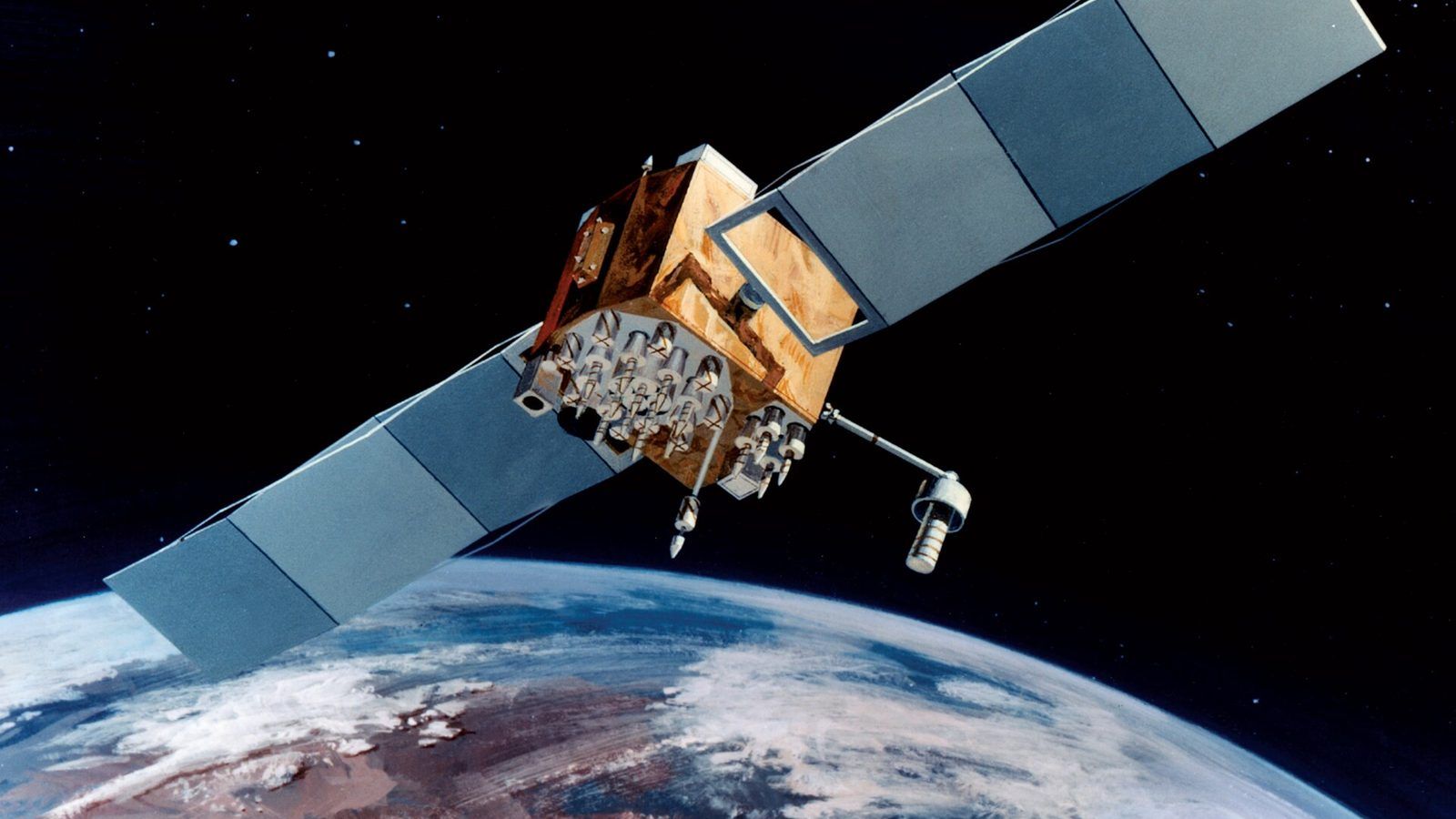
The 273 nanoseconds measured going west is a small number, and it is also a 40 standard deviation detection of the combined effect. The 59 going east is less clean, because the two terms nearly cancel and the prediction is small, but the sign was right and the size was within the stated uncertainties. In 1996 the experiment was repeated for its 25th anniversary with a single clock on a flight from London to Washington and back, with the same result to better precision, and the GPS satellites have been repeating it continuously since 1977. The GPS clocks run 38.5 microseconds a day fast by the same two terms, with the gravitational one dominant because the satellites are so high.
Why it still matters
The experiment is often described as a test of the twin paradox, and in one respect it is: a clock that goes away and comes back shows a different elapsed time from one that stays, and the difference is what the integral of the proper time along each world line says it should be. The twin paradox article explains why no contradiction arises. What makes the Hafele-Keating experiment more interesting than a twin paradox is that the clock that stays home is not in an inertial frame either. The ground clock goes round with the Earth, and the correct prediction only comes out when all three clocks, the ground one and the two flying ones, are referred to the same non-rotating frame. Working that out properly is the subject of the second half of Unit 6 of the masterclass, and the gravitational term is derived in Unit 8 from the equivalence principle.
Caesium clocks of 1971 could resolve the effect over a world trip. The optical lattice clocks of today resolve it over a staircase. In 2010 a group at the National Institute of Standards and Technology compared two aluminium ion clocks and saw the lower one tick slower when it was 33 centimetres below the other, and in 2022 a strontium clock at JILA resolved the gravitational redshift across a millimetre of height inside a single cloud of atoms. The airline tickets are no longer needed, and the physics has not changed.