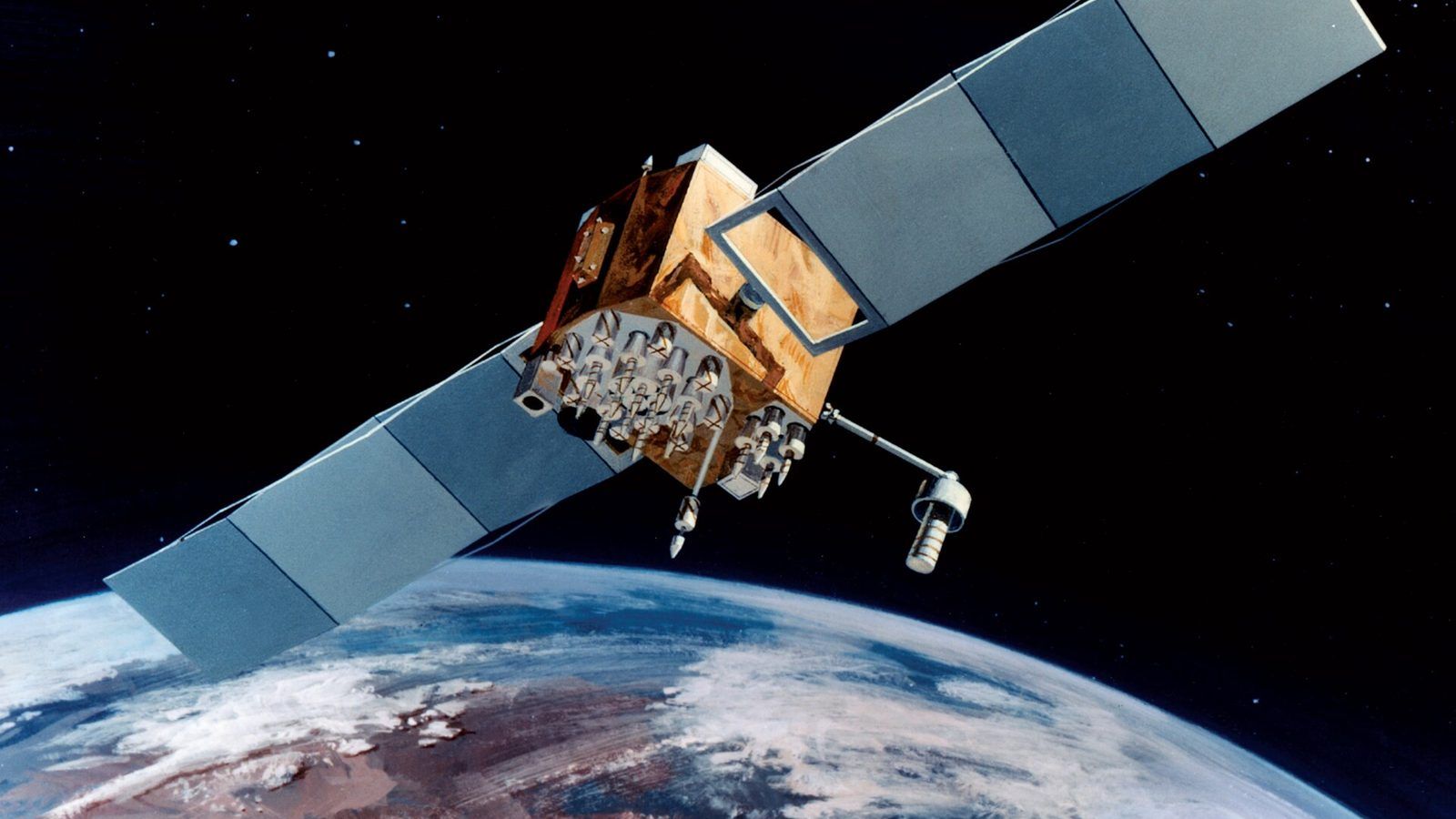
 Image: United States Air Force, public domain
Why your phone needs general relativity
A GPS satellite carries atomic clocks that would run 38.5 microseconds a day fast, by the clocks on the ground, if nobody did anything about it. Light travels 300 metres in a microsecond, so an uncorrected day would put every distance from satellite to receiver off by about 11 kilometres. The engineers who built the system in the 1970s knew this and set the clocks to run slow on purpose before launch. Every position fix your phone makes depends on that decision, and the decision rests on two effects, one from special relativity and one from general relativity, that pull in opposite directions.
Where the satellites are
The satellites orbit at a radius of 26,560 kilometres from the centre of the Earth, about 20,200 kilometres above the ground, and go round once in 11 hours 58 minutes, half a sidereal day. Their speed is about 3.87 kilometres per second. Each one carries caesium or rubidium clocks that tick at a fundamental frequency of 10.23 megahertz, and the whole system is a set of synchronized clocks broadcasting the time. A receiver listens to four or more satellites, works out how long each signal has been travelling, and solves for its own position and for the error of its own cheap quartz clock.
The arithmetic is unforgiving. A timing error of one nanosecond is a distance error of 30 centimetres. For a position good to a few metres, the satellite clocks must agree with the ground to about 10 nanoseconds, and they must keep that agreement for a day between uploads from the control segment.
The clock that moves runs slow
Special relativity says that a clock moving at speed \(v\) past you ticks slower than your own by the Lorentz factor, \(\gamma = 1/\sqrt{1 - v^2/c^2}\). At 3.87 kilometres per second the factor is close to one, and the binomial approximation turns it into a fractional slowing of \(v^2/2c^2\). With \(v = 3{,}874\) metres per second and \(c = 299{,}792{,}458\) metres per second, that is \(8.3 \times 10^{-11}\). Multiply by the 86,400 seconds of a day and the orbiting clock loses 7.2 microseconds a day because of its speed.
Strictly, the comparison should be made with a clock at rest at the centre of the Earth, and the clock on the ground also moves, at up to 465 metres per second at the equator. The ground clock's own slowing is already folded into the definition of the second as kept on the rotating Earth, so the 7.2 microseconds is the figure that matters for the satellites. Unit 3 of the masterclass derives the Lorentz factor from a light clock and shows where the approximation comes from.
The clock higher up runs fast
General relativity adds a second effect. A clock deeper in a gravitational potential ticks slower than one higher up. For weak fields the fractional difference in rate is the difference in Newtonian potential divided by \(c^2\),
\[ \frac{\Delta f}{f} = \frac{\Phi_{\mathrm{sat}} - \Phi_{\mathrm{ground}}}{c^2} = \frac{GM}{c^2}\left(\frac{1}{R_{\mathrm{E}}} - \frac{1}{r}\right). \]With \(GM = 3.986 \times 10^{14}\) cubic metres per second squared for the Earth, the ground radius 6,371 kilometres, and the orbital radius 26,560 kilometres, the bracket is \(1.19 \times 10^{-7}\) per metre and the factor in front is 4.43 millimetres, so the fractional rate difference is \(5.28 \times 10^{-10}\). Over a day that is 45.7 microseconds, and the sign is the other way: the satellite clock gains.
The net effect is a gain of \(45.7 - 7.2 = 38.5\) microseconds a day, a fractional rate of \(4.465 \times 10^{-10}\). The fix is simple once you know the number. Before launch, the clock is set to 10.22999999543 megahertz instead of 10.23 megahertz. Seen from the ground, in orbit, it then ticks at exactly the right rate.
What would happen without the correction
The error would grow by 38.5 microseconds a day, which is 11.5 kilometres of range a day. The receiver solves for its own clock error, so a common offset shared by all satellites cancels to first order, and the position error would grow more slowly than 11 kilometres a day. But the satellites are at different heights and on orbits with small eccentricities, so their offsets would not be equal, and the system would be useless within a day or two. Neil Ashby's review Relativity in the Global Positioning System in Living Reviews in Relativity works through every term, including several that a first calculation leaves out.
Two of those smaller terms are worth knowing. The orbits are not perfect circles. An eccentricity of 0.02 moves the satellite in and out by about 500 kilometres and makes its clock speed up and slow down over each orbit, by up to 46 nanoseconds, which the receiver corrects with a formula in the broadcast message. And the receiver on the rotating Earth moves while the signal is in flight, which is the Sagnac effect, worth up to 207 nanoseconds for a signal crossing the equator. Both are routine corrections inside a chip that costs a few dollars.
A test that runs every day
People sometimes ask whether general relativity has practical consequences. The answer is in their pocket. The 45.7 microseconds a day is a direct measurement of gravitational time dilation, and the system would fail in a way that is impossible to miss if the prediction were wrong by even one per cent. When the first satellite with a caesium clock was launched in 1977, the engineers were cautious enough to include a switch: the clock was launched running at the uncorrected frequency, and after twenty days of comparison with the ground, when the measured rate was within one per cent of the predicted 38.5 microseconds a day, the correction was switched on.
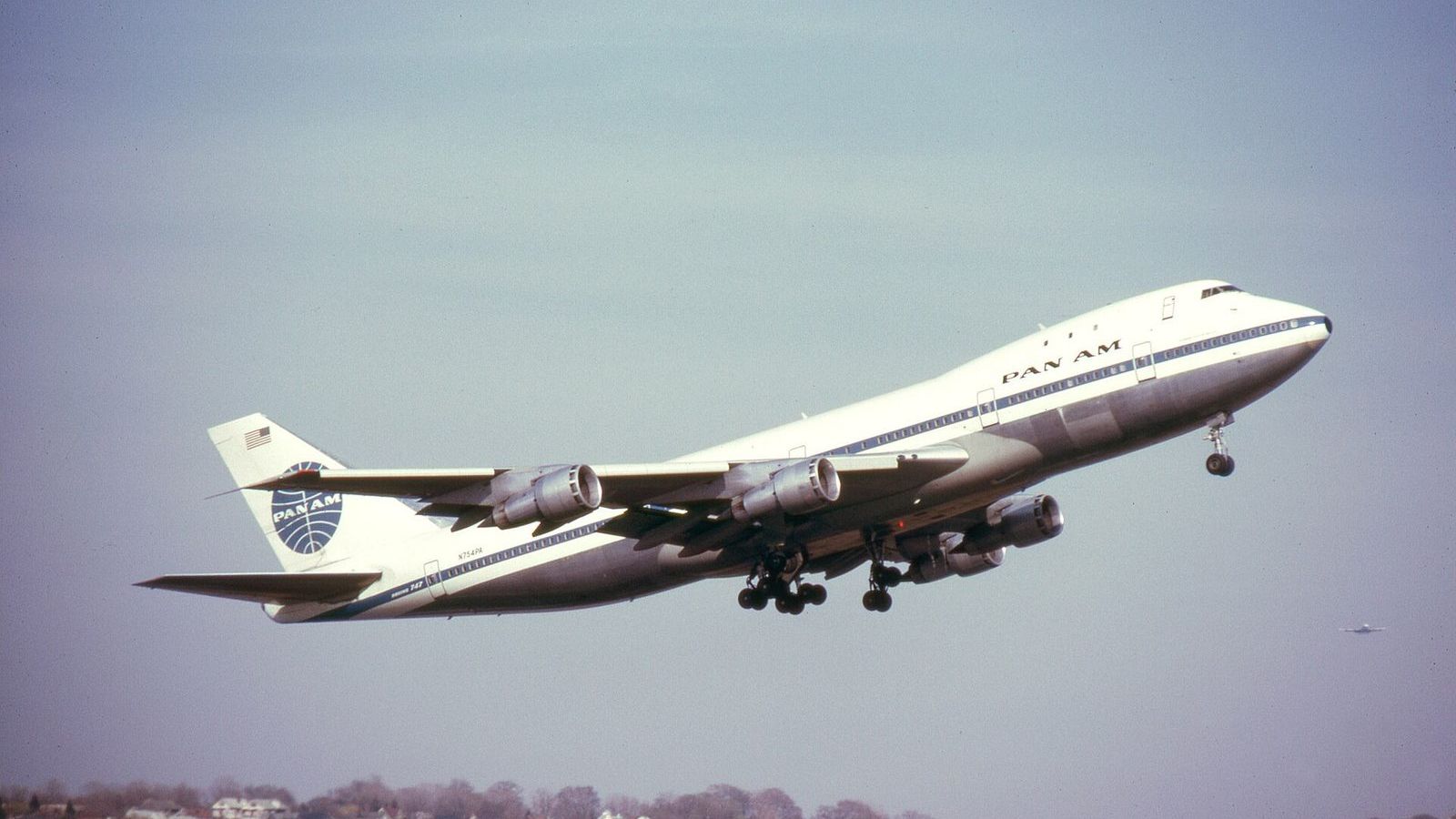
The same physics appears far from navigation. The ground clocks of the time services at the national laboratories are compared with a correction for their height above sea level, because a clock 1,000 metres higher runs faster by about one part in \(10^{13}\). The best optical clocks now resolve a height difference of a centimetre. The unit on the equivalence principle explains why a clock in a weaker gravitational potential must run faster, starting from a thought experiment about a lift, and the clocks that flew around the world in 1971 were the first direct check of the same two effects with real clocks on real aircraft.