 Image: ESO/L. Calçada (CC BY 4.0)
The star that orbits a black hole at 7,650 kilometres per second
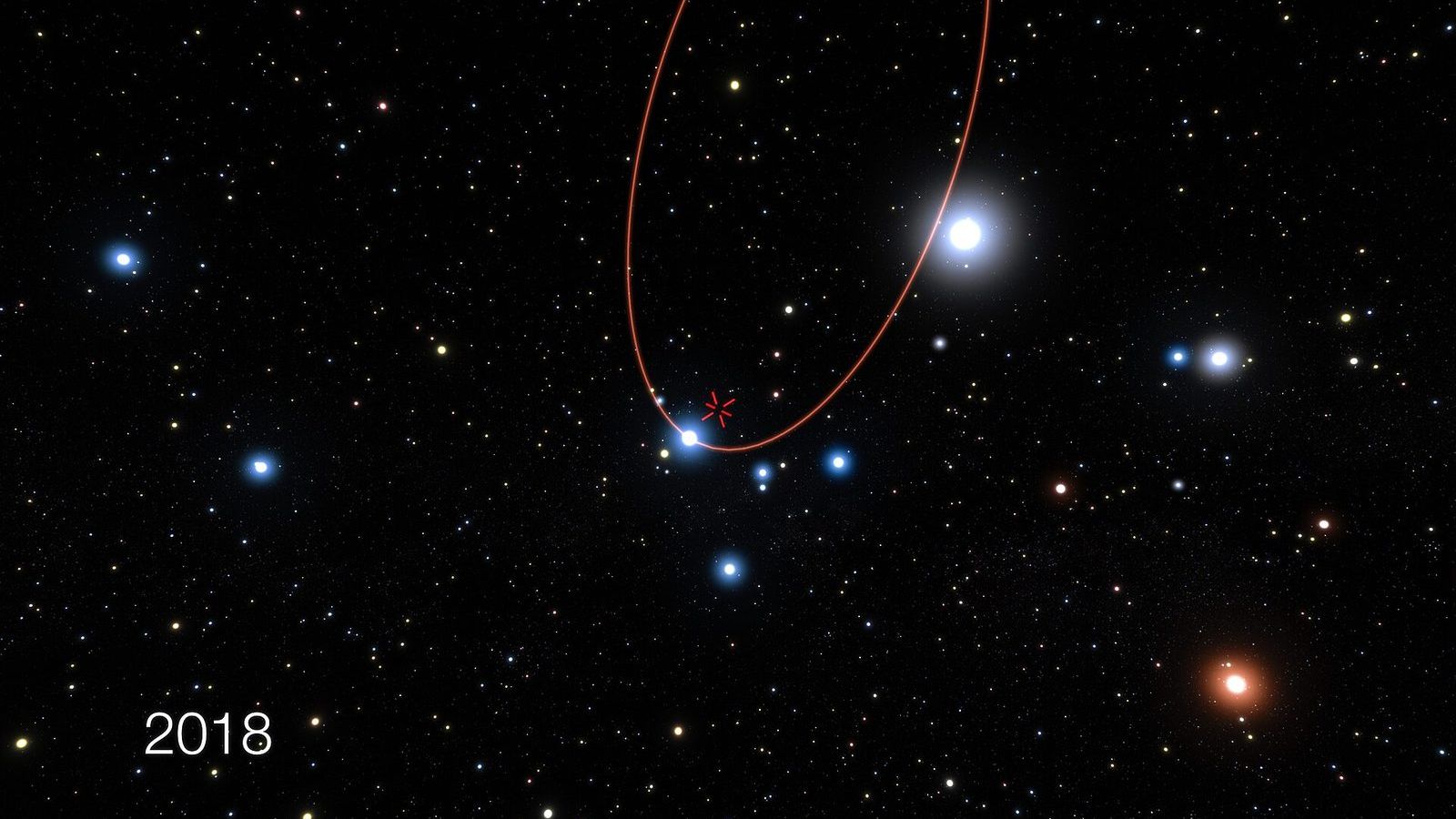
At the centre of the Milky Way, 27,000 light years away behind a wall of dust that blocks all visible light, a star called S2 orbits something invisible. Its orbit takes 16.05 years and is a long ellipse, and at its closest point, in May 2018, the star passed within 120 astronomical units of the centre at 7,650 kilometres per second, 2.55 per cent of the speed of light. From the orbit alone, Kepler's third law gives the mass of the invisible object: 4.3 million times the mass of the Sun, in a volume small enough that the only known explanation is a black hole. Two groups have followed this star for nearly thirty years, and their leaders, Reinhard Genzel and Andrea Ghez, shared the Nobel Prize in Physics 2020 with Roger Penrose.
Thirty years of positions
The radio source at the galactic centre, Sagittarius A* (Sgr A* from here on), was found in 1974. Whether it was a black hole was an open question until the 1990s, when infrared cameras and telescopes of 8 to 10 metres made it possible to see individual stars within a few light-months of it through the dust. Genzel's group at the Max Planck Institute for Extraterrestrial Physics began measuring their positions in 1992 with the New Technology Telescope in Chile and later with the Very Large Telescope. Ghez's group at the University of California, Los Angeles began in 1995 with the Keck telescopes in Hawaii. S2, called S0-2 by the Los Angeles group, turned out to be the star with the shortest well-measured orbit, and by 2002 both groups had followed it through its first pericentre passage and shown that the mass inside its orbit was several million solar masses.
Seeing the star at all requires correcting for the atmosphere. Adaptive optics measures the blurring of the air hundreds of times a second and bends a deformable mirror to cancel it, and with it the big telescopes reach their diffraction limit, about 50 milliarcseconds in the infrared. In 2016 the GRAVITY instrument began combining the four 8-metre telescopes of the Very Large Telescope as an interferometer, which improved the positions to a few tens of microarcseconds, a thousand times better and about the apparent size of a grapefruit on the Moon. The second pericentre passage, in 2018, was watched with that instrument.
What was measured in 2018
The test was the gravitational redshift. Light leaving the star near pericentre has to climb out of the black hole's potential, and its wavelength is stretched. On top of that, the star's speed of 7,650 kilometres per second produces the transverse Doppler shift of special relativity, which is the same slowing of a moving clock that the light clock gives, and the two effects together amount to an extra apparent recession velocity of about 200 kilometres per second over and above the ordinary Doppler shift of the orbit. Newtonian physics predicts zero for this extra term.
The GRAVITY collaboration measured the star's radial velocity through the passage with the SINFONI spectrograph and its position with the interferometer, fitted the whole orbit, and found the relativistic term with a strength of \(0.90 \pm 0.17\) times the prediction of general relativity, where zero would be Newton. The paper is Detection of the gravitational redshift in the orbit of the star S2 near the Galactic centre massive black hole, published in Astronomy and Astrophysics in July 2018. The Los Angeles group, with Keck data, confirmed it in 2019. This was the first test of the redshift with a clock orbiting a black hole, and a star is a fine clock, because the spectral lines of hydrogen and helium in its atmosphere have known rest wavelengths.
The orbit that does not close
The second test came in 2020. The same precession that moves Mercury's perihelion by 43 arcseconds a century, described in its own article, moves the pericentre of S2 by 12 arcminutes per orbit, 17,000 times more per orbit than Mercury, because the central mass is four million times larger and the pericentre distance is only about 1,400 Schwarzschild radii. The formula is the one from the Schwarzschild metric,
\[ \Delta\phi = \frac{6\pi GM}{c^2 a(1 - e^2)}, \]with a semi-major axis of about 1,000 astronomical units and an eccentricity of 0.885, and the GRAVITY data over the whole 2017 to 2019 passage gave the precession at \(1.10 \pm 0.19\) times the predicted value, in the paper Detection of the Schwarzschild precession in the orbit of the star S2. Had there been a large amount of unseen mass, such as a cluster of dark stars, spread within the orbit of S2, the precession would have been reduced or reversed, and the measurement limits any such mass to a small fraction of a per cent of the black hole.
What is at the centre
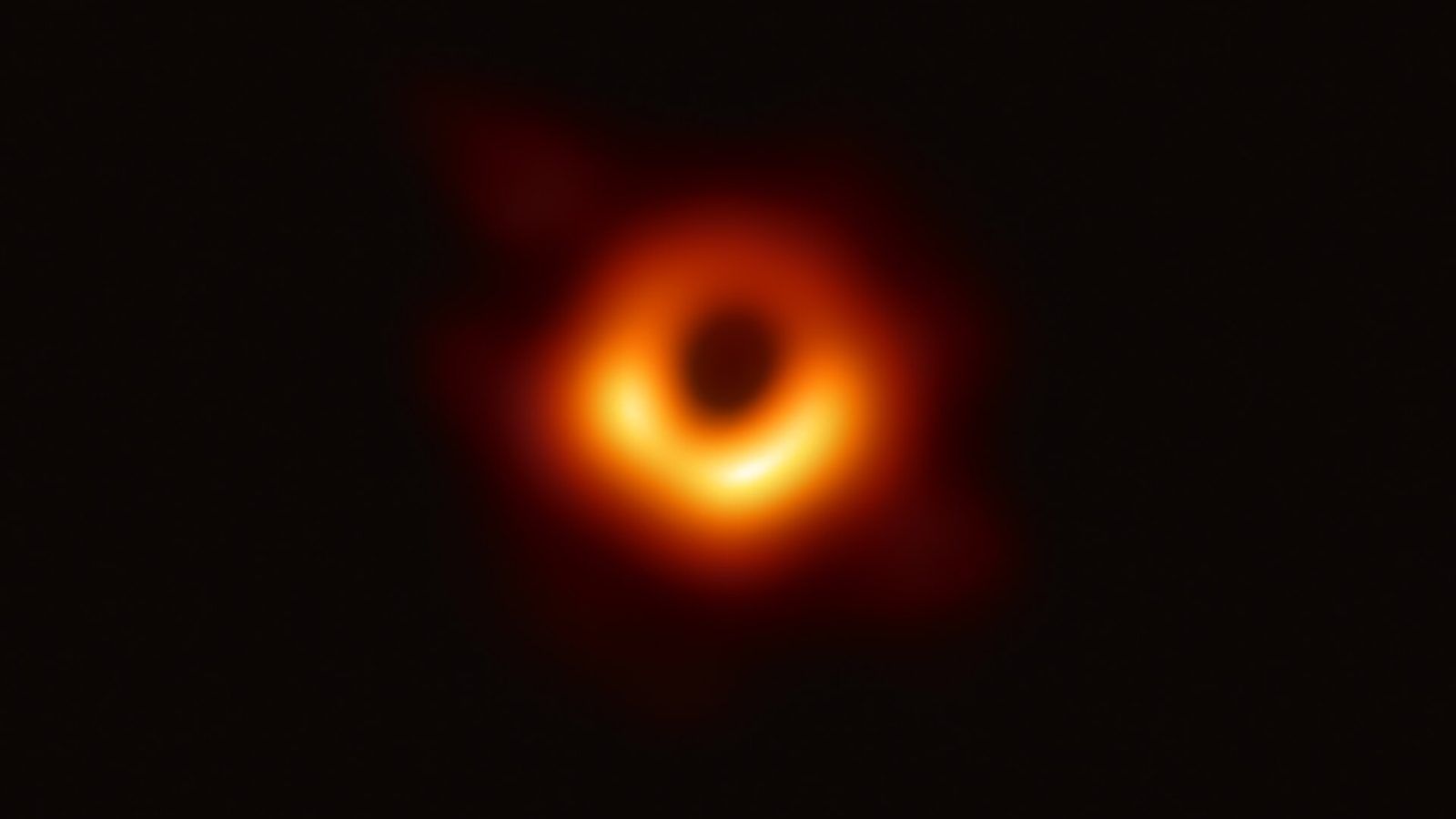
By 2022 the combined data put the mass of Sgr A* at 4.30 million solar masses, with an uncertainty of under one per cent, and the distance at 8.28 kiloparsecs, 27,000 light years. The Schwarzschild radius of that mass is 12.7 million kilometres, 0.085 astronomical units, eighteen solar radii. S2 at pericentre is 1,400 times further out than that, so it probes the field where general relativity's corrections are of order \(v^2/c^2 \approx 6 \times 10^{-4}\), a thousand times stronger than at Mercury but still in the weak-field regime. In May 2022 the Event Horizon Telescope published an image of Sgr A* itself with a ring 52 microarcseconds across, which at that distance is the size the shadow of a 4.3 million solar mass black hole should have. The star and the picture agree, and the article on the M87* image explains what the ring is.
The Nobel citation of 2020 gave half the prize to Genzel and Ghez "for the discovery of a supermassive compact object at the centre of our galaxy" and the other half to Penrose for showing in 1965 that black holes are an unavoidable consequence of general relativity. The summary on the Nobel Prize site tells the story in two pages. The star S2 will next pass pericentre in 2034, and GRAVITY, now upgraded, will measure the precession again with ten times the precision. Unit 12 of the masterclass uses S2 as its main worked example, from Kepler's law for the mass to the redshift at pericentre.