 Image: Event Horizon Telescope Collaboration (CC BY 4.0)
What the first black hole picture shows
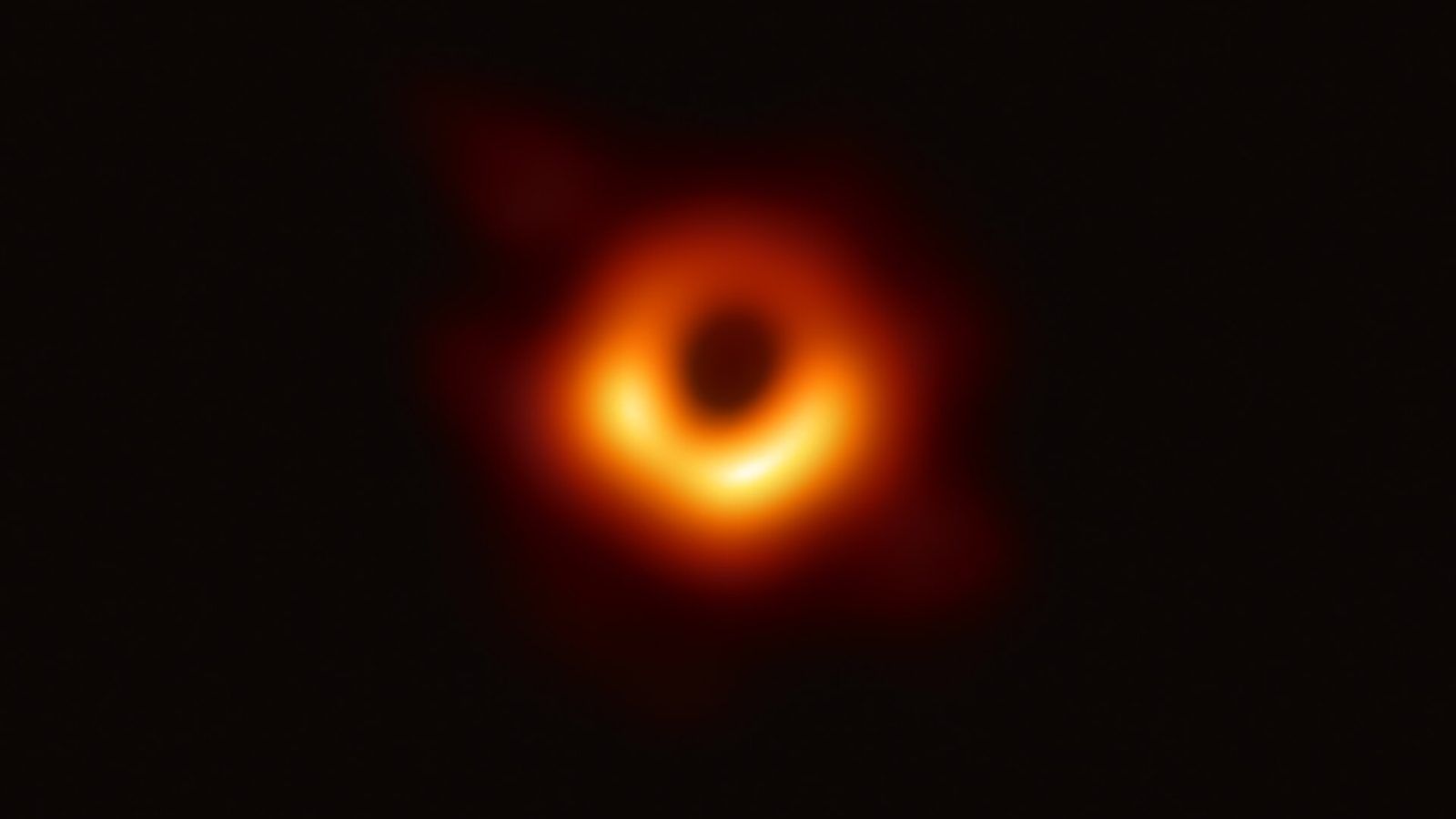
On 10 April 2019, in six press conferences held at the same moment in Brussels, Santiago, Shanghai, Taipei, Tokyo, and Washington, the Event Horizon Telescope (EHT) collaboration showed a picture of a bright ring with a dark centre. The ring is the black hole at the middle of the galaxy Messier 87, 55 million light years away, and it is 42 microarcseconds across. An arcsecond is 1/3,600 of a degree, and a microarcsecond is a millionth of that, so the ring is about the angle a tennis ball would take up on the Moon. No telescope on Earth can see something that small on its own. This article explains what the picture is a picture of, and how it was taken.
Why a black hole has a shadow
A black hole is black, and the gas around it is bright, so the natural guess is that the picture shows glowing gas with a black ball in the middle. The real geometry is stranger. Far from the hole, light travels in straight lines. Close to it, the Schwarzschild metric bends light so much that at a radius of 1.5 Schwarzschild radii a ray can go round the hole in a circle. That surface is the photon sphere. Any ray that comes in closer than that, from any direction, spirals in and is lost. The result is that an observer far away sees a dark disc, called the shadow, that is larger than the horizon itself. For a non-rotating hole the diameter of the shadow is \(2\sqrt{27}\,GM/c^2\), about 5.2 Schwarzschild radii, or 2.6 times the diameter of the horizon.
The gas around M87* orbits in a thick, hot disc and glows at radio wavelengths. Light from the gas just outside the photon sphere is bent around the hole and reaches us from every side, so the edge of the shadow is lit up as a ring. That is the orange ring in the picture. The dark patch inside it is the shadow, and the horizon is somewhere inside the dark patch, at less than half the shadow's diameter, invisible by definition.
The numbers behind the ring
The mass of M87* was known before the picture from the motion of stars near the centre of the galaxy, which gave about 6.2 billion solar masses, and from the motion of the gas, which gave about 3.5 billion. The Schwarzschild radius of a 6.5 billion solar mass hole is 6.5 billion times the Sun's 2.95 kilometres, which is 19 billion kilometres, about 130 times the distance from the Earth to the Sun. The shadow is 5.2 times that, 100 billion kilometres. At a distance of 16.8 megaparsecs, which is \(5.2 \times 10^{20}\) kilometres, that is an angle of
\[ \theta = \frac{1.0 \times 10^{11}\ \mathrm{km}}{5.2 \times 10^{20}\ \mathrm{km}} = 1.9 \times 10^{-10}\ \mathrm{rad} = 40\ \text{microarcseconds}. \]The measured ring is \(42 \pm 3\) microarcseconds, and from it the collaboration derived a mass of \(6.5 \pm 0.7\) billion solar masses, which agreed with the stellar measurement and settled the disagreement with the gas measurement. The ring is a little larger than the bare shadow because the glowing gas sits slightly outside the photon sphere, and the collaboration ran thousands of simulations of gas around spinning and non-spinning black holes to calibrate the step from ring size to mass. The six papers that describe all of this were published together in The Astrophysical Journal Letters on the day of the announcement.
The ring is brighter at the bottom than at the top. That is the Doppler effect of the orbiting gas: the gas on the side moving towards us is brightened and the gas moving away is dimmed, by the same relativistic beaming that Unit 5 derives for a moving source. The brightness pattern tells the collaboration which way the material circles the hole: clockwise as seen from Earth, with the axis of rotation pointing about 17 degrees away from our line of sight. The famous jet of M87, which stretches 5,000 light years out of the galaxy, points along that axis.
A telescope the size of the Earth
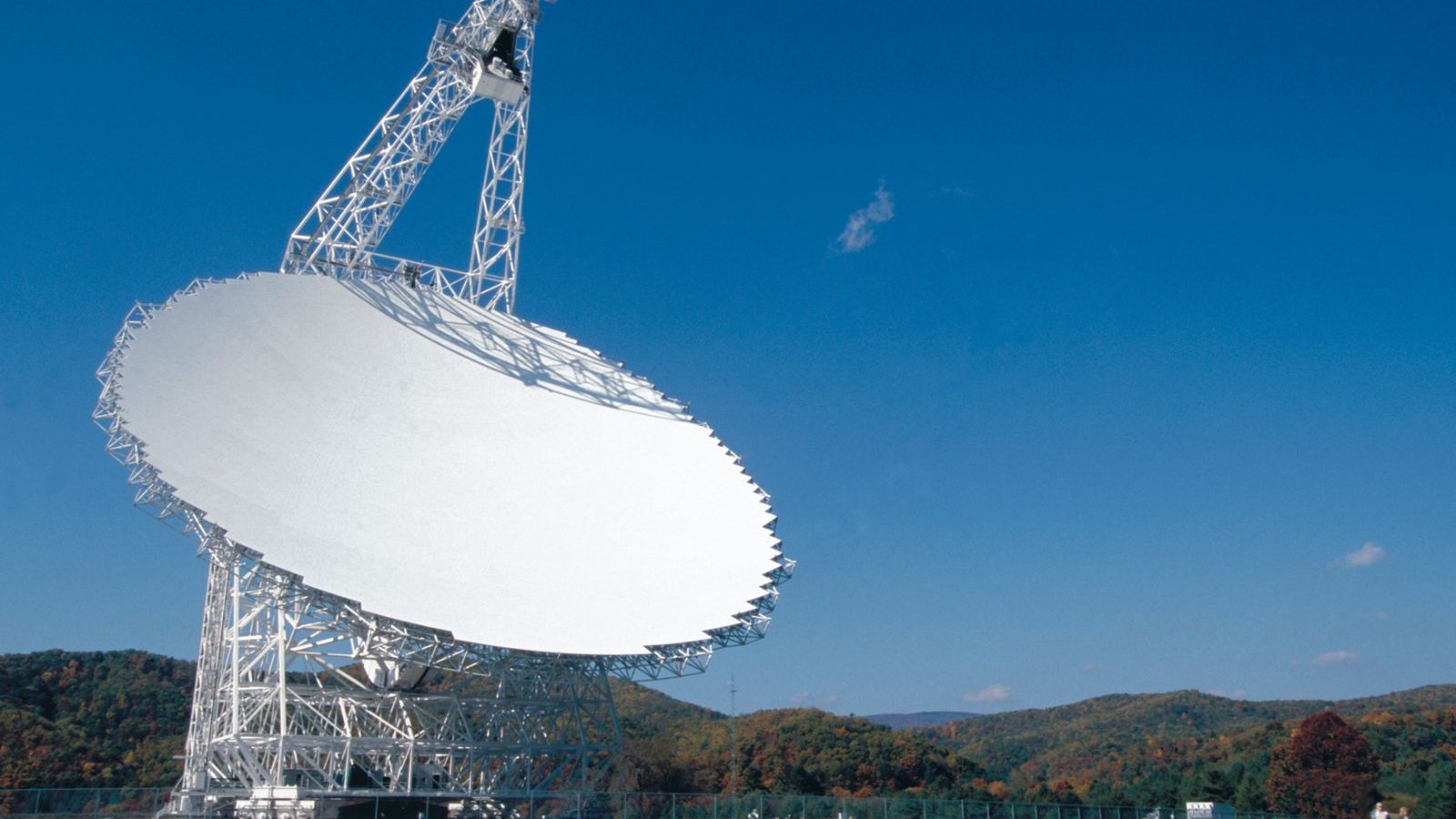
The resolution of a telescope is set by the wavelength divided by the aperture. To see 20 microarcseconds at a wavelength of 1.3 millimetres you need an aperture of about 10,000 kilometres, roughly the diameter of the Earth. No dish of that size will ever be built, so the EHT combines radio telescopes on different continents into one instrument. Each telescope records the incoming radio waves with a time stamp from a hydrogen maser clock, and the recordings are combined later in a computer, as if the signals had met at a single focus. The technique is called very long baseline interferometry, and radio astronomers have used it since the 1960s; the EHT pushed it to a wavelength short enough to see through the gas around the hole.
The M87* data were taken over four nights between 5 and 11 April 2017 by eight telescopes at six sites: the ALMA array and the APEX dish in the Atacama Desert of Chile, the IRAM 30 metre telescope in the Sierra Nevada of Spain, the James Clerk Maxwell Telescope and the Submillimeter Array on Mauna Kea in Hawaii, the Large Millimeter Telescope on a volcano in Mexico, the Submillimeter Telescope in Arizona, and the South Pole Telescope. The observations produced about five petabytes of data, far too much to send over the internet, so the hard drives were flown to the correlators at the Massachusetts Institute of Technology's Haystack Observatory and at the Max Planck Institute for Radio Astronomy in Bonn. The drives from the South Pole could only leave after the Antarctic winter, in December 2017. The picture itself took another year, because four independent teams reconstructed the image separately, without talking to each other, to make sure that the ring was in the data and not in anyone's expectations. The ESO press release of the day lists all the partners.
What the picture tests
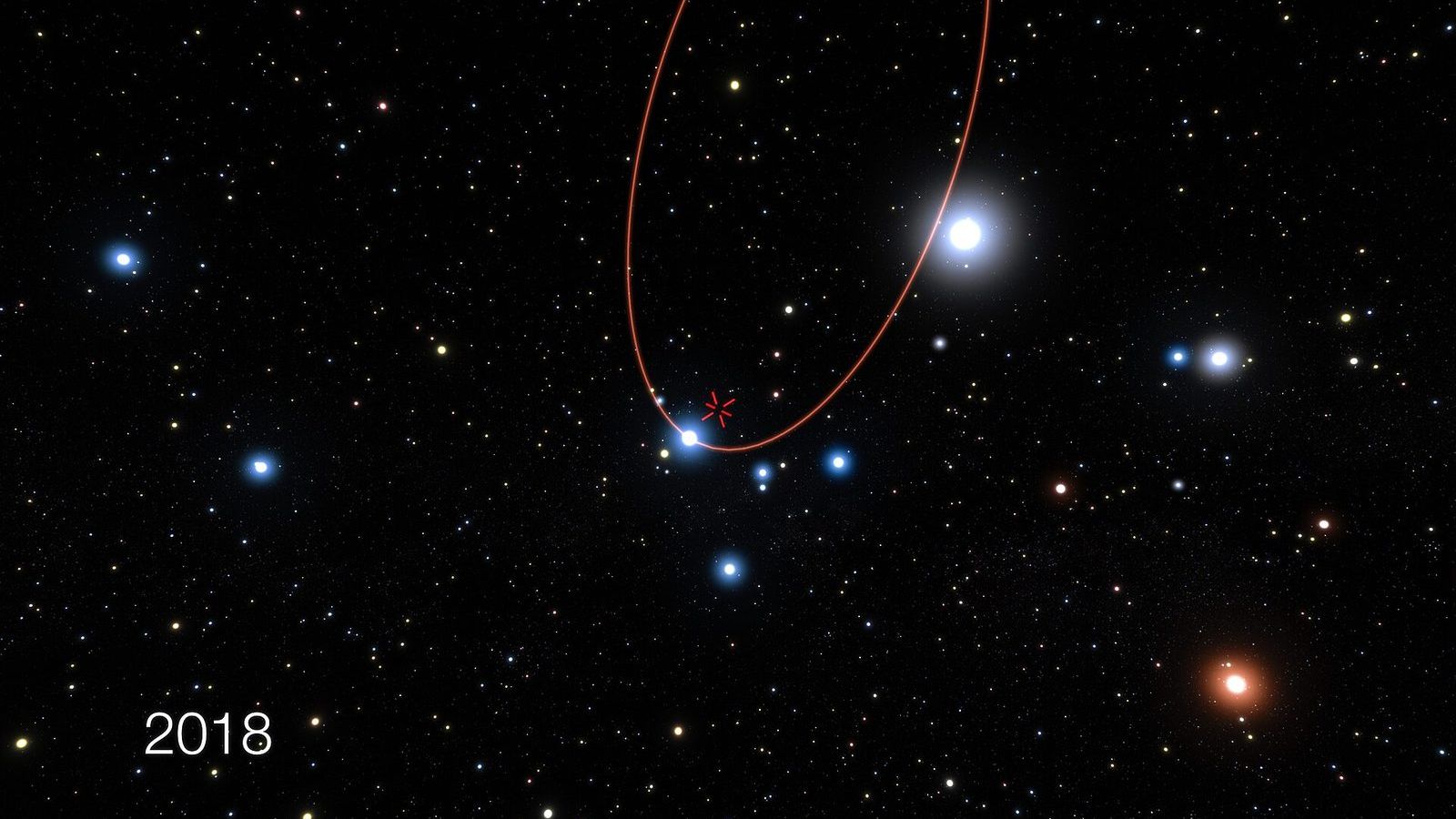
The shadow is a prediction of general relativity in the strong field, where the corrections to Newton's gravity are of order one rather than parts in a million. The size of the shadow depends only on the mass and, slightly, on the spin, so once the mass is known from stars the shadow is a test with no free parameters. The measured ring was consistent with the Schwarzschild and Kerr predictions, and in later work the collaboration used it to limit the possible deviations from the Kerr metric. The picture also shows that the thing at the centre of M87 is compact enough to have a photon sphere, which rules out most alternatives to a black hole that had been proposed for the object. Together with the star S2, whose orbit around the Milky Way's black hole is the subject of another article, and with the gravitational waves of merging black holes, it is one of three independent ways in which black holes are now observed.
The second picture
On 12 May 2022 the collaboration published the ring of Sagittarius A*, the black hole at the centre of our own galaxy, from the same April 2017 observing run. It is 52 microarcseconds across. The hole is 1,500 times less massive than M87*, at 4 million solar masses, but it is also 2,000 times closer, at 27,000 light years, so the two rings have almost the same angular size, and the comparison is a direct check that the shadow scales with mass divided by distance as the formula says. Sagittarius A* was the harder target, because the gas around a 4 million solar mass hole orbits in minutes rather than days, and the picture changed while the telescopes watched it. The announcement explains how the collaboration averaged over that variability.
Unit 12 of the masterclass derives the photon sphere and the shadow diameter from the Schwarzschild metric and works through the M87* calculation above as one of its examples. What a falling observer would experience, as opposed to what a distant one sees, is the subject of the article on the event horizon.