 Image: Amber Stuver (CC BY-SA 4.0)
The clearest gravitational wave yet
On 14 January 2025, at 08:22:03 UTC, the two LIGO detectors recorded a chirp that lasted about a quarter of a second and stood out of the noise with a signal-to-noise ratio of about 80. The first detection, GW150914, had reached 24, and no event in the ten years between had passed 42. The source was almost a twin of the first one: two black holes of about 33 solar masses each, merging into one of 63. What the extra loudness bought was precision, and with it two tests that had been out of reach, one of a theorem Stephen Hawking proved in 1971 and one of the shape of a black hole's ringing. The results were published in Physical Review Letters on 10 September 2025.
The event
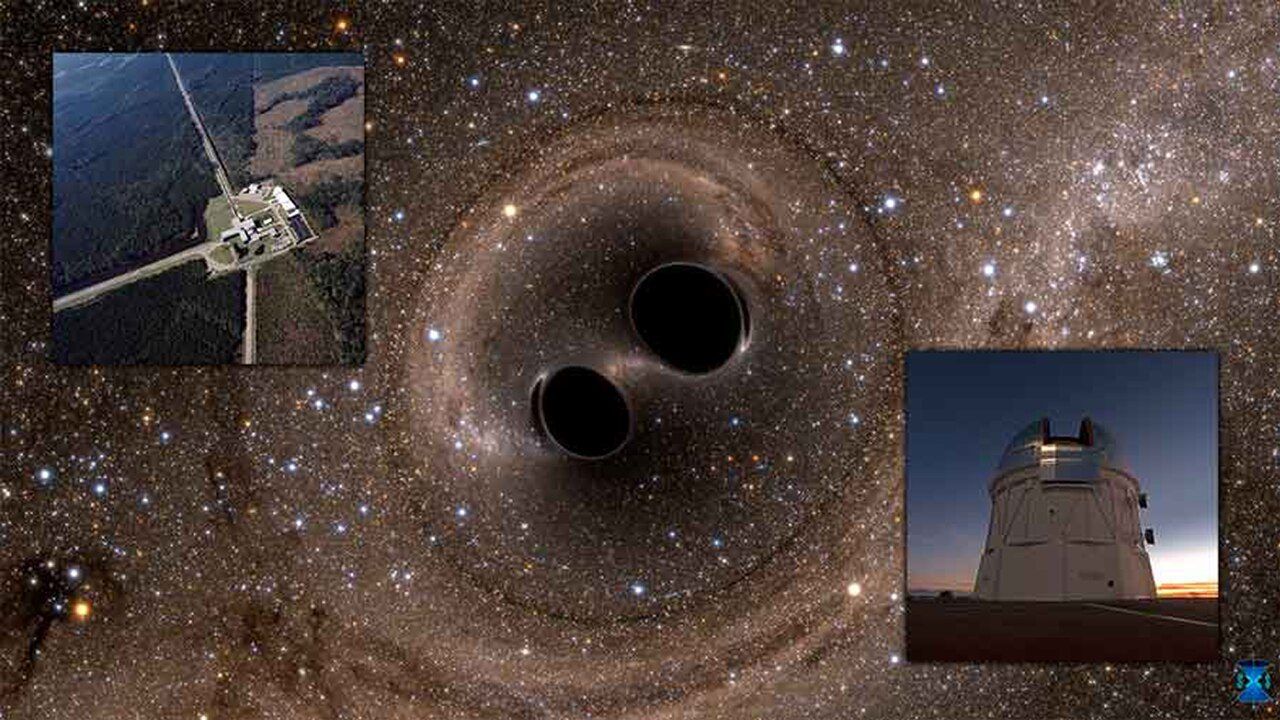
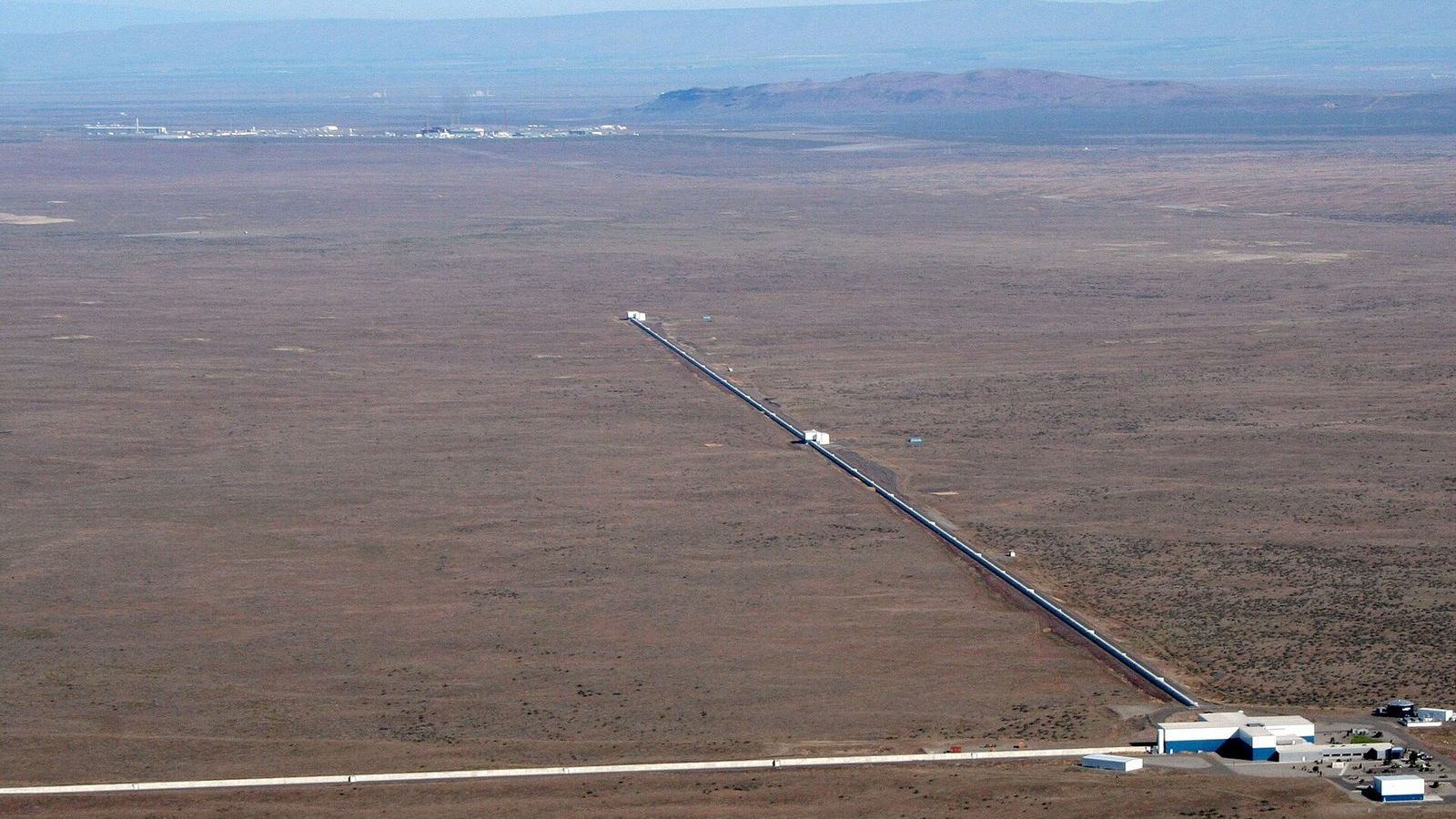
The signal was seen by LIGO Hanford and LIGO Livingston; Virgo and KAGRA were not observing that morning. The fitted masses are \(33.6^{+1.2}_{-0.8}\) and \(32.2^{+0.8}_{-1.3}\) solar masses, nearly equal, with spins of at most a quarter of the maximum a black hole can have and an orbit that was circular by the time it entered the band. The final black hole has \(62.7^{+1.0}_{-1.1}\) solar masses and a spin of 0.68 of the maximum; about 3 solar masses were radiated away. The redshift is 0.09, which puts the source about 1.3 billion light years away, within a few per cent of the distance of GW150914. The analysis is in GW250114: Testing Hawking's Area Law and the Kerr Nature of Black Holes, which is free on arXiv, and the LIGO Laboratory's announcement walks through it in plain language.
Why was this event so much clearer than the first? The source was no closer and no heavier. The detectors were better. Between 2015 and 2025 the LIGO instruments went through two major upgrades, and by the fourth observing run their range for a pair of 30 solar mass black holes had roughly doubled, with much of the gain at the frequencies where the merger and ringdown happen. The improvements are the ones the article on LIGO describes: higher laser power, better mirror coatings, and squeezed light, which since 2023 has been applied in a frequency-dependent form that reduces quantum noise across the whole band at once. Louder events are also rarer, and ten years of observing bought the chance of one.
Hawking's area theorem
In 1971 Hawking proved from general relativity that the total area of the event horizons of black holes can never decrease, whatever happens to them, as long as matter has positive energy. Two black holes may merge, and the one that results may have less mass than the two together, because energy leaves as gravitational waves, but its horizon area must still be at least the sum of the two original areas. The theorem has a close relative in thermodynamics: the area of a black hole behaves like an entropy, and Jacob Bekenstein and Hawking turned that into a formula a few years later. A merger is a direct test, because the areas before and after can both be measured.
The area of a black hole's horizon depends on its mass and spin. For a non-rotating hole of mass \(M\) it is \(16\pi (GM/c^2)^2\), four times the area of a sphere of one Schwarzschild radius; a spinning hole of the same mass has a smaller horizon, down to half that area at the maximum spin. For GW250114 the two initial black holes, almost non-rotating, had a combined area of about 240,000 square kilometres, roughly the area of the United Kingdom. The final hole, heavier but spinning at 0.68 of the maximum, has about 400,000 square kilometres. The area grew, as the theorem says it must, and it grew by more than the mass loss alone would suggest, because the spin acquired from the orbit shrinks the horizon less than the added mass enlarges it.
The test is only as good as the two area measurements. The initial masses and spins come from the inspiral, the final mass and spin from the ringdown, and the two parts of the signal have to be analysed separately so that the comparison is honest. For GW150914 that had been done in 2021, and the area was found to increase with 95 per cent confidence, which is to say that the data left a one-in-twenty chance that it had not. For GW250114 the confidence is 99.999 per cent. The LIGO team also checked that the conclusion holds when the loudest cycles around the merger are left out of the analysis entirely, so that the result rests on the inspiral and the ringdown alone.
The ringing of a Kerr black hole
When the two black holes merge, the result is at first a misshapen horizon that settles down to the final shape by radiating away its lumps, the way a struck bell settles into a pure tone. General relativity predicts the tones. A black hole described by Roy Kerr's solution of 1963 rings at a set of frequencies, each decaying at its own rate, and both the frequencies and the decay rates are fixed by the mass and the spin alone, with nothing else to adjust. This is the no-hair theorem in audible form: a black hole has no property beyond mass, spin, and charge, so its spectrum has no free parameters.
A ringdown had been seen before, but only its loudest tone, which gives one frequency and one damping time, two numbers to fix the two unknowns of mass and spin, leaving nothing over to test. GW250114 is the first event loud enough for a second tone to be identified with confidence, the first overtone of the dominant mode, found at a significance of 4.1 standard deviations. Two tones give four numbers, and the test is whether all four come from one Kerr black hole with one mass and one spin. They do: the frequencies and decay rates are consistent with the Kerr prediction, and any deviation of the mode frequencies from it is limited to about 30 per cent. A second paper, Black Hole Spectroscopy and Tests of General Relativity with GW250114, pushed this further and found the signal consistent with general relativity in every test applied to it.
What one loud event is worth
More than three hundred mergers have been catalogued since 2015, and most of what is known about the population of black holes, their masses, spins, and merger rate, comes from the statistics of the faint majority. The physics of a single horizon, though, is tested by the loud few, because the ringdown is the quietest part of any signal and the first to vanish into the noise. A detector of the next generation, such as the Einstein Telescope planned in Europe or Cosmic Explorer in the United States, would record a GW250114 with a signal-to-noise ratio in the thousands, and several tones at once, which would turn black hole spectroscopy from a single result into a routine measurement.
Unit 12 of the masterclass states the area theorem and checks it on the published masses of GW150914 as a worked example, with GW250114 as the sharper test in one sentence; Unit 14 covers the ringdown and the no-hair test, and lists GW250114 among the events of the catalogue as the loudest.