 Image: SXS, LIGO Laboratory, and T. Abbott, NOAO/AURA/NSF (CC BY 4.0)
The sound of two black holes merging
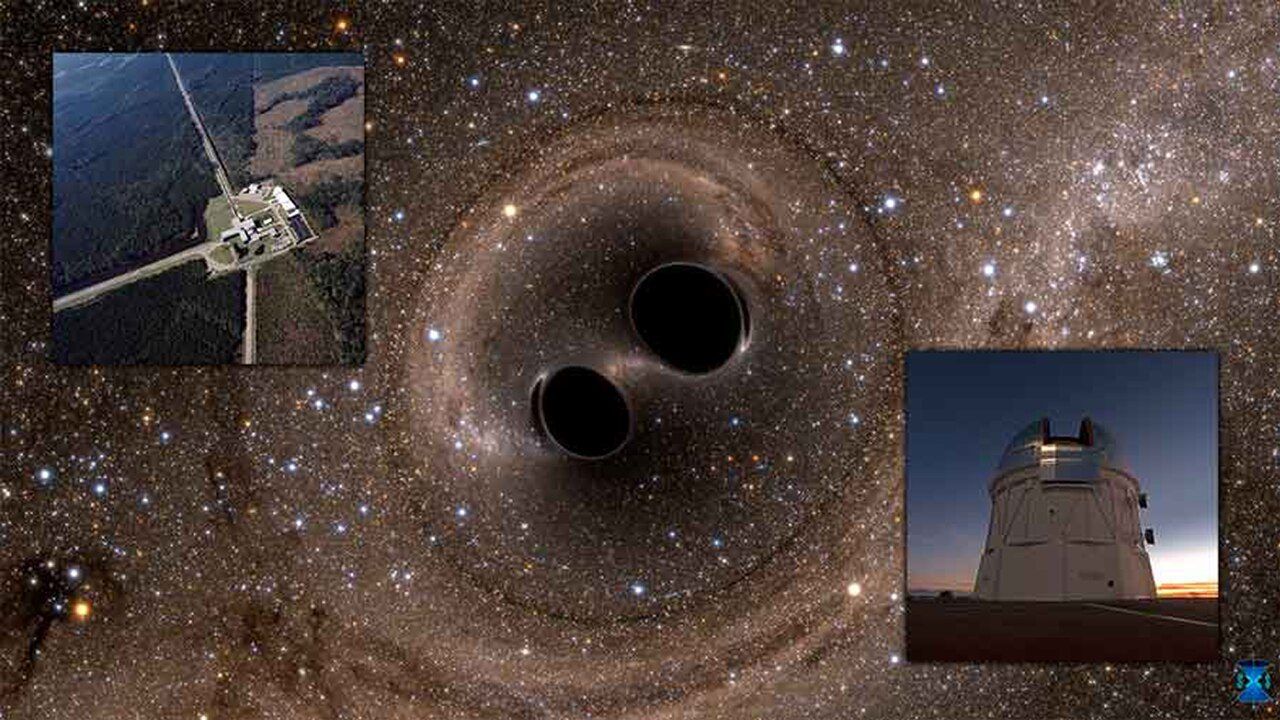
At 09:50:45 UTC on 14 September 2015 the LIGO detector in Livingston, Louisiana, recorded a wobble in the length of its arms that lasted about a fifth of a second. The detector in Hanford, Washington, recorded the same wobble 6.9 milliseconds later. The wobble rose in frequency from 35 hertz to about 250 hertz and in amplitude at the same time, then died away in a few cycles. Played through a loudspeaker, it is a short upward whoop, and the LIGO team called it a chirp. Everything that is known about the source, two black holes 1.3 billion light years away, was read off that chirp. This article reads it line by line.
What the detector recorded
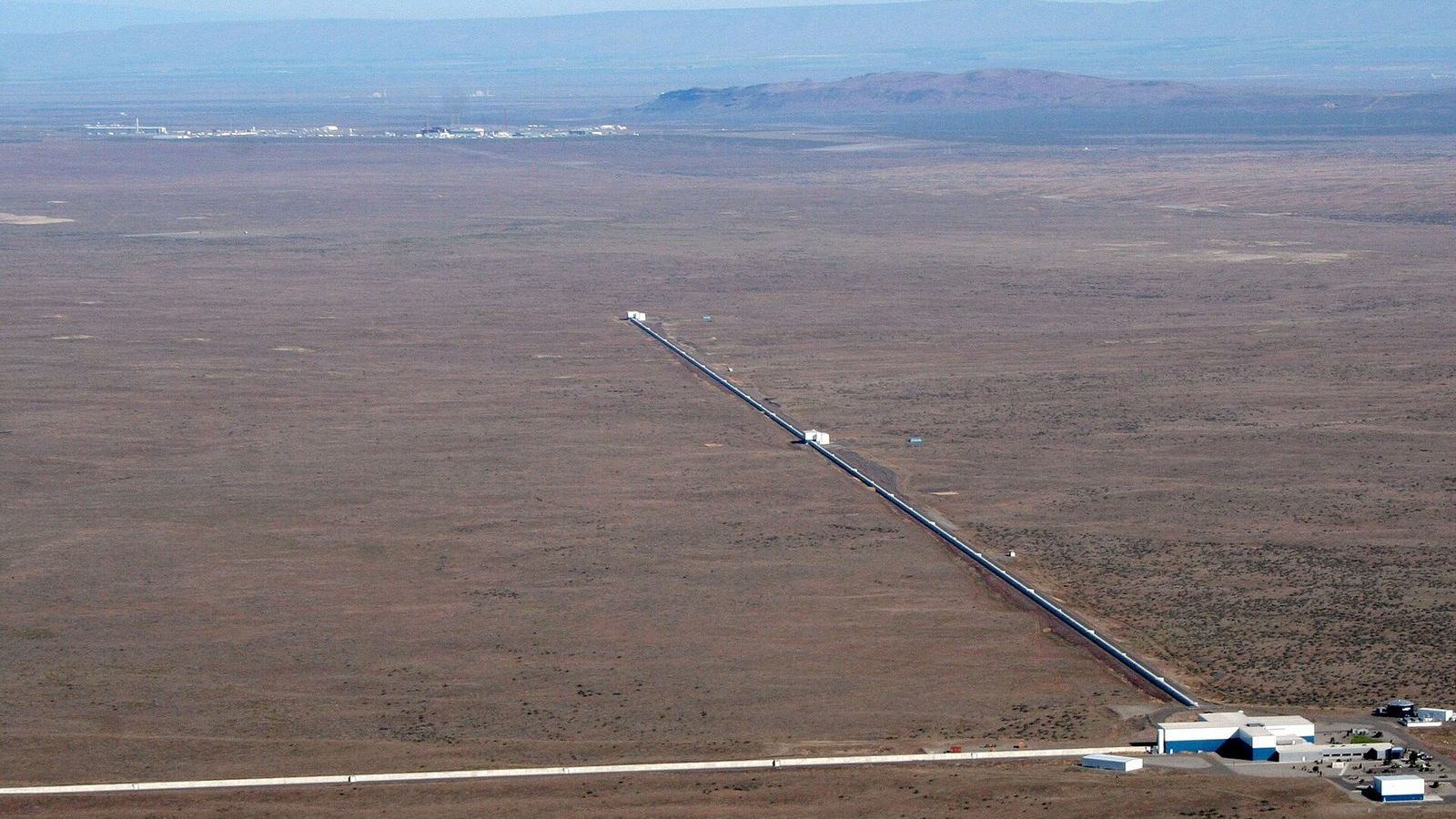
A gravitational wave stretches space in one direction and squeezes it in the perpendicular direction, and reverses half a cycle later. LIGO's two arms are 4 kilometres long and at right angles, so a wave makes one arm longer and the other shorter, and the detector measures the difference, which is the strain \(h\) multiplied by the arm length. The peak strain of GW150914 was \(1.0 \times 10^{-21}\). Over 4 kilometres that is a change of \(4 \times 10^{-18}\) metres, about one four-hundredth of the diameter of a proton; the article on LIGO explains how that can be measured at all. The two detectors are 3,002 kilometres apart, so a wave travelling at the speed of light needs up to 10 milliseconds to cross from one to the other, and the 6.9 milliseconds say that the source was closer to the direction of Livingston than of Hanford, somewhere in a ring on the southern sky.
Reading the frequency
Two masses in orbit emit gravitational waves at twice their orbital frequency, because the mass distribution repeats itself every half turn. A wave at 35 hertz therefore means an orbit of 17.5 turns per second, and at 250 hertz the objects were circling each other 125 times a second. As they lose energy to the waves, the orbit shrinks and speeds up, and the frequency rises faster and faster. General relativity gives the rate of that rise, and it depends on only one combination of the two masses, called the chirp mass:
\[ \mathcal{M} = \frac{(m_1 m_2)^{3/5}}{(m_1 + m_2)^{1/5}}, \qquad \dot{f} = \frac{96}{5}\,\pi^{8/3}\left(\frac{G\mathcal{M}}{c^3}\right)^{5/3} f^{11/3}. \]Measure the frequency at two moments, which gives \(f\) and \(\dot{f}\), and the chirp mass follows. For GW150914 it comes out at about 30 solar masses as seen by the detector, or 28 in the source's own frame once the cosmological redshift of the signal is allowed for. The chirp mass fixes the product and sum of the masses only in combination; the full fit to the waveform, including how fast the amplitude grew and how the signal ended, gives \(36^{+5}_{-4}\) and \(29 \pm 4\) solar masses. Put those two numbers into the formula above and you get 28, which is the check the masterclass asks you to do.
Why only black holes fit
The frequency peaked near 250 hertz, which is an orbital frequency of 125 hertz. Kepler's third law, which still holds roughly at this stage, gives the separation of two bodies with a total mass of 65 solar masses circling at that rate: about 350 kilometres between their centres. The Schwarzschild radius of a 36 solar mass object is 106 kilometres, and of a 29 solar mass object 86 kilometres, so the two bodies were orbiting at a separation of only about twice their own diameters, at a good fraction of the speed of light. Neutron stars have at most about 2 solar masses, and ordinary stars of 30 solar masses are millions of kilometres across and would have collided long before reaching 250 hertz. Nothing but a pair of black holes can be that heavy, that small, and that close.
The energy and the distance
The final black hole, found from the ringing of the signal after the peak, has a mass of \(62 \pm 4\) solar masses, which is 3 solar masses less than 36 plus 29. Those three solar masses, \(5 \times 10^{47}\) joules by \(E = mc^2\), were radiated as gravitational waves, most of them in the last 0.1 seconds. The peak power was about \(3.6 \times 10^{49}\) watts, which the LIGO announcement compared with the light of all the stars in the observable universe and found about fifty times larger. For that tenth of a second, this one event outshone everything else, in a form of radiation nobody had ever recorded.
The distance comes from the amplitude. The strain of an inspiralling binary at distance \(r\) depends on the chirp mass and the frequency, both of which are known from the chirp itself, and falls off as \(1/r\), so the measured \(10^{-21}\) gives \(r\). A binary is a standard siren: unlike a star, whose luminosity has to be calibrated from other stars, its intrinsic loudness is fixed by general relativity. The result was \(410^{+160}_{-180}\) megaparsecs, about 1.3 billion light years, with the large uncertainty coming mainly from not knowing the orientation of the orbit. The waves left their source when the most complex life on Earth was single cells.
How the team knew it was real
The signal arrived during an engineering run, four days before the first observing run of Advanced LIGO was due to begin, and an automatic search for unmodelled bursts flagged it within three minutes. The first worry was a test injection, a fake signal fed into the hardware to exercise the pipeline, and the team spent weeks confirming that no injection had been made. The second question was how often noise alone produces something this loud. The analysis slid the data of one detector against the other by many offsets larger than 10 milliseconds, so that any coincidence had to be chance, and found that a false signal as strong as GW150914 would occur less than once in 203,000 years, a significance above 5.1 standard deviations. The signal-to-noise ratio of 24 was high enough that the chirp is visible by eye in the filtered data, which is rare; most detections since are found only by matched filtering against a bank of template waveforms.
The discovery was announced on 11 February 2016 and published the same day in Physical Review Letters as Observation of Gravitational Waves from a Binary Black Hole Merger, a paper with about a thousand authors. Rainer Weiss, Barry Barish, and Kip Thorne received the Nobel Prize in Physics 2017 for the decades of work that led to it. The data themselves, 32 seconds around the event from both detectors, are on the Gravitational Wave Open Science Center with a tutorial that reproduces the published figure in a few dozen lines of Python.
What the chirp confirmed
Three things. Gravitational waves travel through space and can be measured directly, forty-one years after the Hulse-Taylor pulsar showed that they carry energy. Black holes of about 30 solar masses exist in pairs and merge, which stellar astronomers had not expected, because the known black holes in our galaxy are mostly 5 to 15 solar masses. And the merger itself, the part that no pen-and-paper calculation can follow, matched the waveform computed by numerical relativity, which had only been able to simulate a full merger since 2005. The loudest event so far, recorded in January 2025, has since tested that final stage far more sharply.
Unit 14 of the masterclass derives the chirp equation from the quadrupole formula, computes the chirp mass of GW150914 from the published frequencies, and works through the separation, energy, and distance estimates above as examples.