 Image: LIGO Laboratory (public domain)
How LIGO measures a four-hundredth of a proton
A gravitational wave with a strain of \(10^{-21}\), the size of the first one ever detected, changes the length of a 4 kilometre arm by \(2 \times 10^{-18}\) metres, and the difference between LIGO's two arms by twice that, \(4 \times 10^{-18}\) metres. A proton is about \(1.7 \times 10^{-15}\) metres across, so the detector has to notice a change of one four-hundredth of a proton in a distance of 4 kilometres, which is one part in \(10^{21}\). A measurement of that precision sounds impossible, and for most of the twentieth century physicists thought it was. This article goes through how it is done.
Michelson's instrument, enlarged
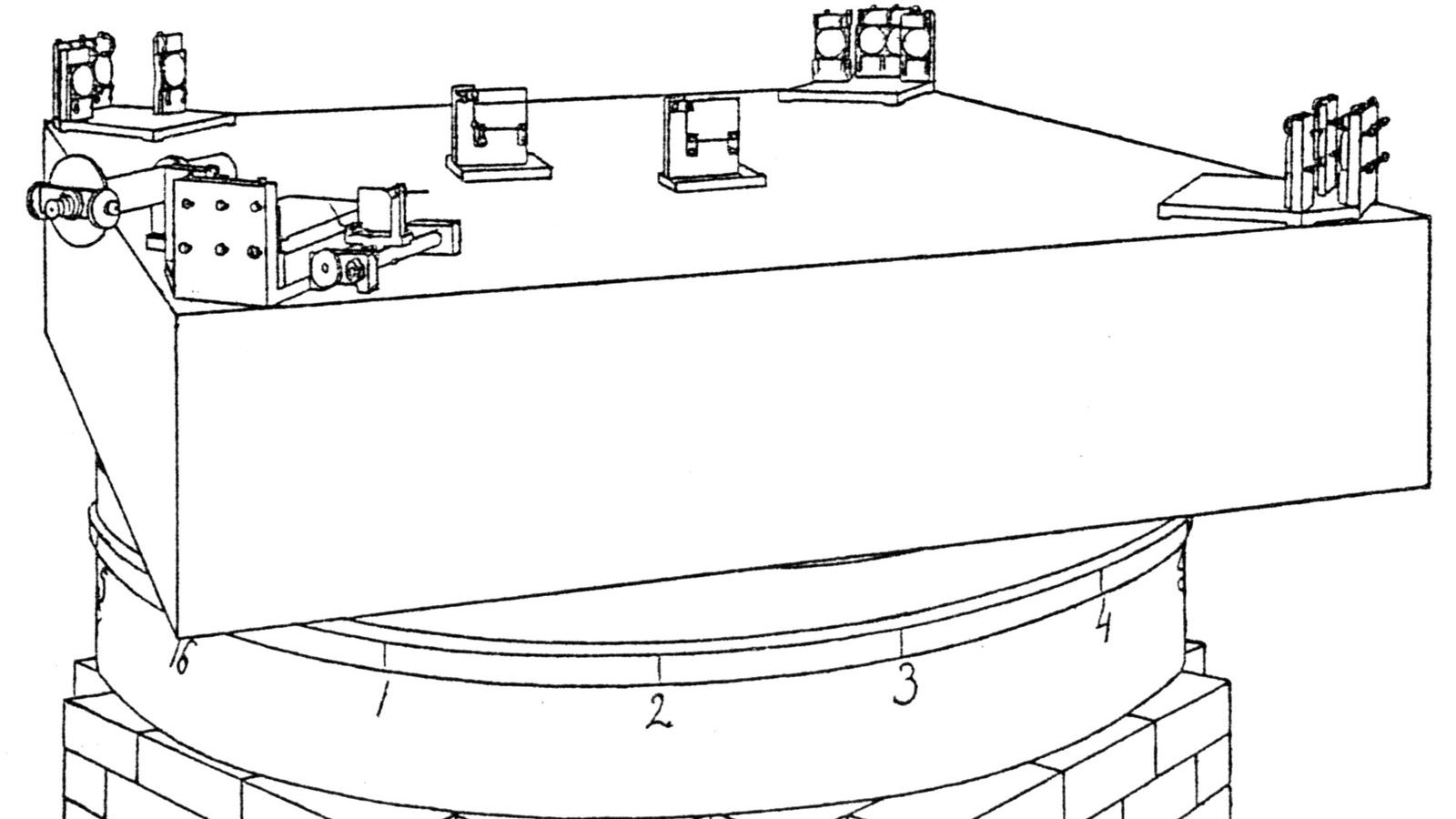
LIGO is a Michelson interferometer, the same design that Michelson and Morley used in 1887 to look for the ether. A laser beam is split in two at a half-silvered mirror, the two halves travel down two perpendicular arms, bounce off mirrors at the far ends, and come back to recombine. If the arms have exactly the right lengths the two returning waves cancel and the output is dark. If one arm becomes slightly longer than the other, the waves no longer cancel exactly and some light leaks out. The amount of light at the output measures the difference in arm lengths, in fractions of the wavelength of the laser.
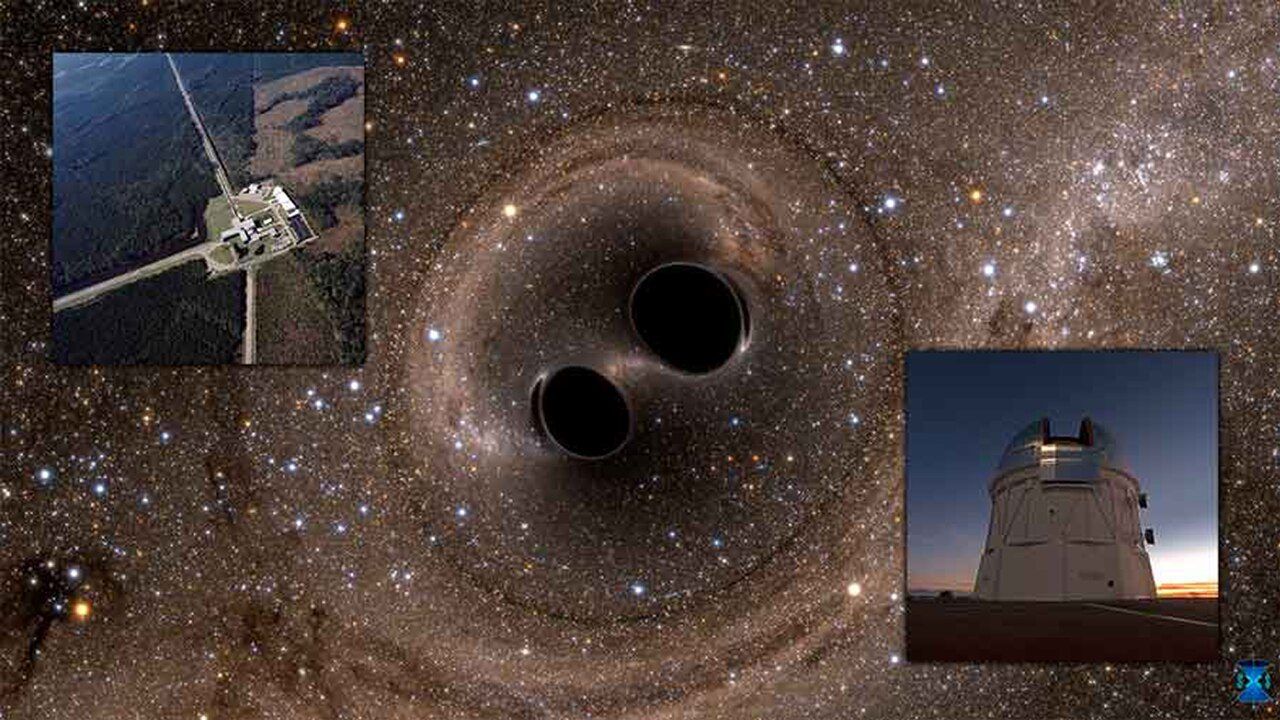
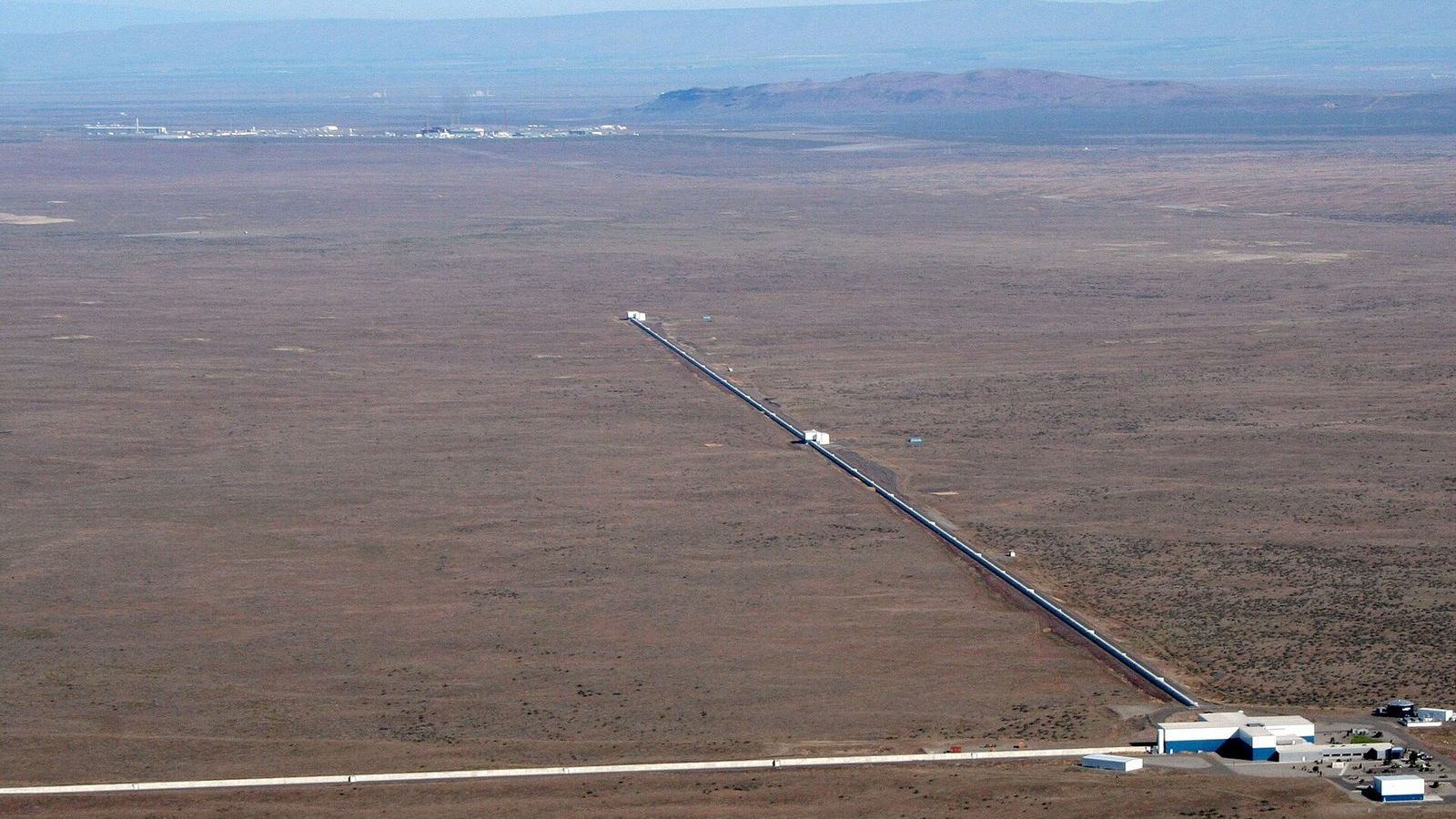
A gravitational wave passing through stretches one arm and squeezes the other, then reverses, at the wave's frequency, which for a merging pair of black holes is tens to hundreds of hertz. The output light flickers in step. The longer the arms, the larger the absolute change for a given strain, which is why LIGO's arms are 4 kilometres and not 4 metres. The two sites, Hanford in Washington state and Livingston in Louisiana, are 3,002 kilometres apart, so that a real wave appears in both within 10 milliseconds and a local disturbance appears in only one.
Three hundred round trips
Four kilometres is still short compared with the wavelength of a 100 hertz gravitational wave, which is 3,000 kilometres, so the arms are made optically longer. A second mirror near the beam splitter turns each arm into a Fabry-Perot cavity in which the light bounces back and forth about 300 times before it leaves, so the effective arm length is about 1,200 kilometres and the phase shift from a given strain grows by the same factor. A further mirror, the power recycling mirror, sends the light that comes back towards the laser into the interferometer again, so that although the laser supplies about 40 watts, several hundred kilowatts circulate in the arms. The design value for Advanced LIGO is 750 kilowatts. The light is infrared, at a wavelength of 1,064 nanometres, and the phase shift that GW150914 produced after 300 round trips was about \(10^{-8}\) radians, a hundred-millionth of a cycle. All of this happens in one of the largest vacuum systems in the world, 10,000 cubic metres of pipe at a trillionth of atmospheric pressure, because air would scatter the light and its density fluctuations would mimic a signal.
The noise budget
The hard part of the measurement is everything that moves the mirrors or the output light other than a gravitational wave. The LIGO engineers keep a noise budget, a plot of every known disturbance against frequency, and the detector's sensitivity curve is the sum of all of them. Three dominate.
Below about 10 hertz the ground moves. Traffic, waves on distant coasts, and the wind shake the Earth by a micrometre or so, \(10^{12}\) times more than the signal. The mirrors therefore hang as pendulums, and a pendulum driven above its natural frequency moves much less than its support, by a factor that grows as the square of the frequency ratio. LIGO's test masses hang at the bottom of a chain of four pendulums, each stage attenuating further, mounted on platforms that are themselves actively steadied by seismometers and actuators. Above 10 hertz the ground motion is reduced by a factor of \(10^{10}\) or more; below it, no detector on Earth can listen, which is why the millihertz band belongs to space missions and pulsars.
Between about 10 and 100 hertz the mirrors and their suspensions jiggle from their own heat. Every atom in a 40 kilogram mirror is vibrating, and the collective motion of its surface at room temperature is larger than the signal. The remedy is to make the mirrors of a material with very low internal friction, fused silica, hang them on thin fused silica fibres welded to the glass, and polish the surfaces so that the thermal motion is concentrated at the sharp resonances of the material, away from the frequencies where signals are expected.
Above a few hundred hertz the limit is the light itself. A laser beam is a stream of photons arriving at random, and the number arriving in any short interval fluctuates by the square root of that number; this is shot noise, and it is indistinguishable from a flicker caused by a wave. The only cure is more photons, which is why the circulating power is raised to hundreds of kilowatts. More power, though, means more radiation pressure kicking the mirrors at low frequency, and the trade-off between the two defines a limit called the standard quantum limit. Since 2019 LIGO has pushed below it with squeezed light, a state of the laser field in which the uncertainty in the photon number is reduced at the cost of a larger uncertainty in the phase, prepared in a separate optical cavity and injected at the output. The improvement is a factor of about 1.4 in strain at high frequency, and since the volume of space a detector can survey grows as the cube of its range, that is almost three times as many detectable events.
Finding the signal in the noise
Even with all of this, most signals are weaker than the noise at any single moment. They are found by matched filtering: the data are compared, moment by moment, with a bank of hundreds of thousands of template waveforms computed from general relativity for different masses and spins, and the comparison adds up the small match at every cycle of the signal. A chirp that lasts a hundred cycles can therefore be pulled out of noise that is ten times larger than it at any instant. The signal-to-noise ratio that the filter reports, 24 for GW150914, is the measure of how clearly it stands out; the Black Hole Hunter game from Cardiff University lets you try the same thing by ear and find out where your hearing gives up and the filter does not.
Whether a candidate is real is a separate question. The team shifts the data of the two detectors against each other by more than the 10 millisecond light travel time, many thousands of times, and counts how often noise alone produces a coincidence as loud as the candidate. For GW150914 the answer was less than once in 203,000 years. The two sites, Virgo in Italy, and KAGRA in Japan also allow a source to be located on the sky by triangulation, which is how the neutron star merger of 2017 was found by optical telescopes within hours.
From an idea to a detection
Rainer Weiss worked out the design and most of the noise budget above in a 1972 report at the Massachusetts Institute of Technology, written after he had tried to explain Joseph Weber's resonant bar detectors to his students and found that a laser interferometer should do better. Prototypes of a few metres were built at MIT, at Caltech under Ronald Drever, who added the Fabry-Perot arms, and in Garching and Glasgow. Construction of the two 4 kilometre sites began in 1994, the first version of LIGO ran from 2002 to 2010 without a detection, and the rebuilt Advanced LIGO found GW150914 within days of switching on in September 2015. The LIGO Laboratory describes the interferometer and its technology on its own pages in more detail than there is room for here.
Unit 15 of the masterclass derives the response of an arm to a wave, works out the phase shift and the shot-noise limit with the published powers, and explains the matched filter with one formula.