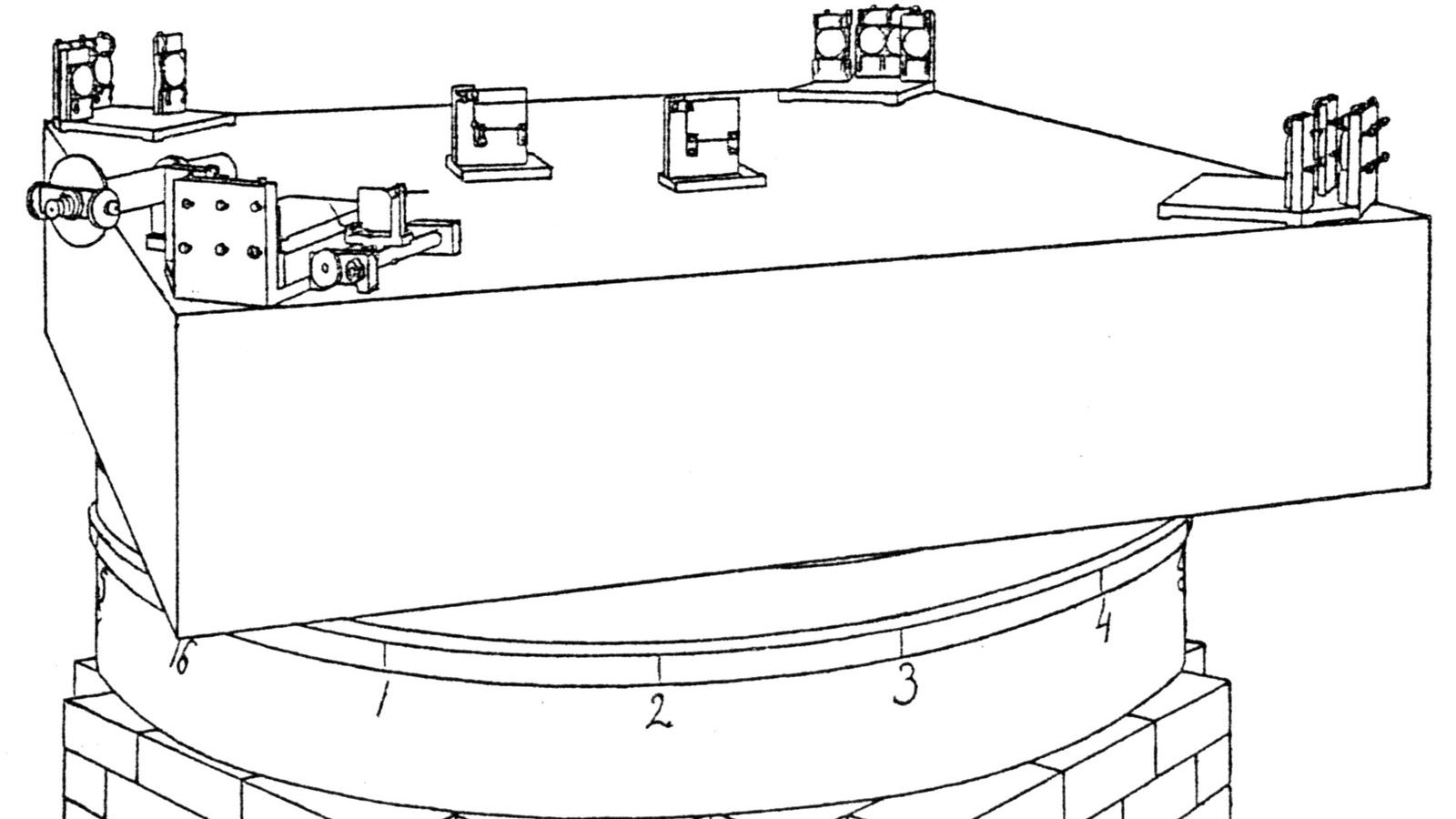
 Image: A. A. Michelson and E. W. Morley, American Journal of Science (1887), public domain
The experiment that failed and changed physics
In the basement of a building of the Case School of Applied Science in Cleveland, on 8, 9, 11, and 12 July 1887, two men walked slowly around a stone slab that floated on a pool of mercury and called out numbers to each other. Albert A. Michelson (1852 to 1931) looked through a small telescope at a pattern of light and dark stripes while Edward W. Morley (1838 to 1923) wrote down the position of the central dark stripe at each of sixteen marks on the wall. They expected the stripe to move back and forth as the slab turned, by about four tenths of a stripe. It did not move. The result was published in the American Journal of Science that November, and nobody knew what to make of it for eighteen years.
What they were looking for
Light was known to be a wave, and every wave anyone knew travelled in something. The medium for light was called the ether, and the Earth, moving around the Sun at 30 kilometres per second, had to be moving through it. A wind of ether of 30 kilometres per second, one ten-thousandth of the speed of light, should blow through every laboratory.
Michelson had designed an instrument to feel that wind in 1881, in Potsdam. A beam of light hits a half-silvered mirror and splits in two. One half goes along an arm parallel to the Earth's motion and bounces back; the other goes along an arm at right angles and bounces back. The two halves recombine and interfere, and the interference pattern depends on the difference in the time the two halves have spent travelling. A swimmer who goes a fixed distance downstream and back takes longer than one who goes the same distance across the river and back, and the same applies to the two beams. If the arms have length \(L\) and the ether wind has speed \(v\), the time difference is close to
\[ \Delta t \approx \frac{L}{c}\,\frac{v^2}{c^2}. \]Turn the whole instrument by 90 degrees, and the arm that had the longer time now has the shorter one, so the pattern should shift by twice this amount.
The numbers of 1887
The quantity \(v^2/c^2\) is \(10^{-8}\), which is why the 1881 attempt, with arms of about 1.2 metres, was too crude. For the 1887 instrument, Michelson and Morley folded the light path with sixteen mirrors so that each beam travelled about 11 metres in total before returning to the splitter. The expected time difference is then 11 metres divided by \(c\), times \(10^{-8}\), which is \(3.7 \times 10^{-16}\) seconds. The light they used had a period of about \(2 \times 10^{-15}\) seconds, so the expected shift was about 0.2 of a fringe in one orientation and 0.4 of a fringe between the two orientations at right angles. A shift of a hundredth of a fringe was visible in the telescope.
The slab was sandstone, about 1.5 metres square and 30 centimetres thick, and it floated on mercury in an annular iron trough so that it could be turned without any strain on the mirrors. Once set turning, it kept going at about one revolution in six minutes, and the observer walked around with it. They took readings at noon and at six in the evening, because the direction of the Earth's motion relative to the laboratory changes through the day, and over several days, because it changes through the year.
The result, in their own words, was that the displacement was certainly less than a twentieth of the expected value and probably less than a fortieth. The relative speed of the Earth and the ether was less than a sixth of the orbital speed, and they considered the hypothesis of a stationary ether to be wrong. The paper is short, and the original can be read on the NASA Astrophysics Data System: On the Relative Motion of the Earth and the Luminiferous Ether.
Eighteen years of patching
The first reaction was to save the ether. Perhaps the Earth dragged the ether with it near its surface, so that there was no wind in a basement; but stellar aberration, measured by James Bradley in 1728, requires the ether to be at rest with respect to the Sun. In 1889 George Francis FitzGerald suggested that bodies moving through the ether contract along the direction of motion by exactly the factor needed to hide the effect, and in 1892 Hendrik Antoon Lorentz worked out the same contraction from his theory of electrons. The contraction factor was \(\sqrt{1 - v^2/c^2}\), and it cancelled the time difference exactly. Lorentz went on to find the full set of transformations that now carry his name, as a mathematical device for making Maxwell's equations look the same in a moving frame.
The device worked, and it was ugly. The contraction was a real squeezing of matter by its motion through a medium that could not be detected in any other way. Michelson himself never gave up the ether. He repeated the experiment with longer arms and at altitude, with the same result, and received the Nobel Prize in Physics 1907 for his optical instruments, the first American to receive the prize.
What Einstein did with it
In his paper of 1905, On the Electrodynamics of Moving Bodies, Albert Einstein mentioned the failed attempts to detect the motion of the Earth relative to the "light medium" in his second sentence and then set them aside. He did not patch the ether; he removed it. His two postulates were that the laws of physics are the same in every inertial frame, and that light moves at the same speed \(c\) in every inertial frame, whatever the motion of the source. From these two statements the Lorentz transformation follows without any medium at all. The contraction of FitzGerald and Lorentz is still there, with the same factor, as a consequence of how two frames assign coordinates to the same events, and the null result of 1887 is what you expect when there is nothing for the Earth to move through.
How much the experiment influenced Einstein is still argued among historians. He read Lorentz, and he knew of the result; he said later that it had been of no decisive importance to him and that Fizeau's measurement of light in moving water and the aberration of starlight had weighed more. What is beyond argument is that, after 1905, the Michelson-Morley result became the standard first fact of every textbook on relativity, because it is the one experiment that a student can understand completely in an hour.
The result today
The experiment has been repeated with better instruments ever since. Modern versions use two optical resonators at right angles, cooled and isolated, and compare their frequencies as the laboratory turns with the Earth. The best of them limit any directional variation of the speed of light to a few parts in \(10^{18}\), ten orders of magnitude below what Michelson and Morley could see. Unit 2 of the masterclass works through the 1887 arithmetic and then builds the two postulates from it, and the original 1905 paper is free to read, in English, in the Collected Papers of Albert Einstein.