 Image: N. R. Tanvir, A. J. Levan, et al. (CC BY 3.0)
The 1.7 seconds that tied light to gravity
At 12:41:04 UTC on 17 August 2017 the two LIGO detectors and Virgo recorded a gravitational wave that had been rising in pitch for about 100 seconds, far longer than the fifth of a second of GW150914. At 12:41:06, 1.74 seconds after the chirp ended, the Fermi satellite's gamma-ray detector saw a short burst from the same part of the sky. Eleven hours later a small telescope in Chile found a new point of light in a galaxy 130 million light years away. Within a day about 70 observatories on every continent and in orbit were pointed at it. This article follows the sequence and says what each step taught.
A hundred seconds of chirp
The length of the signal gave away what the source was before anything else did. The rate at which a binary's frequency rises depends on its chirp mass, and a chirp mass of 1.188 solar masses, the value fitted to GW170817, means that the signal crawls up through LIGO's band from 30 hertz over about 100 seconds and 3,000 cycles, where the 30 solar mass black holes of GW150914 took 0.2 seconds. The individual masses came out between 1.17 and 1.60 solar masses, with a total of 2.74, which is the range of neutron stars and well below any black hole known. The long signal also made the measurement of the masses and the sky position much better than for a short one.
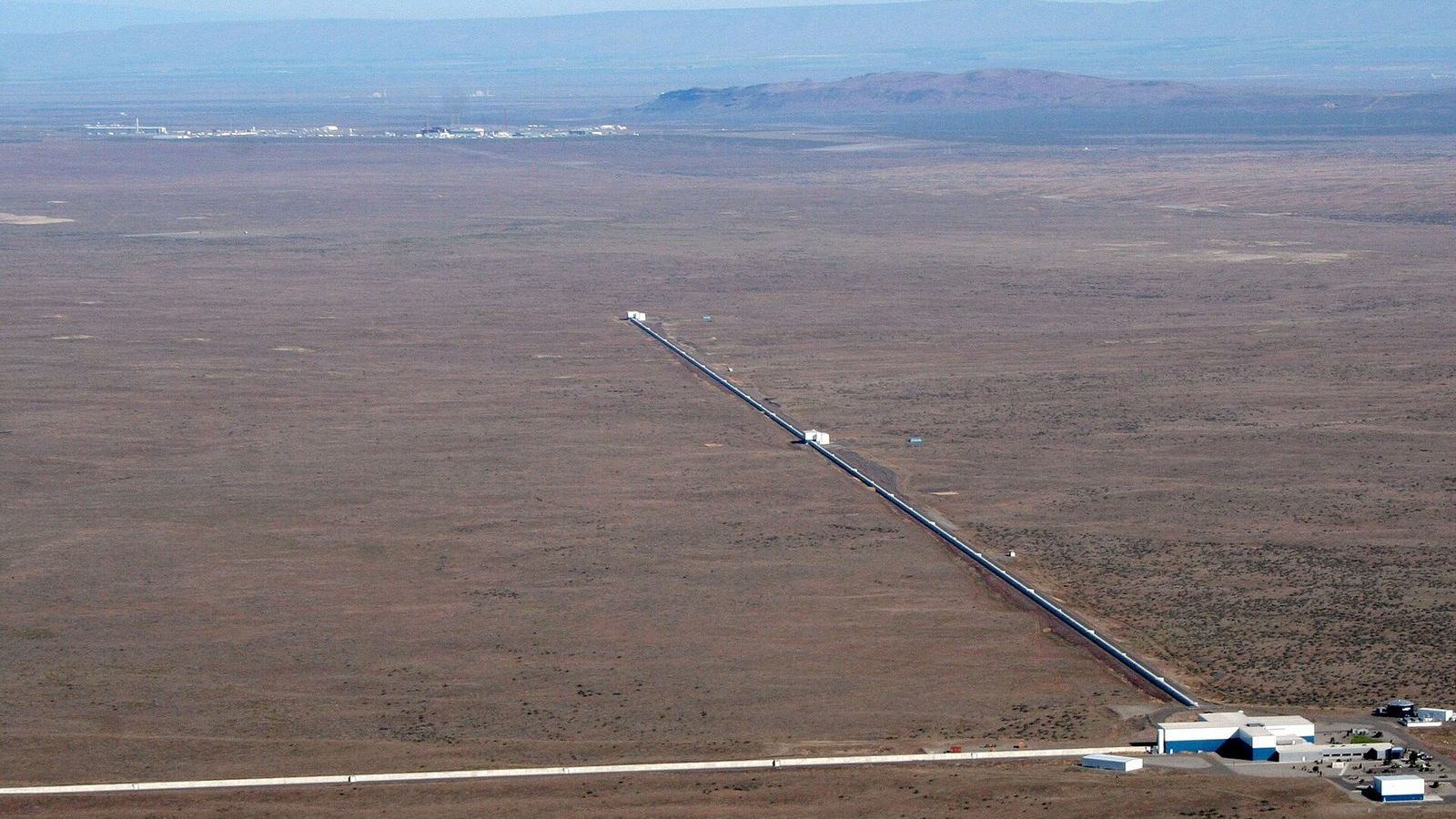
Virgo, the detector near Pisa, had joined the two LIGO sites only on 1 August 2017, and its contribution was decisive even though it hardly saw the signal: the source happened to lie in a direction where Virgo is almost blind, and that absence, combined with the arrival-time difference between Hanford and Livingston, shrank the sky area to about 30 square degrees in the southern constellation Hydra. The gravitational-wave amplitude gave a distance of about 40 megaparsecs. Both numbers were sent to the astronomers within hours.
The burst, and what 1.7 seconds means
Gamma-ray bursts shorter than two seconds had been suspected since the 1980s of coming from merging neutron stars, and GRB 170817A, seen by Fermi and by the INTEGRAL satellite, settled it. The two signals came from the same place and the same moment, give or take 1.74 seconds. The gamma rays are thought to be launched a second or two after the merger, by a jet that has to punch out of the debris, so the delay is not a difference in speed. It is an upper limit on one. The two signals had travelled for 130 million years, and if gravitational waves moved at a speed different from light by even one part in \(10^{15}\), the gap on arrival would have been more than a hundred seconds. The published bound, in the paper Gravitational Waves and Gamma-rays from a Binary Neutron Star Merger, is that the fractional difference between the two speeds lies between \(-3 \times 10^{-15}\) and \(+7 \times 10^{-16}\).
That number closed a whole shelf of theories. Several alternatives to general relativity that had been proposed to explain the acceleration of the universe without dark energy predicted that gravitational waves travel at a speed measurably different from \(c\). Within weeks of the event, papers ruled them out. One afternoon of data did what two decades of cosmological surveys had not.
The glow in NGC 4993
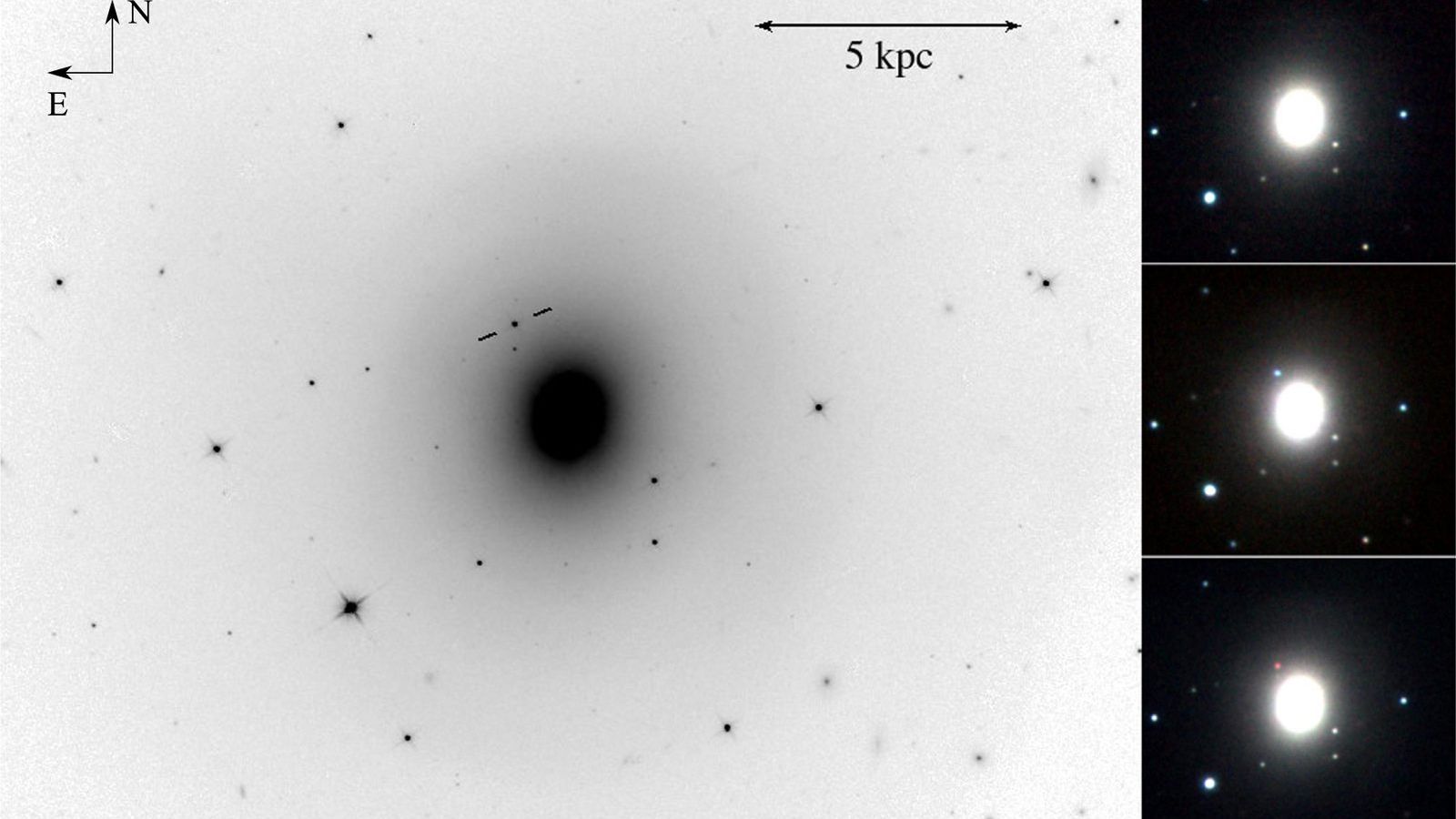
With a 30 square degree box and a distance of 40 megaparsecs, the astronomers had a list of a few dozen galaxies to look at. At 23:33 UTC, 10.9 hours after the merger, the 1 metre Swope telescope at Las Campanas in Chile found a new source next to the elliptical galaxy NGC 4993, which is at the right distance. Five other teams found it independently within the hour. It brightened and turned from blue to red over a few days, and faded within two weeks, which is what a kilonova had been predicted to do.
The prediction runs like this. When two neutron stars merge, about a hundredth of a solar mass of matter, more than three thousand Earth masses, is flung out at a tenth of the speed of light. It is almost pure neutrons, and as it expands the neutrons are captured by the few nuclei present faster than those nuclei can decay, building elements up to and beyond uranium in a second. This rapid neutron capture, the r-process, had been known since the 1950s to be the only way to make about half of the elements heavier than iron, including gold and platinum, but where it happened was an open question. The freshly made nuclei are radioactive and heat the debris, which glows at a thousandth of a supernova's brightness, hence the name. The red colour that appeared after a few days is the signature of the lanthanides, the heavy elements whose many spectral lines block blue light, and the spectra taken at the Very Large Telescope showed absorption features that match the r-process predictions. The ejected mass works out at a few hundredths of a solar mass in total, and the gold and platinum alone at somewhere between a few and a few tens of Earth masses, depending on the model of the ejecta. The joint paper by the gravitational-wave collaborations and about 70 observatories, Multi-messenger Observations of a Binary Neutron Star Merger, has nearly 4,000 authors.
Measuring the universe with a siren
The amplitude of a gravitational wave gives the distance to the source with no calibration beyond general relativity, which makes a binary a standard siren. The host galaxy's spectrum gives its recession velocity. Distance and velocity together give the Hubble constant, the expansion rate of the universe, by a route that is independent of every rung of the astronomical distance ladder. From this one event the result was \(70^{+12}_{-8}\) kilometres per second per megaparsec, too rough to decide between the two competing values of about 67 and 73, but a few dozen such events with known host galaxies would do it. The LIGO press release of 16 October 2017 summarises the whole chain of observations.
What the neutron stars were made of
In the last orbits before the merger each star raises a tide on the other, and the tide drains a little extra energy from the orbit, so the chirp ends slightly sooner than it would for two point masses. The size of the effect depends on how stiff neutron star matter is, which is unknown, because nothing on Earth reaches a density of \(10^{17}\) kilograms per cubic metre. GW170817 showed the tidal effect was small, which means the stars were compact, with radii of about 11 to 13 kilometres, and that ruled out the stiffest models of the matter inside them. The question of what a 1.4 solar mass star 12 kilometres across is made of, at its centre, is still open, and the next loud neutron star merger will narrow it further.
Unit 14 of the masterclass computes the time to merger of GW170817 from 30 hertz, derives the speed-of-gravity bound from the 1.74 seconds and the 40 megaparsecs, and explains the kilonova in its second research spotlight.