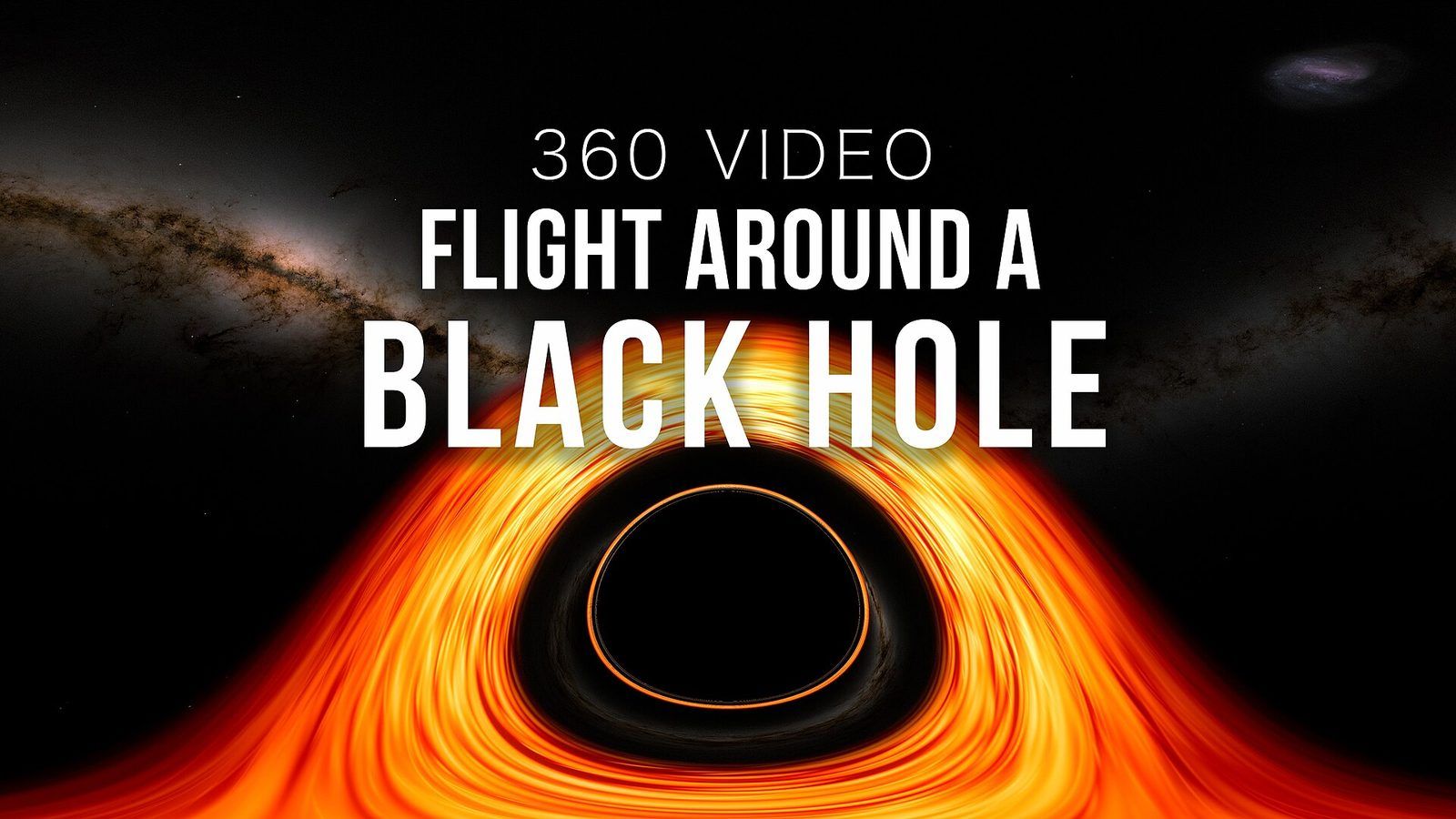
 Image: NASA's Scientific Visualization Studio, public domain
What happens at the event horizon
Drop a clock into the black hole at the centre of the Milky Way, a mass of 4.3 million Suns, from far away. It crosses the event horizon, which is 12.7 million kilometres from the centre, without feeling anything at all. It reaches the centre 28 seconds later, by its own reading. A second clock watching from a safe distance tells a different story: the falling clock slows as it approaches the horizon, its light becomes redder and dimmer, and it never quite arrives. Both accounts are correct. Working out why is what Unit 12 of the masterclass is about, and this article gives the numbers.
Where the horizon is
Outside a spherical mass \(M\), the geometry of spacetime is the Schwarzschild solution, and it has one special radius,
\[ r_{\mathrm{s}} = \frac{2GM}{c^2}. \]For the Sun this is 2.95 kilometres; for the Earth, 8.9 millimetres; for a black hole of ten solar masses, 29.5 kilometres; for the 4.3 million solar masses at the centre of the galaxy, \(1.27 \times 10^{10}\) metres, about eighteen times the radius of the Sun. The radius grows in proportion to the mass, and this one fact decides almost everything about what falling in is like, because the tidal stresses at the horizon fall as \(1/M^2\). An ordinary star of a given mass has a radius much larger than its Schwarzschild radius. A black hole is a mass whose matter has fallen inside its own \(r_{\mathrm{s}}\), and the surface at \(r_{\mathrm{s}}\) is the event horizon.
The faller
The equivalence principle says that a freely falling observer in a small enough region sees no gravity. There is no local experiment that tells the clock it has crossed the horizon; no sign, no change of density, no wall. The one thing that could be felt is the tide, the difference in the pull on the head and on the feet. For a body of length \(\ell\) at radius \(r\), the stretching acceleration is
\[ \Delta a \approx \frac{2GM\,\ell}{r^3}. \]At the horizon of a ten-solar-mass black hole, with \(\ell\) of two metres, this is \(2 \times 10^{8}\) metres per second squared, twenty million times the acceleration of gravity on Earth. Nothing survives that; the stretching along the fall and squeezing across it is what the astrophysicists call spaghettification, and it happens well outside the horizon. At the horizon of the galactic centre black hole the same formula gives a thousandth of a metre per second squared, about a ten-thousandth of the acceleration of gravity on Earth, which a person would not notice. For a large black hole the horizon is harmless, and the tide only becomes lethal deep inside.
How long does the inside last? For an object dropped from rest far away, the proper time from the horizon to the centre is
\[ \tau = \frac{2}{3}\,\frac{r_{\mathrm{s}}}{c}, \]and the number is 66 microseconds for ten solar masses, 28 seconds for the galactic centre, and about twelve hours for the 6.5 billion solar masses of M87*. Firing rockets does not help: inside the horizon the radial coordinate \(r\) behaves like time, and moving to smaller \(r\) is as unavoidable as moving to a later moment. Any attempt to resist shortens the time rather than lengthening it, because a straight world line in spacetime has the longest proper time, and the free fall is the straight line. The centre, \(r = 0\), is where the tide becomes infinite. It is a genuine singularity of the geometry, and there the theory stops having anything to say.
The watcher
A distant observer sees the horizon very differently, and the reason is the behaviour of light. Light climbing out of a gravitational potential is redshifted. From a radius \(r\) outside a Schwarzschild mass to infinity, each frequency is reduced by the factor \(\sqrt{1 - r_{\mathrm{s}}/r}\), which is zero at the horizon. Signals sent by the falling clock at equal intervals of its own time arrive at ever longer intervals, with ever longer wavelengths, and the last signal sent from the horizon itself never arrives at all. The distant observer sees the clock slow down and appear to hover just outside \(r_{\mathrm{s}}\).
Hover is the wrong picture, though, because the light also fades. The redshift grows exponentially with the watcher's time, with a time constant of about \(2.6\,r_{\mathrm{s}}/c\), which is 0.26 milliseconds for ten solar masses and under two minutes for the galactic centre. After a few of these time constants the clock has become redder than any detector can register and emits too few photons to see. In practice the falling object disappears, fast. The "frozen star" of older textbooks, which pictured matter piling up just outside the horizon forever, is an artefact of the coordinates; by the proper time of anything falling, the crossing takes no time at all, and by the time of anyone watching, the object has faded in minutes.
The coordinate singularity
In Schwarzschild's original coordinates the metric misbehaves at \(r_{\mathrm{s}}\), and for forty years it was unclear whether that was a property of spacetime or of the coordinates. Arthur Eddington in 1924 and David Finkelstein in 1958 found coordinates in which nothing singular happens at the horizon, and Martin Kruskal and George Szekeres in 1960 found a set that covers the whole geometry at once, with the horizon as an ordinary light-like surface. In Finkelstein's picture, the light cones tilt more and more towards the centre as \(r\) decreases, until at \(r_{\mathrm{s}}\) the outgoing edge of the cone points straight up the \(r = r_{\mathrm{s}}\) line and outgoing light stays put. Inside, both edges point inward. The horizon is a one-way membrane for light and for everything slower than light, which is everything.
What the horizon is not
It is not a surface made of anything, and in a large black hole it is not even a place where anything happens locally. It is not the edge of the mass, which has all fallen to the centre. It is not where the escape velocity equals \(c\) in the Newtonian sense, although John Michell made that calculation in 1783 and got the right radius by accident. It is the boundary of the region from which no signal can ever reach the outside, defined by the whole future of the spacetime, which is why a horizon can exist, in principle, at a place where the curvature is small. The 2019 photograph of M87* shows the shadow this boundary casts on the light behind it, and the article on that picture explains what the dark region is and why it is 2.6 Schwarzschild radii across rather than one.