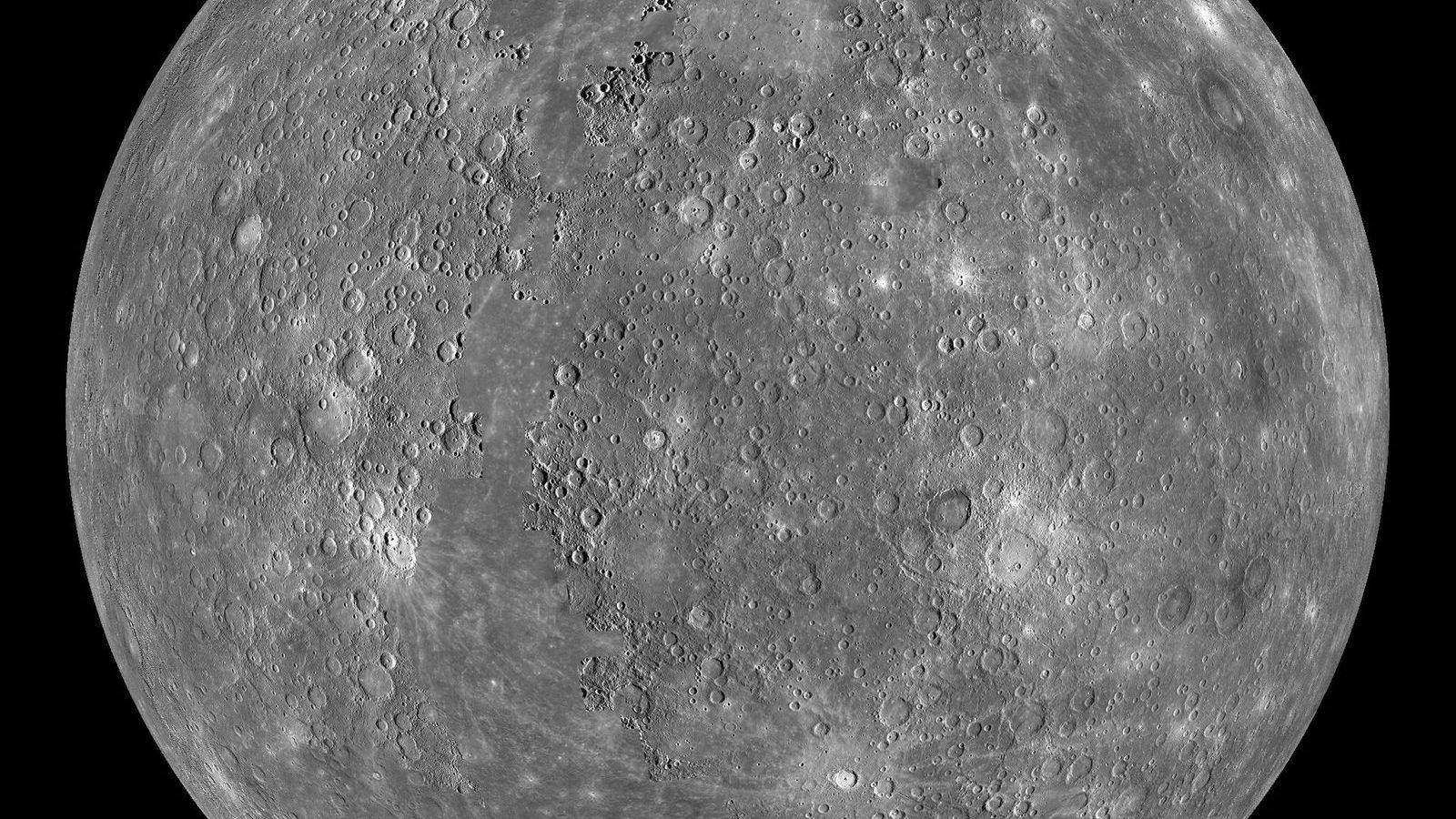
 Image: NASA/Johns Hopkins University Applied Physics Laboratory/Carnegie Institution of Washington, public domain
Mercury's 43 arcseconds
Mercury's orbit is an ellipse, and the ellipse slowly turns. Its closest point to the Sun, the perihelion, moves forward by 574 arcseconds per century, relative to the fixed stars. That is about 0.16 of a degree, and it would take 225,000 years for the orbit to turn all the way round. Newtonian gravity explains most of it: the other planets pull on Mercury, and their combined effect is 531 arcseconds per century. The remaining 43 arcseconds per century were discovered in 1859 and had no explanation until 18 November 1915.
Le Verrier and the planet that was not there
Urbain Le Verrier was the astronomer who in 1846 had predicted the position of Neptune from the irregularities of Uranus, and in 1859 he applied the same method to Mercury. He collected observations of Mercury's transits across the Sun going back to 1697, computed the pull of every known planet, and found that the perihelion advanced about 38 arcseconds per century more than it should. Simon Newcomb, at the United States Naval Observatory, redid the calculation in 1882 with better planetary masses and got 43.
Le Verrier's natural guess was that the Neptune trick would work again. A planet inside the orbit of Mercury, or a ring of small bodies, would do it, and the hypothetical planet was named Vulcan. A French country doctor, Edmond Lescarbault, reported seeing it cross the Sun in 1859, and for fifty years astronomers looked for it at every eclipse. It was never found, and a planet large enough to move Mercury would have been seen easily. Other ideas were tried: an oblate Sun, whose equatorial bulge would add a small extra pull; a slight change in the exponent of Newton's law, from 2 to 2.00000016, as Asaph Hall proposed in 1894. None of them worked without breaking something else.
Where the 574 comes from
The arithmetic of the Newtonian part is worth seeing. Venus, the nearest planet, contributes 278 arcseconds per century. Jupiter, far away but massive, contributes 154. The Earth contributes 90, and Mars, Saturn, and the rest about 10 between them, for a total of 531. A separate 5,025 arcseconds per century is not a motion of the orbit at all; it is the precession of the Earth's own axis, which moves the reference point from which astronomers measure longitudes, and it is subtracted out before any of this starts. The observed value, 574, has an uncertainty of under one arcsecond, so the 43 left over is a measured number, with an uncertainty of about 1 per cent.
What general relativity adds
In Newton's theory the orbit of a single planet around the Sun is a closed ellipse, exactly, and this is a special property of the inverse-square law. Any small change to the force law makes the ellipse fail to close, so that each perihelion is a little further round than the last. General relativity changes the law near the Sun. In the Schwarzschild solution, the field outside a spherical mass, the equation for the orbit picks up one extra term beyond Newton's, proportional to \(1/r^3\) in the effective potential and down by a factor of order \(v^2/c^2\) compared with the main term. Mercury moves at 48 kilometres per second, so \(v^2/c^2\) is \(2.6 \times 10^{-8}\), and the orbit is very nearly, but not exactly, a closed ellipse.
The advance of the perihelion per orbit comes out as
\[ \Delta\phi = \frac{6\pi G M}{c^2 a (1 - e^2)}, \]where \(a\) is the semi-major axis and \(e\) the eccentricity. For Mercury, \(a\) is \(5.79 \times 10^{10}\) metres, \(e\) is 0.2056, and \(GM/c^2\) for the Sun is 1,477 metres. The bracket \(1 - e^2\) is 0.958. The result is \(5.02 \times 10^{-7}\) radians per orbit, which is 0.1035 arcseconds. Mercury goes round the Sun in 87.97 days, 415.2 times a century, and the total is 42.98 arcseconds per century. Einstein got this number from an approximate solution of his equations on 18 November 1915, a week before the final form of the equations, and wrote that he had been beside himself with excitement for days; the story of that month is in its own article. Karl Schwarzschild found the exact solution a few weeks later, and the formula above comes from it. Unit 11 of the masterclass derives the orbit equation and the precession step by step.
Why Mercury
The formula explains why the effect was first seen in Mercury and not in a bigger planet. The advance per orbit grows as the planet gets closer to the Sun, through the \(1/a\), and Mercury also goes round more often. For Venus the prediction is 8.6 arcseconds per century, for the Earth 3.8, and both have been measured, but Venus's orbit is so nearly circular that its perihelion is hard to locate, and the Earth's is masked by the precession of the equinoxes. The eccentricity matters too: an elongated orbit has a well-defined perihelion that can be timed precisely, and Mercury's 0.2056 is the largest among the planets.
The same formula far from the Sun
The effect that was a nuisance to Le Verrier is now a measuring instrument. The binary pulsar PSR B1913+16, two neutron stars orbiting each other in 7.75 hours, has a periastron that advances by 4.2 degrees per year, 35,000 times Mercury's rate, and the measured value gives the total mass of the two stars to four decimal places. The star S2, which orbits the black hole at the centre of our galaxy in 16 years, has a pericentre that advances by 12 arcminutes per orbit, and the GRAVITY instrument at the Very Large Telescope measured it in 2020, as the article on S2 describes. In each case the formula is the one above, with \(M\), \(a\), and \(e\) changed, and in each case the agreement with the measurement is within the uncertainties.
Mercury itself is still measured. Radar ranging to the planet since the 1960s, and the tracking of the MESSENGER spacecraft in orbit around it from 2011 to 2015, have confirmed the 43 arcseconds to better than one part in ten thousand, and the Sun's oblateness, which the 1960s debate had made a worry, has been pinned down by helioseismology to a contribution of about 0.03 arcseconds per century, too small to matter. The number Le Verrier could not explain is now one of the most precisely confirmed predictions in physics.