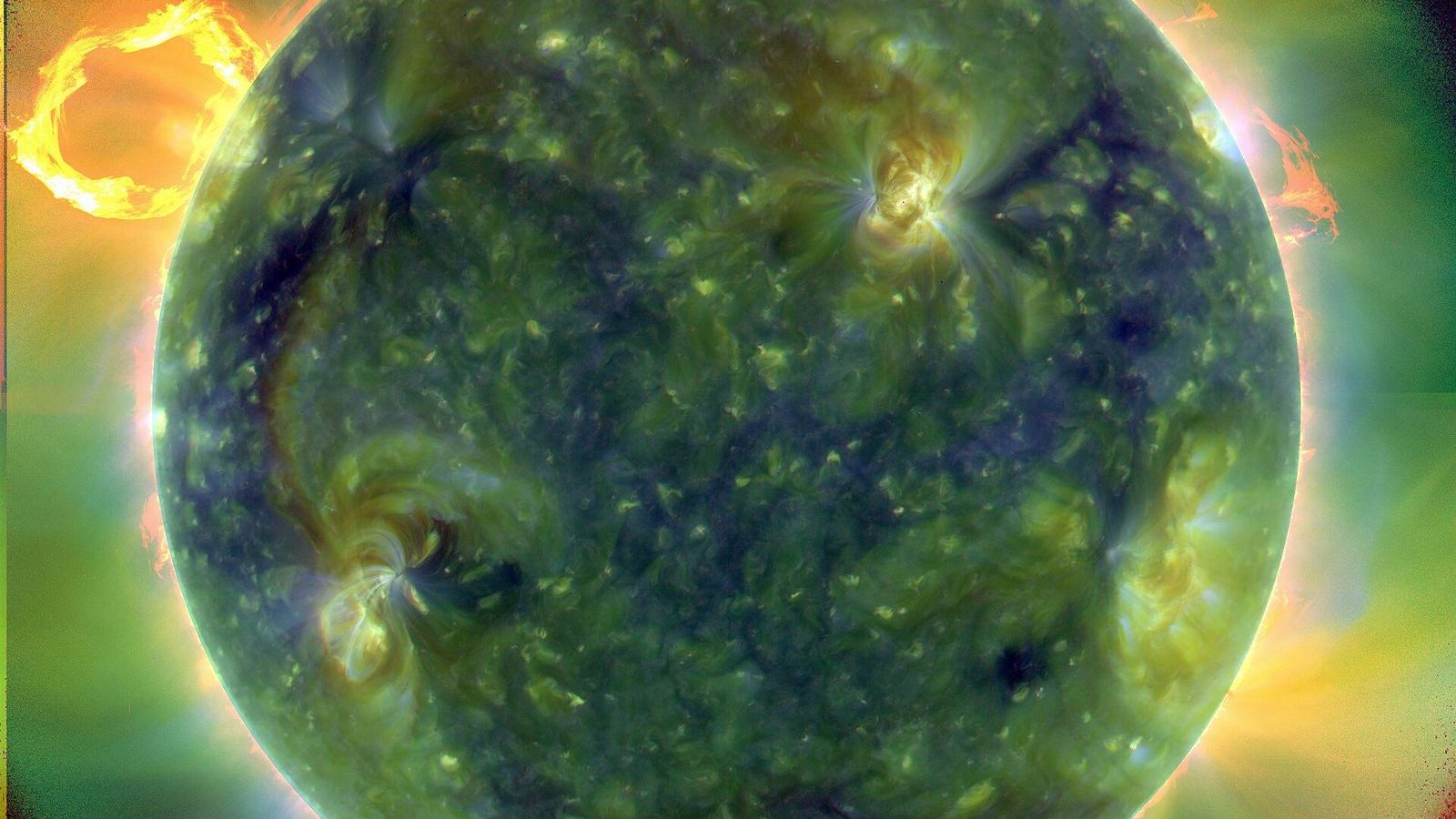
 Image: NASA/Goddard/SDO AIA Team, public domain
What E = mc² actually says
One gram of matter, any matter, holds \(9 \times 10^{13}\) joules. That is 25 million kilowatt hours, the output of a large power station for a day. The Sun turns 4.3 million tonnes of its mass into light every second. A charged phone battery is heavier than a flat one by about half a nanogram. All three statements come from \(E = mc^2\), the equation Albert Einstein published in September 1905 in a three-page paper with the title Does the Inertia of a Body Depend upon its Energy Content? The equation is short enough to put on a T-shirt and is misread more often than any other in physics.
Mass is energy that is not going anywhere
The equation says that a body at rest, with mass \(m\), has an energy \(mc^2\) by virtue of its mass alone. The constant \(c^2\) is \(9 \times 10^{16}\) metres squared per second squared, which is why a small mass is a large energy. It also says the reverse: if a body at rest gives off energy \(E\), in any form, its mass falls by \(E/c^2\). The energy can be light, heat, the kinetic energy of fragments, anything. Einstein's own example was a body emitting two flashes of light in opposite directions, so that its momentum does not change but its energy does, and he showed that its mass must have dropped by the energy of the flashes divided by \(c^2\).
This is the part that deserves attention. Every energy change comes with a mass change. A spring compressed with 100 joules of work is heavier by \(1.1 \times 10^{-15}\) kilograms. A cup of tea that cools by 50 degrees loses about \(6 \times 10^{-13}\) kilograms. Burning a kilogram of petrol releases 46 megajoules, and the carbon dioxide and water that result weigh half a microgram less than the petrol and oxygen that went in. None of these is measurable on a balance, which is why chemistry got on fine for two centuries with the rule that mass is conserved. The rule is wrong by parts in \(10^{10}\).
Where the fraction becomes visible
Nuclear reactions move enough energy per particle for the mass change to be measured directly. A deuteron, the nucleus of heavy hydrogen, is lighter than a free proton plus a free neutron by 0.1 per cent, and the difference, 2.22 million electron volts, is the energy released when they bind and the energy needed to split them. When four hydrogen nuclei are turned into one helium nucleus in the core of the Sun, 0.7 per cent of their mass becomes energy. The fission of a uranium-235 nucleus releases about 200 million electron volts, 0.09 per cent of its mass. The bomb that destroyed Hiroshima converted less than a gram.
The Sun's luminosity is \(3.83 \times 10^{26}\) watts. Divide by \(c^2\) and the Sun is losing \(4.3 \times 10^9\) kilograms a second, 4.3 million tonnes, in the form of light and neutrinos. That sounds like a lot until it is compared with the Sun's mass of \(2 \times 10^{30}\) kilograms: in 4.6 billion years the Sun has lost about 0.03 per cent of itself this way, and it has fuel for several billion years more. The light that falls on the Earth each second carries a mass of about two kilograms.
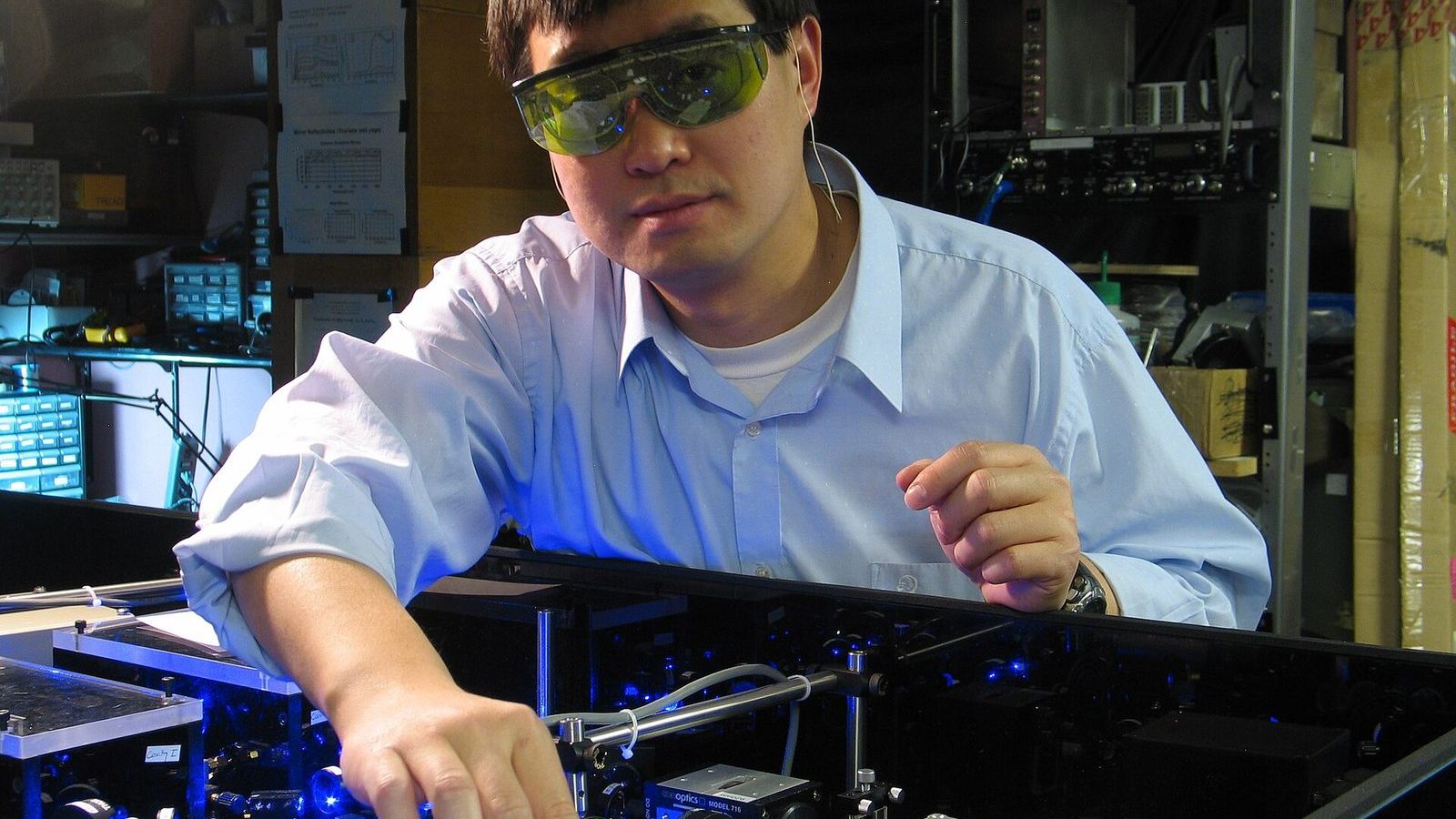
The most precise direct test was done in 2005 by a group at MIT and at the Institut Laue-Langevin in Grenoble. They measured the energy of the gamma rays given off when a nucleus of sulfur or silicon captures a neutron, and separately, in a Penning trap, the tiny difference in mass between the nucleus before and after capture. The two sides of \(E = mc^2\) agreed to 0.00004 per cent. The paper, A direct test of \(E = mc^2\), appeared in Nature at the end of that year.
What the equation does not say
It does not say that mass turns into energy as if one thing became another. Energy is conserved in every reaction, and so is the total mass of an isolated system, as long as one counts the mass of a system properly: the invariant mass of a box containing a nucleus and the gamma ray it just emitted is the same as the mass of the nucleus before the emission. What changes is where the energy sits. Before, it was all in the rest energy of one nucleus; after, some of it is in a photon flying away. A photon has no mass of its own, and a box of photons bouncing between mirrors has mass, and both statements are consistent, because mass is a property of a system and is not the sum of the masses of its parts.
It does not say that a moving body has more mass. Older books wrote \(E = m c^2\) with a "relativistic mass" \(m = \gamma m_0\) that grows with speed, and some popular accounts still say that nothing can reach \(c\) because its mass would become infinite. Physicists today use the word mass for the rest mass alone, a number that every frame agrees on, and put the dependence on speed where it belongs, in the energy and the momentum:
\[ E = \gamma m c^2, \qquad \vec{p} = \gamma m \vec{v}, \qquad E^2 = p^2 c^2 + m^2 c^4. \]The last of these, the energy-momentum relation, is the equation that is used in practice. For a body at rest, \(p = 0\) and it collapses to \(E = mc^2\). For a photon, \(m = 0\) and it gives \(E = pc\), which is why light carries momentum and can push a solar sail. For a proton in the Large Hadron Collider with an energy of 6.8 tera-electron volts, it gives a momentum of 6.8 tera-electron volts divided by \(c\) to one part in \(10^{8}\), and the rest energy of 0.938 giga-electron volts barely matters. Unit 7 of the masterclass derives all three from the requirement that momentum be conserved in every frame, and then uses them on collisions.
Where the mass of ordinary things comes from
The best illustration of the equation is the one that sits in every atom. A proton has a mass of 938 million electron volts divided by \(c^2\). The three quarks inside it have masses that add up to about 9 million electron volts divided by \(c^2\), one per cent of the total. The other 99 per cent is the energy of the gluon field that binds the quarks and the kinetic energy of the quarks as they move inside the proton. The mass of a chair, a planet, or a reader is almost entirely the confined energy of motion and fields inside nucleons, and \(E = mc^2\) is the statement that this energy weighs. The equation is a fact about every kilogram, and the nuclear reactions in which it was first seen are the special case where a little of that energy gets out.
The 1905 paper is three pages, and the derivation is one paragraph. It can be read in translation in the Collected Papers of Albert Einstein, volume 2. Einstein wrote the result as \(L/V^2\) for the mass change, with \(L\) for the energy of the light and \(V\) for its speed, and spent the last sentence wondering whether radium salts, which were known to give off energy steadily, might one day show the effect. They do, and so does everything else.