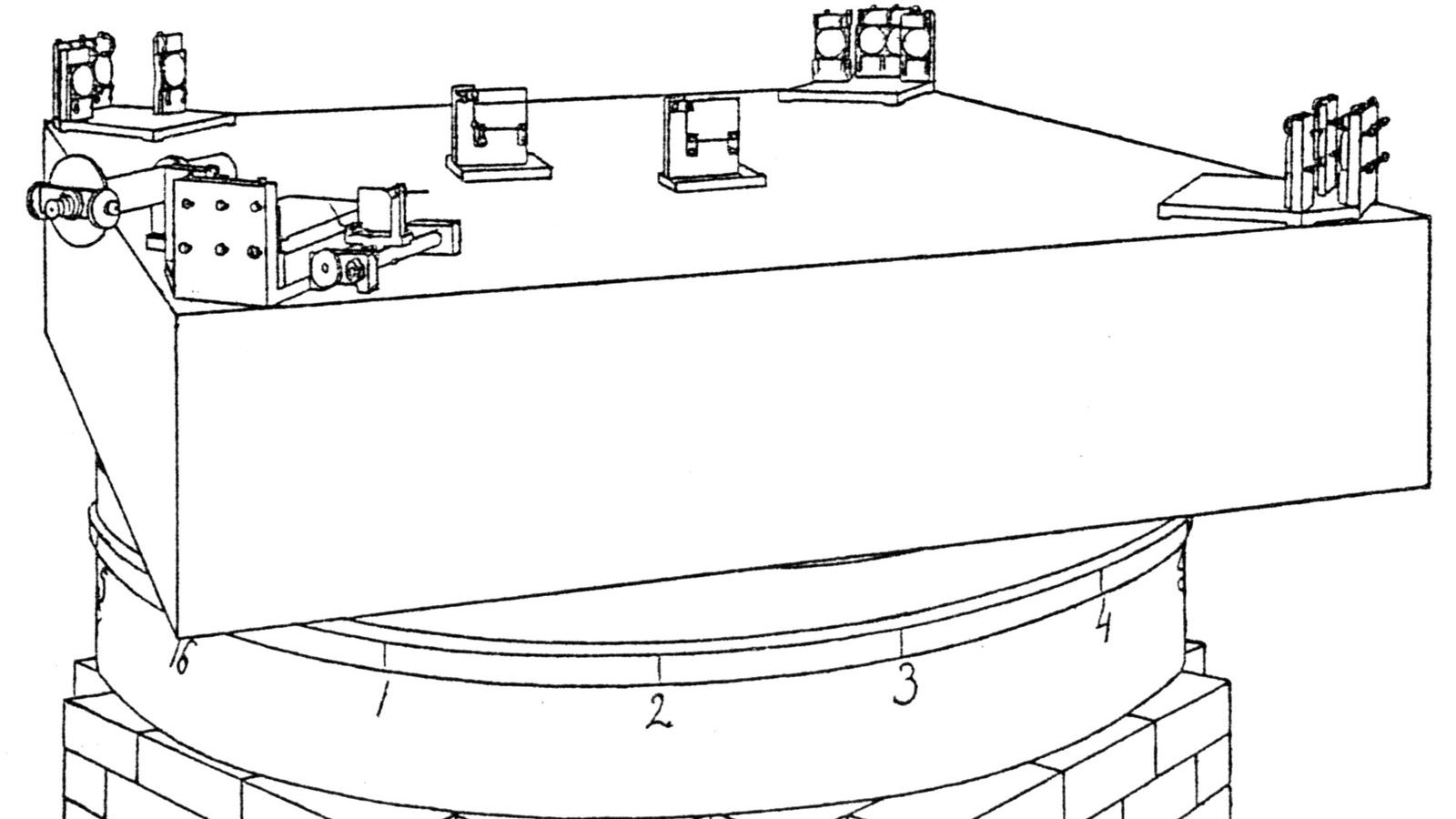
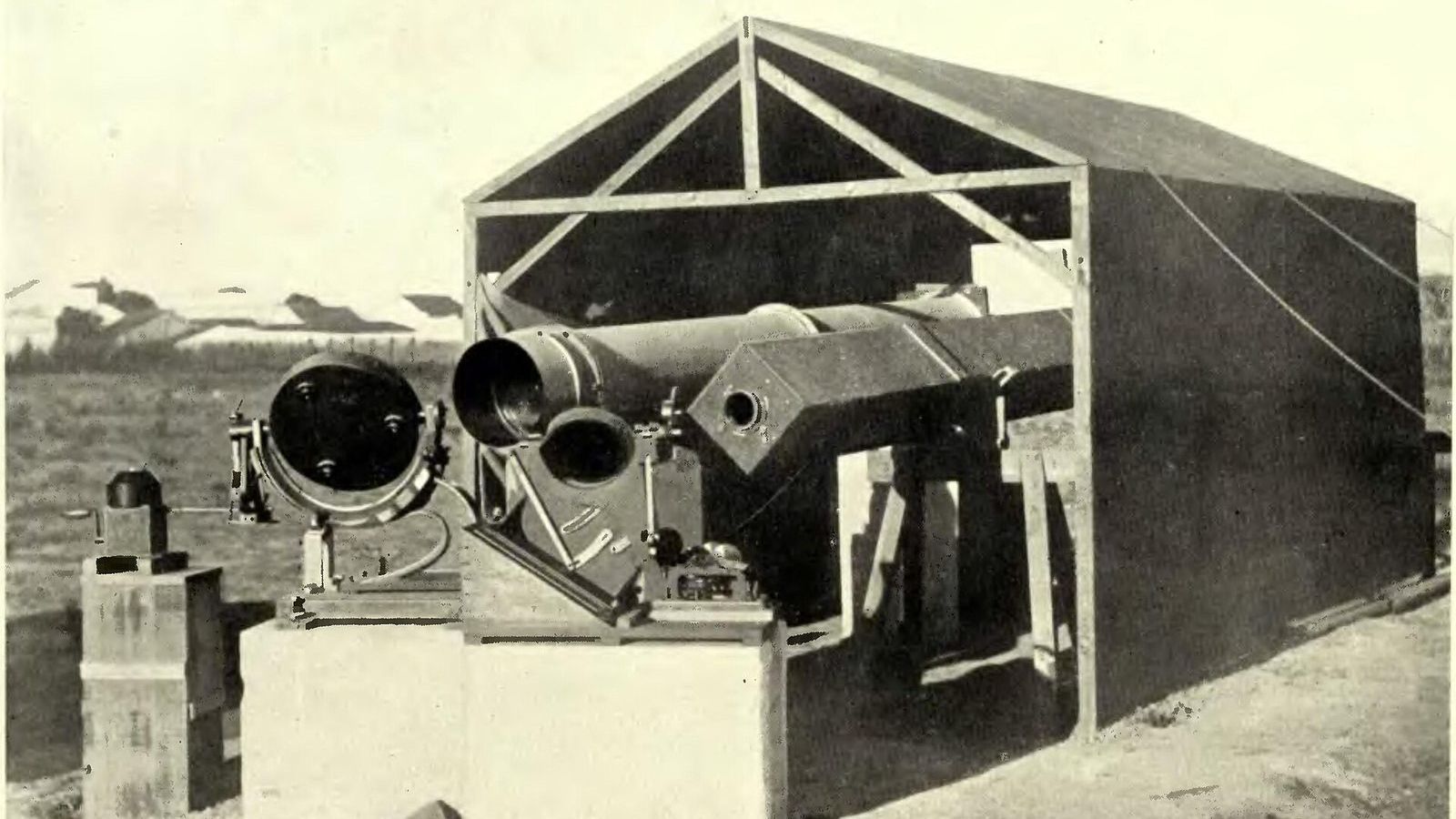
 Image: C. Davidson, Philosophical Transactions of the Royal Society A (1920), public domain
The eclipse that made Einstein famous
A star seen just beside the Sun is not where it appears to be. Its light has passed through the Sun's gravitational field on the way to us and has been bent towards the Sun, so the star appears pushed outward, away from the Sun's edge. Einstein's general theory of relativity, completed in November 1915, put the size of the shift at the Sun's edge at 1.75 arcseconds, about a two-thousandth of the width of the Sun itself. Newtonian gravity acting on light as if it were a stream of particles gives half of that, 0.87 arcseconds. The only time anyone could see stars beside the Sun was during a total eclipse, and the next good one after the war was on 29 May 1919.
Why that eclipse
Frank Dyson, the Astronomer Royal, noticed in 1917 that the 1919 eclipse would take place with the Sun in front of the Hyades, a cluster of bright stars in Taurus, which meant a dozen stars bright enough to photograph through the corona. The track of totality ran from Brazil across the Atlantic to Africa. Dyson organized two expeditions. Andrew Crommelin and Charles Davidson went to Sobral in northern Brazil with two telescopes, a 13-inch astrographic lens fed by a mirror and a 4-inch lens of longer focal length. Arthur Eddington and Edwin Cottingham went to the island of Príncipe in the Gulf of Guinea with a second astrographic lens.
Eddington was a Quaker and a conscientious objector, and had been kept out of military service in 1918 partly on the argument that he was needed for this expedition. He was also one of the few people in Britain who had read and understood Einstein's theory, which had reached England through the neutral Netherlands during the war.
The day
At Príncipe the morning was cloudy with rain, and the sky cleared only partly during totality. Of the sixteen plates taken, two showed enough stars to measure, five on each. At Sobral the sky was clear, but the 13-inch telescope's images were out of focus, because the heat of the morning had distorted the mirror, and the stars came out as smeared blobs. The 4-inch telescope at Sobral worked well, and its seven good plates with seven stars each became the backbone of the result.
Measuring a shift of about one arcsecond on a photographic plate is hard. One arcsecond at the focal length of the 4-inch instrument was about a thirtieth of a millimetre. The eclipse plates were compared with plates of the same stars taken at night, months later, when the Sun was elsewhere, and the comparison had to allow for changes in the scale of the plate from temperature and from the different focus. The predicted displacement falls off with distance from the Sun's centre, as \(1/r\), so the measurement was a fit of this known pattern to the small shifts of several stars.
The numbers
The Sobral 4-inch plates gave a deflection at the Sun's edge of 1.98 arcseconds, with a probable error of 0.12. The Príncipe plates gave 1.61 with a probable error of 0.30. The out-of-focus Sobral astrographic plates gave 0.93, with a larger scatter, and the expedition report set them aside on the grounds that the focus had been lost; this decision has been argued over ever since, and a re-measurement of those plates with modern equipment in 1979 gave 1.55 with an uncertainty of 0.34, in line with the others. Dyson, Eddington, and Davidson concluded that the deflection was between the two values 1.98 and 1.61, and that the Newtonian 0.87 was excluded. Their paper, A Determination of the Deflection of Light by the Sun's Gravitational Field, was published in the Philosophical Transactions of the Royal Society in 1920 and can be found on the NASA Astrophysics Data System at this record.
The result was announced on 6 November 1919 at a joint meeting of the Royal Society and the Royal Astronomical Society in London, with J. J. Thomson presiding. The Times of the next morning carried the headline Revolution in Science and the subheading Newtonian Ideas Overthrown, and within weeks Einstein, then forty, was the most famous scientist alive. He had learned of the preliminary result by telegram in September. Asked by a student what he would have done if the observations had contradicted his theory, he is reported to have said that he would have felt sorry for the dear Lord, because the theory was correct.
Where the factor of two comes from
The Newtonian half of the deflection comes from the slowing of clocks in a gravitational field, which bends the wavefront the way a lens does. The other half comes from the curvature of space, which stretches radial distances near the Sun. Einstein's 1911 calculation included only the first, because the theory then had only a modified time; the full theory of 1915 has both, and the deflection of a ray passing at distance \(b\) from a mass \(M\) is
\[ \delta = \frac{4GM}{c^2 b}. \]At the Sun's edge, \(b\) is the solar radius, \(GM/c^2\) is 1.48 kilometres, and the angle is \(8.5 \times 10^{-6}\) radians, 1.75 arcseconds. Unit 11 of the masterclass derives this from the Schwarzschild metric and shows which half of the answer comes from which part of the metric, and Unit 8 gets the first half from the equivalence principle alone.
What the test looks like now
The 1919 result was good to about 30 per cent, and later eclipse expeditions did little better, because the photographic method has a hard floor. The modern test does not need an eclipse. Radio telescopes thousands of kilometres apart, combined as an interferometer, measure the position of distant quasars as the Sun passes near them each year, and the deflection, which is still 4 milliarcseconds for a source 90 degrees from the Sun, is measured across the whole sky. By 2004 these measurements had confirmed the factor of two to 0.03 per cent. The Cassini spacecraft, in 2003, measured the closely related Shapiro delay of radio signals passing the Sun to 0.002 per cent, and the Gaia satellite corrects every one of its two billion star positions for the bending of light by the Sun, the planets, and the Moon.
The same bending, with galaxies instead of the Sun, is gravitational lensing, and it has turned from a test of the theory into a tool: the masses of galaxy clusters, the distribution of dark matter, and the magnified images of the most distant galaxies all come from the formula above applied to light that has travelled for billions of years. The two blurred plates from a rainy island, with five stars each, started it.