
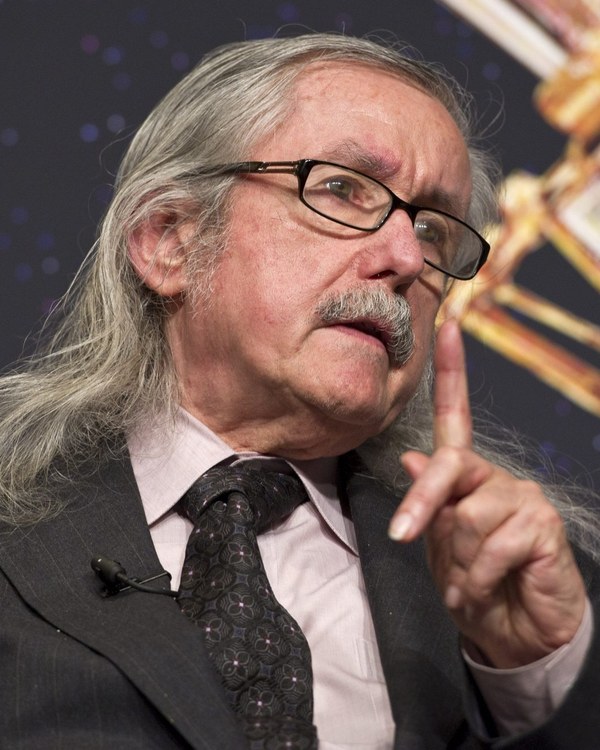
Photo: NASA/Paul E. Alers, Public domain, Wikimedia Commons
Francis Everitt
Stanford University
- Research field
- Experimental gravitation, the Gravity Probe B mission
Francis Everitt joined Gravity Probe B at Stanford in 1962 as its first full-time researcher and later led it as its principal investigator to the final results of 2011. The satellite carried four superconducting gyroscopes in a 642 km polar orbit for a year, pointed at the star IM Pegasi, and measured two relativistic drifts of their spin axes: a geodetic drift of 6,601.8 milliarcseconds per year in the orbital plane, which is the parallel transport of a vector around a closed loop in the curved spacetime of the Earth, and a frame-dragging drift of 37.2 milliarcseconds per year at right angles to it. Both agree with general relativity; the geodetic drift was measured to 0.28 per cent. The unit computes the geodetic drift from the metric and presents the measurement as the test of parallel transport.
In the masterclass
Section 6, after the geodetic precession of a gyroscope has been computed from parallel transport, presents the Gravity Probe B measurement of that precession.
The research is presented in Unit 9: Tensors, Metrics, and Geodesics, in a research spotlight box that explains the result at the level of the unit and links it to what you have just learned.