
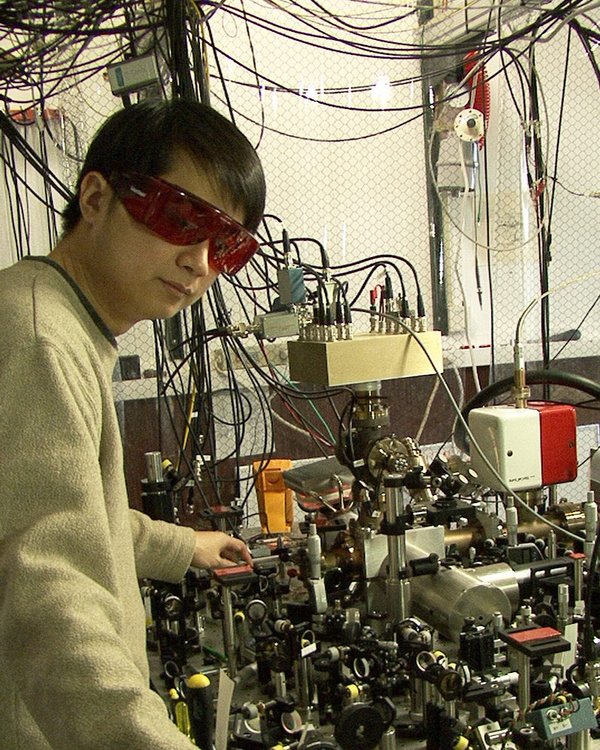
Photo: National Institute of Standards and Technology, Public domain, Wikimedia Commons
Chin-Wen Chou
National Institute of Standards and Technology, Boulder
- Research field
- Optical atomic clocks and precision measurement
Chin-Wen Chou and colleagues at the National Institute of Standards and Technology compared two aluminium-ion optical clocks of extraordinary precision through 75 metres of optical fibre. When the ion of one clock was made to oscillate in its trap at speeds of a few metres per second, its clock slowed by the time dilation of a few parts in 10^16, the twin paradox with an ion as the traveller; when one clock was raised by 33 centimetres, it ran faster by the gravitational shift of about four parts in 10^17. Both effects of Hafele and Keating's flights appeared on a laboratory table, and the unit presents the velocity effect as the laboratory version of its twins.
In the masterclass
Section 5, after Hafele and Keating's flying clocks, presents the optical clocks that saw time dilation at ten metres per second and gravitational time dilation over 33 centimetres.
The research is presented in Unit 6: The Twin Paradox and Accelerated Motion, in a research spotlight box that explains the result at the level of the unit and links it to what you have just learned.