
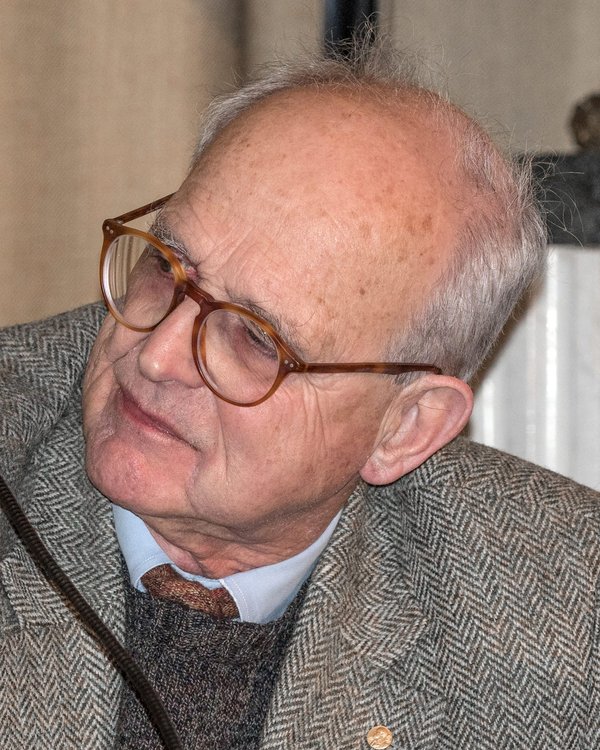
Photo: Bengt Nyman, CC BY 2.0, Wikimedia Commons
Rainer Weiss
Massachusetts Institute of Technology
- Research field
- Experimental physics: the laser interferometer gravitational-wave detector
Rainer Weiss worked out the design of the laser interferometer gravitational-wave detector in a report of April 1972, estimating its noise sources one by one, and spent the following four decades turning it into LIGO. His part of the laureates' joint Nobel lecture tells the experimental story from the prototypes of a few metres in the 1970s to the Advanced LIGO detectors, and presents the noise budget as the instrument by which the collaboration measured its progress. He shared the Nobel Prize in Physics 2017 with Barry Barish and Kip Thorne.
In the masterclass
Section 3, after the noise budget and the excursion on the report of 1972, presents the Nobel lecture of 2017.
The research is presented in Unit 15: Laser Interferometer Observatories, in a research spotlight box that explains the result at the level of the unit and links it to what you have just learned.