
ToR Masterclass Blog
Explanations, background, and advice for curious students.
Latest articles

What happens at the event horizon
For the one who falls in, nothing is felt at the horizon of a large black hole, and the centre comes 28 seconds later. For the one who watches from far away, the faller never gets there, and fades from view in minutes.

Mercury's 43 arcseconds
In 1859 Le Verrier found that the orbit of Mercury turns a little faster than the pull of the other planets can explain. The excess, 43 arcseconds per century, was unexplained for 56 years, until the Schwarzschild metric gave exactly that number.
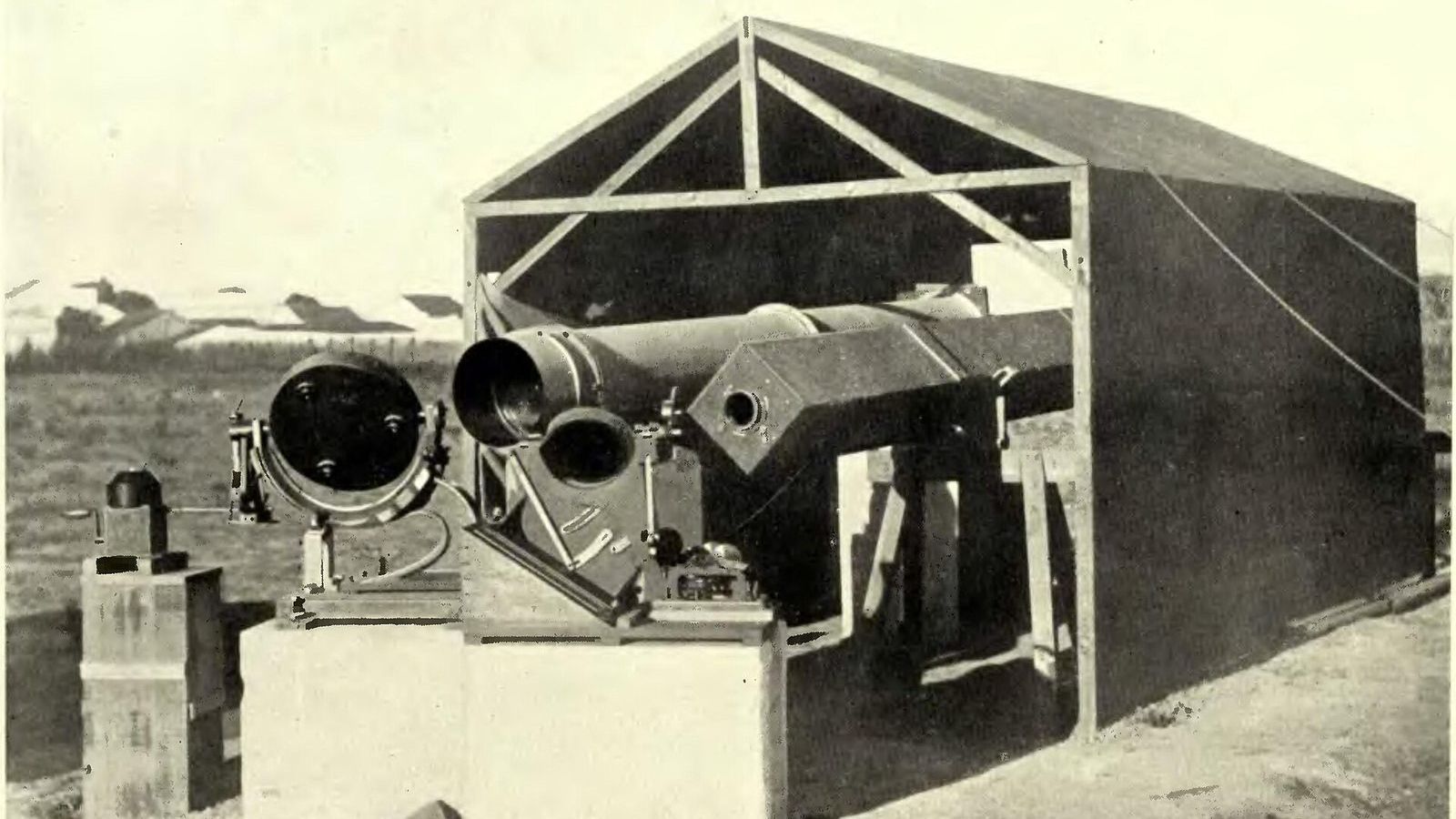
The eclipse that made Einstein famous
On 29 May 1919 two British expeditions photographed stars next to the eclipsed Sun from Brazil and from an island off West Africa. The stars had moved by 1.75 arcseconds, twice what Newton allowed, and on 6 November the result was read out in London.

How Einstein found his equations in November 1915
On four Thursdays in November 1915 Einstein read four papers to the Prussian Academy, changed his field equations twice, computed the orbit of Mercury on 18 November, and wrote the final form on 25 November.

The clocks that flew around the world
In October 1971 four caesium clocks took commercial flights around the world, eastward and then westward. The westbound clocks came back 273 nanoseconds ahead of the clocks that stayed home, and relativity had passed a test that cost 8,000 dollars.

What E = mc² actually says
One gram of anything holds 90 trillion joules, the Sun loses four million tonnes a second, and a battery weighs more when charged. The equation says mass is a form of energy, and it does not say several things people think it says.

Can a 20 metre pole fit in a 10 metre barn?
At 0.866 c the pole is contracted to 10 metres and fits in the barn with both doors shut. From the pole, the barn is 5 metres long. Both are right, and the doors are the clue.

The twin paradox is not a paradox
One twin flies to a star six light years away at 0.6 c and comes back 16 years older. The other has aged 20 years. Both agree on the result, and the reason is the turnaround.

Why moving clocks run slow, with one triangle
A clock made of two mirrors and a pulse of light, one right-angled triangle, and Pythagoras give the Lorentz factor in five lines. The muons that reach the ground show that the clock is not a trick.